Art depicts Jesus in a loincloth on the cross – the brutal truth is he would have been naked
- Written by: David Tombs, Howard Paterson Chair of Theology and Public Issues, University of Otago
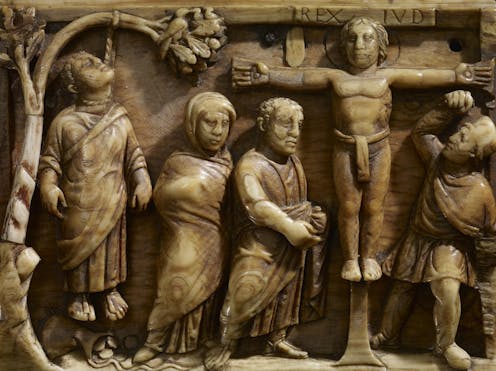
When Jesus is shown on the cross, he is almost always depicted wearing a loincloth around his waist. We now know, however, this has more to do with artistic convention than historical accuracy.
Featuring a loincloth goes back to the first Christian images of the crucifixion. Early examples include the Maskell ivory panel[1] from early 5th-century Rome, and the depiction carved into the doors of the Santa Sabina basilica in Rome, built between 422 and 432 CE.
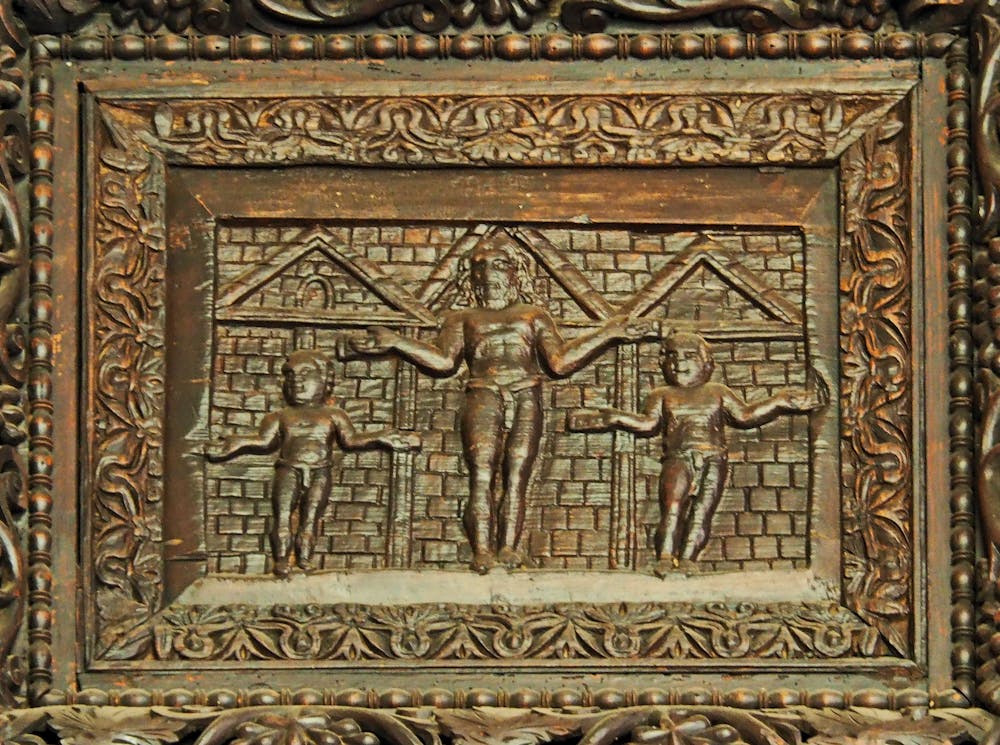
The Santa Sabina depiction shows Jesus crucified alongside the two thieves. But even though their wooden crosses are not shown, the artists have taken care to give each figure a loincloth.
The loincloth adornment has become so firmly fixed since the 5th century that most people take it for granted. However, the historical evidence shows it is not something victims of crucifixion would have been permitted[3].
The naked truth
There are five sources of evidence indicating Jesus was crucified naked.
First, all four New Testament gospels record he was stripped of his clothing at the cross. John includes the detail[4] that Jesus was stripped not only of his outer garment but also his undergarment – his chiton, or tunic.
There is no mention of a loincloth in any of these accounts. Early readers would not have needed to be told Jesus was fully naked. They would have understood what crucifixion involved.
Read more: #HimToo – why Jesus should be recognised as a victim of sexual violence[5]
In support of this, early Christian writers make reference to Jesus’ nakedness. For example, Melito of Sardis, a 2nd-century bishop in what is now Turkey, writes[6]:
The Sovereign has been made unrecognisable by his naked body, and is not even allowed a garment to keep him from view. That is why the luminaries turned away, and the day was darkened, so that he might hide the one stripped bare upon the tree.
In the 4th century, the theologian and philosopher Augustine compared Jesus[7] with Noah, after Noah became drunk and fell asleep naked.
Non-Christian depictions of the cross
The second piece of evidence is a bloodstone amulet from the late 2nd or early 3rd century, often referred to as the Pereire gem (named after a former owner). It shows[8] a bearded and fully naked male figure on the cross, surrounded by inscriptions that include “Son, Father, Jesus Christ”.
 The Pereire gem depicts a naked Jesus on the cross.
British Museum, CC BY-NC-SA[9]
The Pereire gem depicts a naked Jesus on the cross.
British Museum, CC BY-NC-SA[9]
It is believed this gemstone was a magical amulet from the Eastern Mediterranean (Syria or Turkey). Its origins are likely non-Christian, since Christians were warned against magical images.
The image is probably the earliest representation of Jesus on the cross, and predates by about 200 years the Christian 5th-century depictions of the crucifixion featuring a loincloth.
Read more: 'Sexualised' Jesus causes outrage in Spain – but Christians have long been fascinated by Christ's body[10]
Third, the Puteoli graffito[11], dated to the Trajan-Hadrian period of the Roman Empire (98–138 CE), is the earliest image so far discovered for any Roman crucifixion. It was unearthed in 1959 on the wall of an inn in Puteoli near Naples.
It shows a crucified figure pictured from behind. The horizontal stripes across the body suggest the figure has been whipped while naked, and then crucified fully naked.
Fourth, Dionysius of Halicarnassus (writing in the 1st century BCE) records the execution of a slave[12] who was marched to the place of execution naked. Dionysius does not specify that the execution was a crucifixion, but “slaves’ punishment” was a common euphemism for crucifixion. The passage is often cited as historical evidence for the Roman practice of naked crucifixions.
The Puteoli graffito is visible on the wall 15 seconds into the video.Shame and humiliation
Finally, both Christian and Roman writings describe crucifixion in terms of supreme shame, not just extreme pain. The forced naked exposure of the victim would have been a powerful way to promote such shame and humiliation[13]. Permitting a loincloth would undermine this.
The intense shame associated with crucifixion is also a likely reason why Christian artists did not show Jesus on the cross until the 5th century.
Read more: Was Jesus really nailed to the cross?[14]
When they finally began to show the scene, about a century after the emperor Constantine abolished crucifixions, they always gave Jesus a loincloth to reduce the shame and violence of the act.
So, there is no clear historical evidence in favour of loincloths at crucifixions. But there is firm evidence from Christian and non-Christian sources indicating victims were naked.
The practice of including a loincloth was an understandable response to a form of execution intended to deny the victim any dignity. For those interested in the history of crucifixion and how it was seen at the time, the loincloth needs to be seen as an artistic convention to soften the public shame of the cross.
References
- ^ Maskell ivory panel (www.britishmuseum.org)
- ^ CC BY-NC-SA (creativecommons.org)
- ^ would have been permitted (doi.org)
- ^ includes the detail (biblehub.com)
- ^ #HimToo – why Jesus should be recognised as a victim of sexual violence (theconversation.com)
- ^ writes (sachurch.org)
- ^ compared Jesus (www.newadvent.org)
- ^ shows (grbs.library.duke.edu)
- ^ CC BY-NC-SA (creativecommons.org)
- ^ 'Sexualised' Jesus causes outrage in Spain – but Christians have long been fascinated by Christ's body (theconversation.com)
- ^ Puteoli graffito (www.roger-pearse.com)
- ^ records the execution of a slave (penelope.uchicago.edu)
- ^ shame and humiliation (doi.org)
- ^ Was Jesus really nailed to the cross? (theconversation.com)