


a brilliant revival of a play of decay, terror and revulsion
- Written by: Alexander Howard, Senior Lecturer, Discipline of English and Writing, University of Sydney
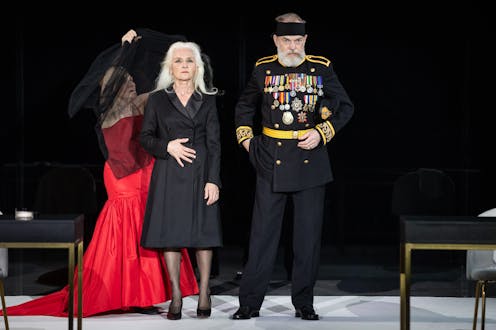
Decay, terror, revulsion. These are three of the central themes of Thomas Bernhard’s rarely performed play The President.
The Austrian is one of the greatest writers of the 20th century, best known in the English-speaking world as a novelist.
As literary scholar Rita Felski[1] puts it, Bernhard’s oeuvre is generally thought of as “an oceanic heave of venom, disgust, bitterness, and loathing”.
By the same token – and this is something Felski neglects to mention – his writing can be extremely funny.
One of the great strengths of the Sydney Theatre Company’s captivating revival of the 1975 play, co-produced with Dublin’s Gate Theatre, is how it manages to balance both these aspects of Bernhard’s writing.
Directed by Ireland’s Tom Creed, the production also features two exceptional lead performances.
Hugo Weaving plays the leader of a middling, unnamed country somewhere in Europe. Grandiose and boastful, Weaving’s titular president spends half of the play hiding away in Portugal and refuses to concede his days are numbered. He insists, against all odds, he can somehow “win it all back”.
Meanwhile, Olwen Fouéré’s furious first lady spends her time physically and emotionally tormenting her maid, Mrs Frolick (Julie Forsyth), while monologuing endlessly and ominously on the topics of hate, torture and the liquidation of shadowy political factions.
A complex writer
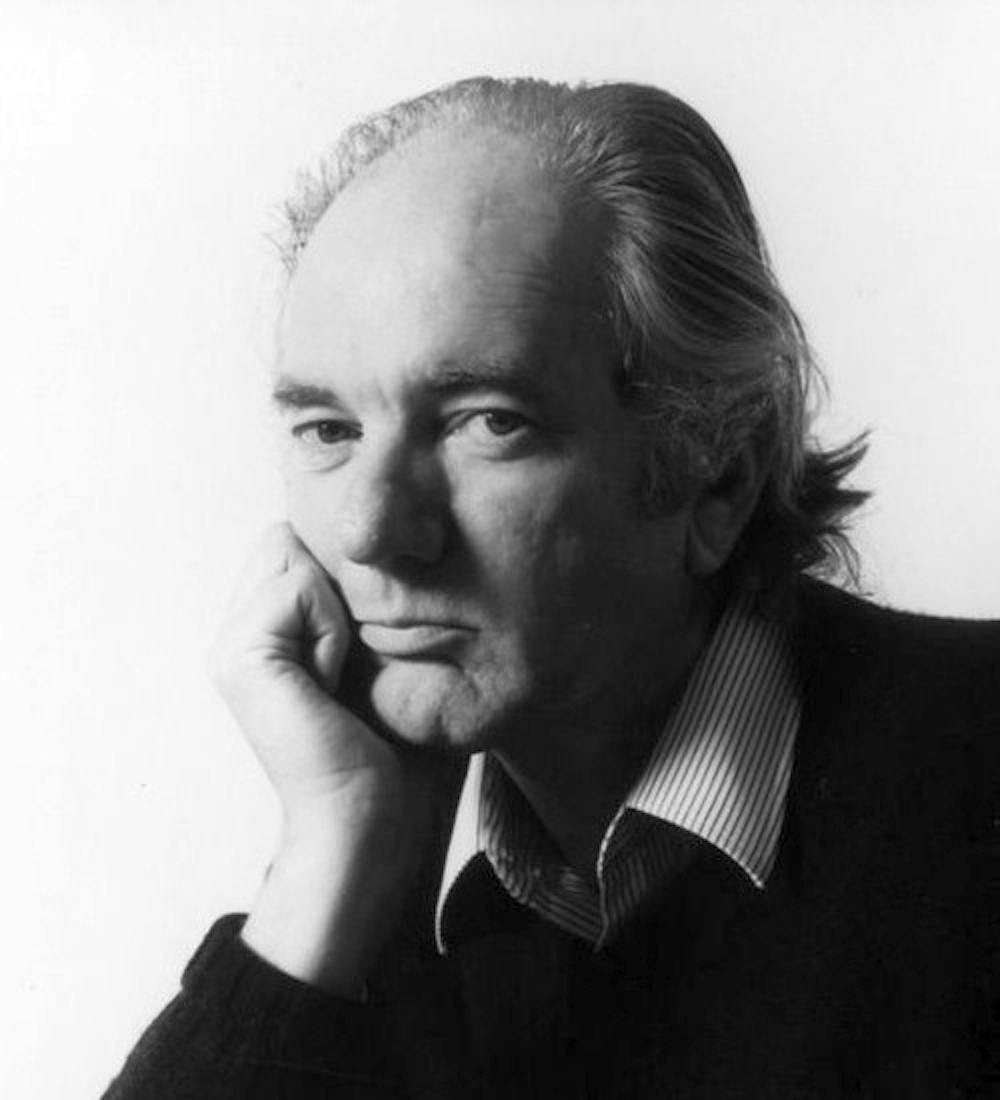
Bernhard was born in 1931 and died in 1989. Through childhood and adolescence he was unhappy and suffered from a host of life-threatening lung ailments. Eventually, his tuberculous-damaged lungs put paid to his youthful musical aspirations of being an opera singer, so he turned to writing.
After stints as a courtroom reporter and journalist, he started publishing poetry. His debut novel, Frost[4] (1963), made him famous. His theatrical breakthrough came in 1970, with his first full-length play, A Feast for Boris[5].
Throughout his career, Bernhard’s feelings about his homeland were complex and fraught. Biographer Gitta Honegger[6], who also translated The President, notes he
came of age while Austria was digging its way out of the devastation of World War II and burying itself in silence about the Holocaust.
He was deeply suspicious about Austria’s refusal to come to terms with its Nazi past and used his standing as a prominent public figure to expose this national hypocrisy.
But these critiques didn’t sit well with everyone in Austria. He was repeatedly attacked for being a Nestbeschmutzer, which roughly translates as “one who fouls their own nest”.
The last play he wrote, Heldenplatz[7] (1988), was an explosive account of the dangers of nationalism and anti-Semitism.
It controversially suggested things hadn’t really changed in Austria since the days of the Third Reich, with one character saying:
conditions today really are the same as they were in thirty-eight there are more Nazis in Vienna now than in thirty-eight it’ll come to a bad end you’ll see it doesn’t even take an extra-sharp mind now they’re coming out again of every hole that’s been sealed for over forty years
The political landscape of 1975
The President was Bernhard’s response to the volatile political climate in Europe of the time.
The president of Bernhard’s demanding play – a fascist dictator in all but name – has just survived an attempt on his life. Anarchists are responsible. There is a possibility the president’s son, who has disappeared, pulled the trigger.
The play opens with the president and his wife preparing for the funeral of a close confidant who was killed in the same assassination attempt (as was the first lady’s beloved dog). The characters are paranoid and panicked:
Aren’t you afraid of the terrorists of some anarchist trying to get you You open a book because you want to read and you are blown into pieces aren’t you are afraid everybody everybody The whole country is ruled by fear
While Bernhard doesn’t specify, it would have been clear to contemporary audiences he had a particular band of West German terrorists in mind: the Red Army Faction.
It was no coincidence the original production opened at the Stuttgart State Theatre on May 21 1975: the same date and city where the key members of the Red Army Faction went on trial.
Also known as the Baader-Meinhof Group[8], the Red Army Faction was responsible for a series of assassinations of German business leaders and politicians during the 1970s.
The Red Army Faction was also vocal and scathing about Germany’s unwillingness to properly confront its Nazi past.
In the words of the group’s de facto leader and theorist, Ulrike Meinhof[9], they had no time for acts of historical erasure, or for those who sought to “turn 12 years of German history into a taboo subject”.
Read more: Baader–Meinhof group member arrested after 30 years on the run – but Germany still can't close the chapter on far-left terrorism[10]
‘Uncomfortable truths’
The creative team behind this version of The President clearly know their history.
In his directorial program notes, Creed acknowledges the violent actions of the Red Army Faction would have loomed large in the imagination of audiences in 1975.
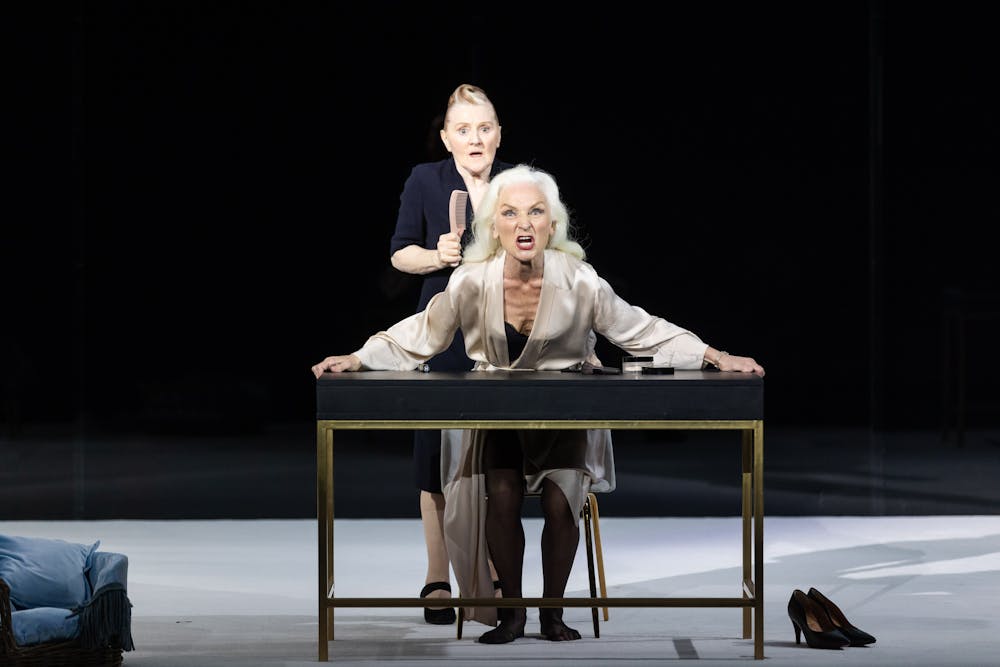 Olwen Fouéré’s furious first lady spends her time physically and emotionally tormenting her maid.
Daniel Boud/Sydney Theatre Company
Olwen Fouéré’s furious first lady spends her time physically and emotionally tormenting her maid.
Daniel Boud/Sydney Theatre Company
Similarly, Weaving has spoken approvingly[11] of Bernhard’s willingness to speak “a lot of uncomfortable truths to his own country”.
In equal measure, however, both Creed and Weaving believe Bernhard’s historically timestamped play can tell us something about the here and now. As Weaving says, The President, which takes a dim view of the performative quality of what passes for politics, is a “fascinatingly timely piece”.
I agree, and wholeheartedly recommend it.
The President is at the Sydney Theatre Company until May 19.
References
- ^ Rita Felski (press.uchicago.edu)
- ^ Monozigote/Wikimedia Commons (commons.wikimedia.org)
- ^ CC BY-SA (creativecommons.org)
- ^ Frost (www.goodreads.com)
- ^ A Feast for Boris (www.goodreads.com)
- ^ Gitta Honegger (www.goodreads.com)
- ^ Heldenplatz (en.wikipedia.org)
- ^ Baader-Meinhof Group (theconversation.com)
- ^ Ulrike Meinhof (www.goodreads.com)
- ^ Baader–Meinhof group member arrested after 30 years on the run – but Germany still can't close the chapter on far-left terrorism (theconversation.com)
- ^ Weaving has spoken approvingly (www.smh.com.au)










