how a landmark legal victory in Europe could affect NZ
- Written by: Vernon Rive, Associate Professor of Law, University of Auckland, Waipapa Taumata Rau
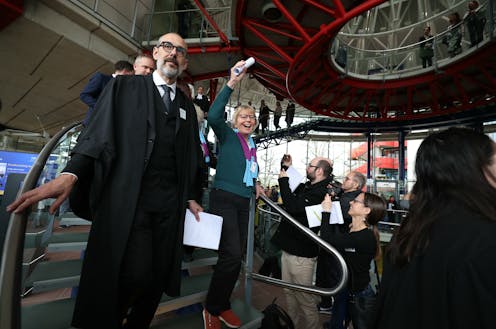
A seven-year campaign by a group of over 2,000 Swiss women – average age 73 – recently ended with a European Court of Human Rights decision[1] variously described as a “landmark[2]”, “monumental[3]”, and “the biggest victory possible[4]”.
Swiss Elders for Climate Protection – KlimaSeniorinnen Schweiz – had challenged the Swiss government’s emissions reductions strategy as “wholly inadequate”. The court largely agreed. The decision has made waves in Europe. Might its ripples reach New Zealand’s shores?
A 2023 survey of global climate litigation[5] counted over 2,300 cases, two thirds filed since 2015. Youth litigants have been especially active, including Sharma v Minister for the Environment[6] in Australia, and Thomson v Minister for Climate Change[7] in New Zealand.
Youth perspectives have resonance in climate cases, given the long-term implications of climate change and impacts of future emissions reductions policies. Cases such as the one taken by KlimaSeniorinnen take a different tack, pointing to the vulnerability of older people.
One applicant had been hospitalised after collapsing during a heatwave. She died during the court proceedings. Others had respiratory or cardiovascular problems exacerbated by rising temperatures. Their evidence aligns with New Zealand research[8] on higher risks from climate change for older people.
Emissions policy on trial
The Swiss women argued, first in the Swiss domestic courts and then in the European Court of Human Rights, that their government’s failure to implement adequate emissions reductions meant it had breached various human rights obligations, including the rights to life, and private and family life[9], under the European Convention on Human Rights (ECHR).
In a 260-page ruling, the court agreed that the right to private life had been breached. But it said it didn’t need to reach a conclusion on the right to life claim. Having declared Switzerland in breach of its ECHR obligations, the court left it to the government to comply with the convention.
Read more: Older Swiss women just set a global legal precedent for challenging their nation's climate change policy[10]
Like New Zealand, Switzerland has made international commitments to emissions reductions under the Paris Climate Agreement. However, the Swiss government struggled to pass legislation reflecting the accepted target reductions.
A national referendum in 2021 rejected a proposed CO₂ Act intended to translate the country’s Paris commitments into domestic law. It was not until June 2023 that a second referendum affirmed a replacement Climate Act. But by the time the European Court of Human Rights issued its decision, the Swiss Climate Act had not yet come into force.
The independent Climate Action Tracker[11] has called Switzerland’s strategy “insufficient”. So it was unsurprising the court declared it in breach of its human rights obligations. The decision has obvious ramifications for the Swiss Confederation and other Council of Europe members. But could it also have implications closer to home?
Implications for NZ courts
New Zealand is not bound by decisions of the European Court of Human Rights. But New Zealand courts regularly consider cases from overseas when determining claims.
Local activists, lawyers and judges will be poring over the judgement, which addresses a number of contested issues in existing and potential future cases in this jurisdiction.
First, New Zealand has ratified other international human rights instruments, including the United Nations International Covenant on Civil and Political Rights (ICCPR). New Zealand is also a party to the ICCPR’s Optional Protocol[12]. This opens it up to compliance rulings by the UN Human Rights Committee, as occurred in the 2020 Teitoita v New Zealand[13] climate-related case.
Read more: One of NZ’s most contentious climate cases is moving forward. And the world is watching[14]
The New Zealand Bill of Rights Act imposes human rights obligations on public authorities. In a related claim[15] to his climate case against Fonterra and others[16], Māori elder Mike Smith has sued the New Zealand government, claiming (among other things) that its inadequate emissions reductions framework breaches the rights to life and to practise culture under the Bill of Rights.
The case is currently at the Court of Appeal. If it goes to the Supreme Court or UN Human Rights Committee, the European Court of Human Rights decision in the KlimaSeniorinnen case could well feature prominently.
But KlimaSeniorinnen‘s relevance is not limited to human rights claims. An important aspect of the European judgement was a meticulous analysis of the factual and scientific context for the women’s claim.
The court comprehensively assessed the latest climate science, endorsing the need for “deep, rapid and sustained reductions in greenhouse gas emissions”. That part of the decision offers something of a model for New Zealand courts in all sorts of climate cases.
Read more: Three secrets to successful climate litigation[17]
Legal issues without borders
The case also addresses a perennial question in climate cases in New Zealand and elsewhere: what is the proper role and function of the courts in assessing government responses to climate change?
Arguments about judicial competence to review policy-laden regulatory responses were (and will be) central to these ongoing cases, including Lawyers for Climate Action v Climate Change Commission[18], now awaiting a decision by the New Zealand Court of Appeal.
In the KlimaSeniorinnen case, the European Court of Human Rights readily acknowledged limits to judicial involvement in climate policy. But it ruled “the Court’s competence in the context of climate change litigation cannot, as a matter of principle, be excluded”.
We can expect its thoughtful approach on this issue to be carefully considered in New Zealand cases.
The Swiss case was decided under a particular legal, constitutional and institutional setting, in many respects different to New Zealand’s. But there is much in the decision that could inform New Zealand judicial responses to common issues which – like greenhouse emissions themselves – know no national borders.
References
- ^ European Court of Human Rights decision (hudoc.echr.coe.int)
- ^ landmark (www.reuters.com)
- ^ monumental (www.ejiltalk.org)
- ^ the biggest victory possible (www.rnz.co.nz)
- ^ survey of global climate litigation (www.lse.ac.uk)
- ^ Sharma v Minister for the Environment (climatecasechart.com)
- ^ Thomson v Minister for Climate Change (climatecasechart.com)
- ^ New Zealand research (www.ehinz.ac.nz)
- ^ private and family life (www.equalityhumanrights.com)
- ^ Older Swiss women just set a global legal precedent for challenging their nation's climate change policy (theconversation.com)
- ^ Climate Action Tracker (climateactiontracker.org)
- ^ Optional Protocol (www.ohchr.org)
- ^ Teitoita v New Zealand (climatecasechart.com)
- ^ One of NZ’s most contentious climate cases is moving forward. And the world is watching (theconversation.com)
- ^ related claim (climatecasechart.com)
- ^ Fonterra and others (theconversation.com)
- ^ Three secrets to successful climate litigation (theconversation.com)
- ^ Lawyers for Climate Action v Climate Change Commission (www.rnz.co.nz)