just 1,200 square kilometres can fulfil Australia’s solar and wind energy needs
- Written by: Andrew Blakers, Professor of Engineering, Australian National University
As Australia’s rapid renewable energy rollout continues, so too does debate over land use. Nationals Leader David Littleproud, for example, claimed regional areas had reached “saturation point” and cannot cope with more wind and solar farms[1] and transmission lines.
So how much land is needed to fully decarbonise energy in Australia? When we switch completely to solar and wind, do we have the space for all the panels, turbines and power lines?
I’ve done the sums[2]. All we need is 1,200 square kilometres. That’s not much. The area devoted to agriculture[3] is about 3,500 times larger at 4.2 million square kilometres. The area of land that would be taken away from agriculture works out at about 45 square metres per person – about the size of a large living room.
We can ditch fossil fuels and reduce greenhouse emissions with negligible impact on agriculture. And in many cases, farmers can be paid for hosting renewable energy infrastructure while continuing to run sheep and cows or grow crops.
Read more: The Nationals want renewables to stay in the cities – but the clean energy grid doesn't work like that[4]
The challenge of the energy transition
Electricity consumption in Australia is currently about 10 megawatt-hours (MWh) per person per year[5].
Decarbonising Australia’s economy will require electrifying many technologies that currently derive their power from burning fossil fuels. Then we need to ensure the electricity grid runs entirely on renewables.
When we electrify transport, heating and industry, annual electricity consumption per capita doubles[6]. But we will need even more electricity to decarbonise aviation and shipping. So it’s reasonable to assume electricity consumption must triple if we are to complete decarbonisation, to 30MWh per person per year.
This would logically be achieved in three stages, starting with the easiest to achieve:
Stage 1: Solar and wind displace coal and gas from the electricity system. The federal government target of 82% renewable electricity[7] by 2030 puts us firmly on track to decarbonise electricity. This trend is already well underway as shown by the graph below.
Stage 2: Clean electricity is used to electrify transport (electric vehicles), heating (electric heat pumps) and industrial heat (electric furnaces). This off-the-shelf technology[8] could largely replace petrol and gas within a decade with negligible impact on the cost of running vehicles and heating homes.
Stage 3: The chemical industry is decarbonised. Clean electricity is used to make ammonia, iron, steel, plastics, cement, and synthetic aviation and shipping fuel.
Where will this clean power come from?
Virtually all new generation capacity in Australia over the past decade has been in solar and wind. Together, solar and wind have risen from about 6% of electricity generation in 2014 to 33% today[9]. Solar and wind provide the cheapest electricity[10].
Most solar power in Australia today comes from rooftop solar panels. These panels don’t require any extra land. But the area of rooftop is limited. In coming years, ground-mounted solar farms will become ever more important.
We’ll also need more wind farms. Each wind farm contains dozens of turbines and spans dozens of square kilometres. But only a small fraction of the land is lost to farming.
And it’s best to spread the solar farms and wind farms throughout the settled areas of Australia, to reduce the effect of local cloud and wind lulls.
Most solar and wind farms are located on sheep and cattle farms inland from the Great Dividing Range. Here there is plenty of sun and wind, and it’s not too far away to transmit electricity to the cities via high-voltage power lines.
Read more: Renewables need land – and lots of it. That poses tricky questions for regional Australia[11]
So how much land do we need?
Typically, only about 1% of land covered by a windfarm[12] is actually lost to farming. In most cases, farmers run livestock or continue cropping[13] around the turbine towers and access roads.
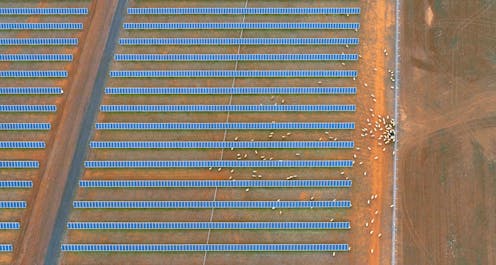
Similarly, because solar panels are spaced apart, the area spanned by a solar farm is often two to three times the actual area of the panels themselves.
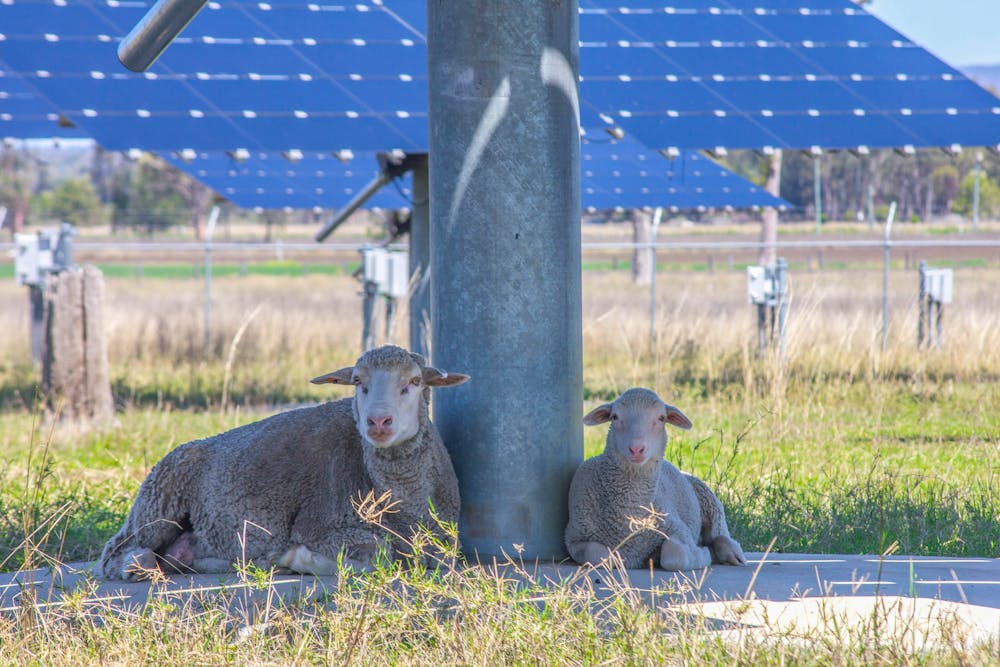
The panels are typically spaced to avoid losses from shading. As an added bonus, it means rain and sunlight can fall between them, allowing grass to grow and livestock to graze and shelter[14].
About 10,000km of new transmission lines[15] will also be required for the energy transition. This sounds like a lot but amounts to just 37 centimetres per person.
Again, the area of land that would be taken away from agriculture for wind turbine towers and access roads is relatively small.
A further small area of land will be dedicated to new storage such as pumped hydro power and batteries.
The total area spanned by the solar farms, wind farms and all the other infrastructure is about 22,000 square km (mostly the land between the turbines in windfarms). But agriculture could continue largely as normal on most of this land.
By my calculations[16], the total area taken away from agriculture to power a 100% renewable energy (zero fossil fuel) economy is about 45 square metres per person. Considering Australia’s total population of 27 million people, that means the total land area required is 1,200 square km. The area currently devoted to agriculture is about 3,500 times larger than this.
Farmers can earn extra income
Mining companies are often permitted to mine land without the consent of the landowner[17].
Solar and wind farm developers do not have the same rights. They must agree on lease fees with landowners before gaining access to land. These fees are typically tens of thousands of dollars per year per turbine[18].
In the case of transmission lines, hosts in Victoria are paid A$200,000 per kilometre[19] over eight years.
The transition to renewable energy has attracted opposition from some residents living near proposed infrastructure. But this can be overcome.
Successful solar and wind farm companies gain community acceptance[20] through genuine transparency, particularly early in the project, to ensure no information vacuum is created and then filled with misinformation.
Paying neighbours as well as the renewable energy host farm, and establishing community funds, is also helpful.
Read more: Win-win: how solar farms can double as havens for our wildlife[21]
Plenty of land to share
The expansion of renewable energy infrastructure will be concentrated in Australia’s regional areas. But we can also expect new energy capacity from elsewhere, such as expanded rooftop solar and new offshore wind farms, which reduces the amount of land needed for the energy transition.
The location of good areas for solar and wind farms is shown in the Australian National University’s renewable energy heatmaps[22], which takes account of the solar and wind resources, proximity to transmission lines, and protected land. Farmers in areas coloured red can command higher prices for leasing land to solar and wind farm companies.
In short, Australia has far more than enough land to host the solar farms and wind farms required for the renewable energy revolution.
Read more: Despairing about climate change? These 4 charts on the unstoppable growth of solar may change your mind[23]
References
- ^ cannot cope with more wind and solar farms (www.smh.com.au)
- ^ done the sums (cdn.theconversation.com)
- ^ area devoted to agriculture (www.agriculture.gov.au)
- ^ The Nationals want renewables to stay in the cities – but the clean energy grid doesn't work like that (theconversation.com)
- ^ 10 megawatt-hours (MWh) per person per year (cdn.theconversation.com)
- ^ electricity consumption per capita doubles (doi.org)
- ^ 82% renewable electricity (www.dcceew.gov.au)
- ^ off-the-shelf technology (doi.org)
- ^ 6% of electricity generation in 2014 to 33% today (opennem.org.au)
- ^ provide the cheapest electricity (theconversation.com)
- ^ Renewables need land – and lots of it. That poses tricky questions for regional Australia (theconversation.com)
- ^ only about 1% of land covered by a windfarm (cdn.theconversation.com)
- ^ farmers run livestock or continue cropping (w-wind.com.au)
- ^ graze and shelter (www.cleanenergycouncil.org.au)
- ^ 10,000km of new transmission lines (www.aemo.com.au)
- ^ By my calculations (cdn.theconversation.com)
- ^ mine land without the consent of the landowner (theconversation.com)
- ^ tens of thousands of dollars per year per turbine (nevetts.com.au)
- ^ A$200,000 per kilometre (reneweconomy.com.au)
- ^ gain community acceptance (assets.cleanenergycouncil.org.au)
- ^ Win-win: how solar farms can double as havens for our wildlife (theconversation.com)
- ^ renewable energy heatmaps (re100.eng.anu.edu.au)
- ^ Despairing about climate change? These 4 charts on the unstoppable growth of solar may change your mind (theconversation.com)