Do we really need to burp babies? Here’s what the research says
- Written by: Karleen Gribble, Adjunct Associate Professor, School of Nursing and Midwifery, Western Sydney University
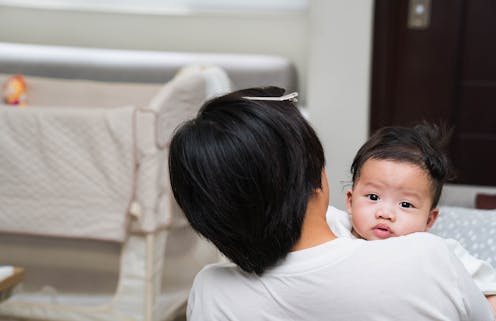
Parents are often advised[1] to burp their babies after feeding them. Some people think burping after feeding is important[2] to reduce or prevent discomfort crying, or to reduce how much a baby regurgitates milk after a feed.
It is true babies, like adults[3], swallow air when they eat. Burping releases this air from the top part of our digestive tracts. So when a baby cries after a feed, many assume it’s because the child needs to “be burped”. However, this is not necessarily true.
Read more: 5 expert tips on how to look after your baby in a heatwave[4]
Why do babies cry or ‘spit up’ after a feed?
Babies cry for a whole host of reasons that have nothing to do with “trapped air”.
They cry when they are hungry, cold, hot, scared, tired, lonely, overwhelmed, needing adult help to calm, in discomfort or pain, or for no identifiable reason. In fact, we have a name for crying with no known cause; it’s called “colic”[5].
“Spitting up” – where a baby gently regurgitates a bit of milk after a feed – is common because the muscle at the top of a newborn baby’s stomach is not fully mature[6]. This means what goes down can all too easily go back up.
Spitting up frequently happens when a baby’s stomach is very full, there is pressure on their tummy or they are picked up after lying down[7].
Spitting up after feeding decreases as babies get older. Three-quarters of babies one month old[8] spit up after feeding at least once a day. Only half of babies still spit up at five months and almost all (96%) stop by their first birthdays.

Does burping help reduce crying or spitting up?
Despite parents being advised to burp their babies, there’s not much research evidence on the topic.
One study[10] conducted in India encouraged caregivers of 35 newborns to burp their babies, while caregivers of 36 newborns were not given any information about burping.
For the next three months, mothers and caregivers recorded whether their baby would spit up after feeding and whether they showed signs of intense crying.
This study found burping did not reduce crying and actually increased spitting up.
When should I be concerned about spitting up or crying?
Most crying and spitting up is normal. However, these behaviours are not:
refusing to feed
vomiting so much milk weight gain is slow
coughing or wheezing distress while feeding
If your baby has any of these symptoms, see a doctor or child health nurse.
If your baby seems unbothered by vomiting and does not have any other symptoms it is a laundry problem rather than something that needs medical attention[12].
It is also normal for babies to cry and fuss quite a lot; two hours a day, for about the first six weeks[13] is the average.
This has usually reduced to about one hour a day by the time they are three months of age.
Crying more than this doesn’t necessarily mean there is something wrong. The intense, inconsolable crying of colic is experienced by up to one-quarter of young babies[14] but goes away with time on its own .
If your baby is crying more than average or if you are worried there might be something wrong, you should see your doctor or child health nurse.
 If your baby likes being ‘burped’, then it’s OK to do it. But don’t stress if you skip it.
Miljan Zivkovic/Shutterstock[15]
If your baby likes being ‘burped’, then it’s OK to do it. But don’t stress if you skip it.
Miljan Zivkovic/Shutterstock[15]
Not everyone burps their baby
Burping babies seems to be traditional practice in some parts of the world and not in others.
For example, research in Indonesia found most breastfeeding mothers rarely or never burped[16] their babies after feeding.
One factor that may influence whether a culture encourages burping babies may be related to another aspect of infant care: how much babies are carried.
Carrying a baby in a sling or baby carrier can reduce the amount of time babies cry[17].
Babies who are carried upright on their mother or another caregiver’s front undoubtedly find comfort in that closeness and movement.
Babies in slings are also being held firmly and upright, which would help any swallowed air to rise up and escape via a burp if needed.
Using slings can make caring for a baby easier. Studies (including randomised controlled trials) have also shown women have lower rates of post-natal depression[18] and breastfeed for longer[19] when they use a baby sling.
It is important baby carriers and slings are used safely, so make sure you’re up to date on the latest advice on how to do it[20].
 Make sure you’re up to date on the latest advice on how to use a sling safely.
Ground Picture/Shutterstock[21]
Make sure you’re up to date on the latest advice on how to use a sling safely.
Ground Picture/Shutterstock[21]
So, should I burp my baby?
The bottom line is: it’s up to you.
Gently burping a baby is not harmful. If you feel burping is helpful to your baby, then keep doing what you’re doing.
If trying to burp your baby after every feed is stressing you or your baby out, then you don’t have to keep doing it.
Read more: No, stress won't dry up your milk. How to keep breastfeeding your baby in an emergency[22]
References
- ^ advised (raisingchildren.net.au)
- ^ important (www.nhs.uk)
- ^ adults (www.mayoclinic.org)
- ^ 5 expert tips on how to look after your baby in a heatwave (theconversation.com)
- ^ “colic” (www.betterhealth.vic.gov.au)
- ^ is not fully mature (www.mayoclinic.org)
- ^ after lying down (www.breastfeeding.asn.au)
- ^ one month old (onlinelibrary.wiley.com)
- ^ antoniodiaz/Shutterstock (www.shutterstock.com)
- ^ One study (onlinelibrary.wiley.com)
- ^ bloody vomit (www.rch.org.au)
- ^ needs medical attention (www.rch.org.au)
- ^ six weeks (www.jpeds.com)
- ^ one-quarter of young babies (link.springer.com)
- ^ Miljan Zivkovic/Shutterstock (www.shutterstock.com)
- ^ rarely or never burped (www.ijhp.net)
- ^ babies cry (pubmed.ncbi.nlm.nih.gov)
- ^ lower rates of post-natal depression (www.techrxiv.org)
- ^ breastfeed for longer (onlinelibrary.wiley.com)
- ^ how to do it (www.qld.gov.au)
- ^ Ground Picture/Shutterstock (www.shutterstock.com)
- ^ No, stress won't dry up your milk. How to keep breastfeeding your baby in an emergency (theconversation.com)
Read more https://theconversation.com/do-we-really-need-to-burp-babies-heres-what-the-research-says-223306