Nuclear power makes no sense for Australia – but it’s a useful diversion from real climate action
- Written by: Adam Simpson, Senior Lecturer, International Studies, University of South Australia
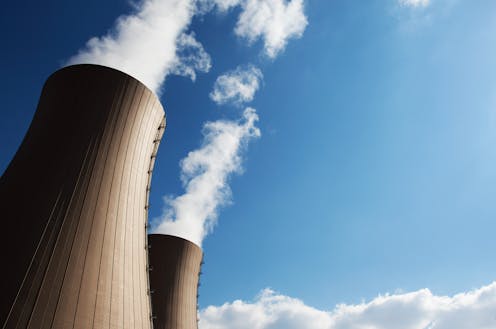
Opposition leader Peter Dutton argues Australia needs nuclear power[1] to achieve net zero emissions by 2050.
But nuclear power is not feasible for Australia. It is too slow[2], too expensive[3] and inappropriate[4] for our energy needs.
As a result, plans to build nuclear power plants, big[5] or small[6], are completely unrealistic.
What’s more, insisting that nuclear power is the only answer to Australia’s net zero commitments is a classic move from the playbook of those who oppose urgent action on climate change.
Coalition pushing for nuclear energy in Australia | 7.30.The climate obstruction playbook
These obstructionist tactics have played out over the 15 years I’ve spent teaching international and environmental politics while researching topics such as energy security and climate justice.
I developed an interest in the evolving strategies of climate change deniers in Australia, and regularly teach this in my environmental politics course. Since Dutton became opposition leader, I’ve included new strategies related to nuclear energy.
Fossil fuel industries and associated right-wing think-tanks, such as the Heritage Foundation[7] in the United States and the Institute of Public Affairs[8] in Australia, have long sought to undermine the science of climate change. Their strategies and tactics are similar to those once used by tobacco companies to undermine links between smoking and lung cancer.
Books such as Merchants of Doubt[9] (2010), and the associated film[10] (2014), documented tactics to “discredit the science, disseminate false information, spread confusion and promote doubt”.
Denying the science of climate change, or downplaying its significance, is an article of faith for many conservatives. While mainstream conservatives in Europe have traditionally[11] agreed with urgent action on climate change, it is increasingly an issue that polarises[12] views between progressive and conservative parties.
In the US, where the climate wars are reminiscent of those in Australia, a large majority of Republicans argue[13] in favour of increasing fossil fuel production over renewable energy sources, such as wind and solar.
But mounting scientific evidence, along with Australia’s international obligations to reduce emissions[14] and people’s personal experience of extreme events such as the 2019–20 Black Summer bushfires, has made outright climate denial largely indefensible for a mainstream political party in this country.
This shift in the Australian electorate has required various shifts in strategy by those who deny either the science of climate change or the urgency of climate action. They have followed what I argue are the six stages of climate obstruction, moving from one stage to the next as the last proved untenable. The latest stage is active support for large-scale nuclear power.
Stage 1: climate change is not happening (arsonists cause bushfires, not climate change[15])
Stage 2: climate change is happening but is not human-induced (solar activity causes climate change, not humans[16])
Stage 3: Australia’s emissions are too small to make a difference, so why should we try?[17]
Stage 4: climate change is happening and human-induced but there are other more pressing priorities (the “coal is good for humanity[18]” argument)
Stage 5: nuclear small modular reactors are the only viable path to net zero (these reactors are an example of a “burgeoning nuclear industry[19]” in the US)
Stage 6: if small nuclear reactors turn out not to be viable, large nuclear[20] reactors are the only path to net zero.
But why nuclear?
The point of all these arguments is to delay the rollout of renewable energy technologies such as wind and solar. Delaying renewables would require extensions in the life of coal-fired and other fossil-fuelled power stations while other technologies are brought online.
In New South Wales, the government is negotiating with Origin Energy to provide subsidies to keep Eraring power station – Australia’s largest coal-fired power station – open for a further four years beyond 2025. Estimates suggest this could cost A$600 million[21] over four years ($150 million a year) for just two of its four units.
This is largely due to the long delays[22] for renewable energy project approvals in NSW compared with elsewhere in the country. But keeping the Eraring power station open would further crowd out, and undermine, private investment that would otherwise drive the transition to renewable energy.
Delaying renewables also feeds into the culture wars. Suggestions that the last election could mark the end of the climate wars[23] have proven premature, to say the least.
The latest shift – from small modular reactors to large-scale nuclear – came after the cancellation[24] in November of the NuScale project in Idaho. This, the only small modular reactor approved in the US, was terminated before construction began after it became increasingly clear the power produced would be too expensive.
Now this technology has been partially sidelined with the Coalition pivoting to large-scale nuclear in more recent policy announcements[25].
Research has demonstrated[26] people concerned about climate change generally tend to have a dim view of nuclear power. Even in countries with existing nuclear industries, the strategy of promoting nuclear energy has been used over the past few decades[27] to delay investment in renewables. Nuclear advocates then extract vast subsidies and other taxpayer funds from governments rather than addressing climate change.
The Coalition made no progress towards a nuclear power industry during its nine years in government. Its vociferous backing for a nuclear industry has only emerged since it has been in opposition[28].
This tactic nevertheless seems to be bearing fruit, in political terms at least. A recent Guardian Essential Poll[29] found more people thought renewables were more expensive than nuclear, when most objective reports suggest nuclear is at least three times more expensive than renewables[30].
Nuclear power also produces high-level radioactive waste. Given Australia’s inability to develop a permanent radioactive waste storage facility[31] for even intermediate level waste, a high-level waste facility seems unlikely to built anytime soon.
Aside from the obvious facts that building nuclear power plants will take too long, be too expensive and fail to meet Australia’s future energy needs, the policy has failed to garner support from state-based Liberal leaders. In Queensland – Australia’s most conservative state and Dutton’s home turf – LNP Leader David Crisafulli is categorically opposing[32] the nuclear push. So there is no realistic chance nuclear power plants will ever be built in Australia.
But for climate obstructionists that is not the point. Their aim is to delay, if possible indefinitely, the impending closures of Australia’s fossil fuel power stations and undermine investment in the renewable energy industry.
References
- ^ Australia needs nuclear power (www.peterdutton.com.au)
- ^ too slow (theconversation.com)
- ^ too expensive (www.csiro.au)
- ^ inappropriate (reneweconomy.com.au)
- ^ big (www.crikey.com.au)
- ^ small (theconversation.com)
- ^ Heritage Foundation (thehill.com)
- ^ Institute of Public Affairs (www.crikey.com.au)
- ^ Merchants of Doubt (www.merchantsofdoubt.org)
- ^ film (www.imdb.com)
- ^ traditionally (doi.org)
- ^ polarises (www.ox.ac.uk)
- ^ argue (www.pewresearch.org)
- ^ obligations to reduce emissions (www.dcceew.gov.au)
- ^ arsonists cause bushfires, not climate change (www.theguardian.com)
- ^ solar activity causes climate change, not humans (theconversation.com)
- ^ so why should we try? (theconversation.com)
- ^ coal is good for humanity (www.theguardian.com)
- ^ burgeoning nuclear industry (www.theaustralian.com.au)
- ^ large nuclear (www.crikey.com.au)
- ^ A$600 million (www.theguardian.com)
- ^ delays (www.theguardian.com)
- ^ climate wars (theconversation.com)
- ^ cancellation (www.reuters.com)
- ^ announcements (www.crikey.com.au)
- ^ demonstrated (doi.org)
- ^ used over the past few decades (www.theguardian.com)
- ^ since it has been in opposition (www.theguardian.com)
- ^ Essential Poll (www.theguardian.com)
- ^ nuclear is at least three times more expensive than renewables (reneweconomy.com.au)
- ^ radioactive waste storage facility (theconversation.com)
- ^ opposing (www.theguardian.com)