‘City deals’ are coming to NZ – let’s make sure they’re not ‘city back-room deals’
- Written by: Tom Baker, Associate Professor in Human Geography, University of Auckland, Waipapa Taumata Rau
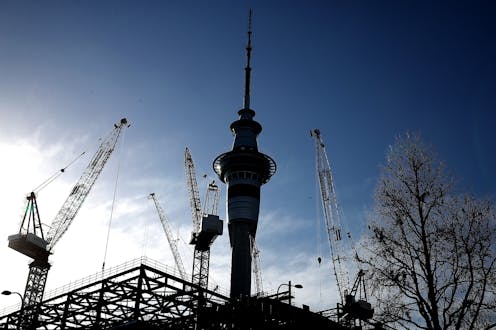
As local and regional councils struggle with inadequate infrastructure and unsustainable costs, New Zealand will be hearing a lot more about the potential solution offered by so-called “city deals”.
These deals are relatively long-term agreements between different levels of government (and sometimes other parties) about deciding, delivering and funding economic development and infrastructure initiatives within a defined local area.
Already, Wellington and Auckland councils are working towards regional deals with central government aimed at giving them more options for funding and managing their affairs. The National-led coalition is expected to announce[1] a framework for city deals later this year.
National flagged its intention to implement city deals before last year’s election. Since then, think tanks[2], global[3] and local[4] consulting firms, Infrastructure NZ and Local Government NZ[5] have all been having their say on how these might work.
A recent meeting[6] of New Zealand mayors and local government chiefs heard from Greater Manchester Mayor Andy Burnham about the UK’s first city deal over a decade ago. He extolled the virtues of a “place first” approach that involves and engages citizens more in the future of their cities.
In the UK, city deals signalled a shift away from a conventional one-size-fits-all model of regional development. Each deal is bespoke, reflecting local priorities. Beginning with Greater Manchester in 2011, there are now more than 30 city deals in the UK[7].
Australia has arranged ten city deals since 2016[8].
Their experiences suggest there are two general varieties of city deal. One revolves around mechanisms for funding infrastructure. The other goes further and involves devolving budgets and responsibilities from central government to newly created regional or city authorities.
City deals offer potential circuit-breakers for stalled and stagnant urban and regional progress, but New Zealand needs to take stock of the lessons being learned elsewhere.
Infrastructure deals
Infrastructure deals offer a co-operative mechanism for addressing deficits in local infrastructure. It’s a problem most wealthy countries are facing after decades of under-investment.
Filling the funding gap has been hindered by various factors: central government reluctance to borrow or tax more, short-term thinking based on electoral cycles, and different priorities within levels of government.
This has all primed politicians to look favourably on seemingly longer-term, co-operative ways to approach infrastructure development.
Australia has opted for infrastructure deals between federal and local governments. These have been praised[9] for providing local governments with formal channels of engagement and extra funding from federal government.
But the deals have also been criticised for commercial secrecy and lacking a coherent national direction[10]. Eight years in, it’s still hard to say whether Australian city deals have really improved infrastructure problems.
Devolution deals
UK city deals have involved devolving limited budgets and responsibility from central government to new sub-national governments, called combined authorities.
At a national level, right-leaning political parties have tended to take up the devolution agenda. But at the local level, politicians of all stripes want more autonomy in what is a highly centralised country.
Greater Manchester is the poster child of devolution deals, with its Mayoral Combined Authority seen as a model for others. It retains 100% of its business rates tax revenue, has developed an active travel strategy, re-municipalised[11] the regional bus system, and improved health and social care[12].
This “trailblazer[13]” deal was extended in 2023. But “devo deals”, as they are known, have been criticised for their lack of transparency[14] (they’re negotiated in private, with no public consultation) and the absence of any attached statutory powers.
For instance, Greater Manchester has yet to gain approval for a spatial plan, which is key to setting the context and tone for economic and social development across ten local authorities. House building in the region has stalled as a result.
The art of the deal
City deals have become popular, in part, for politically symbolic reasons. Put simply, making a deal sounds sexier than “arranging a long-term inter-governmental agreement”.
Maybe not surprisingly, governments that favour city deals have been on the right of the political spectrum, with strong affinities to business. Former Australian prime minister Malcolm Turnbull and current New Zealand prime minister Christopher Luxon also came to politics after corporate careers. City deals align neatly with their public images.
Beyond the symbolism, though, the experiences of Australia and the UK suggest such deals are not in themselves a quick fix for governing cities.
Negotiations often involve little or no reference to an overarching strategy, which can compound social inequalities and lead to unco-ordinated patchworks of projects. Governance has also tended to be opaque, risking the perception they are really “city back-room deals”.
They also call for capacity building in local government, which requires time and resources. UK central government demanded the establishment of a new level of administration – the mayoral combined authority – to oversee delivery of deals.
This entails significant bureaucratic and political manoeuvring. Yet even the largest and best-resourced local government bodies in Australia and New Zealand struggle to mobilise the bureaucratic power and expertise they need, routinely outsourcing to the private sector.
None of these challenges are impossible to overcome. But with city deals set to expand into New Zealand, there is room to refine the art of the deal itself.
References
- ^ expected to announce (newsroom.co.nz)
- ^ think tanks (newsroom.co.nz)
- ^ global (assets.kpmg.com)
- ^ local (www.martinjenkins.co.nz)
- ^ Local Government NZ (www.lgnz.co.nz)
- ^ recent meeting (newsroom.co.nz)
- ^ more than 30 city deals in the UK (commonslibrary.parliament.uk)
- ^ arranged ten city deals since 2016 (www.infrastructure.gov.au)
- ^ been praised (theconversation.com)
- ^ commercial secrecy and lacking a coherent national direction (theconversation.com)
- ^ re-municipalised (www.greatermanchester-ca.gov.uk)
- ^ improved health and social care (www.manchester.ac.uk)
- ^ trailblazer (assets.publishing.service.gov.uk)
- ^ lack of transparency (journals.sagepub.com)