Sleep wrinkles are real. Here’s how they leave their mark
- Written by: Yousuf Mohammed, Dermatology researcher, The University of Queensland
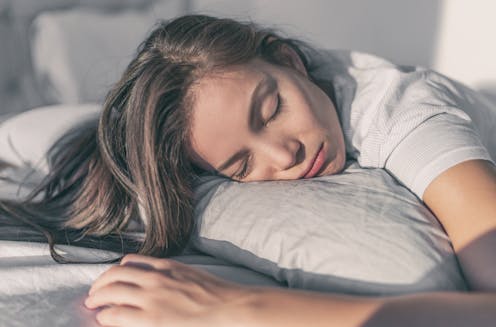
You wake up, stagger to the bathroom and gaze into the mirror. No, you’re not imagining it. You’ve developed face wrinkles overnight. They’re sleep wrinkles.
Sleep wrinkles are temporary. But as your skin loses its elasticity as you age, they can set in.
Here’s what you can do to minimise the chance of them forming in the first place.
How side-sleeping affects your face
Your skin wrinkles for a number of reasons, including ageing, sun damage, smoking, poor hydration, habitual facial expressions (such as grinning, pouting, frowning, squinting) and sleeping positions.
When you sleep on your side or stomach, your face skin is squeezed and crushed[1] a lot more than if you sleep on your back. When you sleep on your side or stomach, gravity presses your face against the pillow. Your face skin is distorted as your skin is stretched, compressed and pulled in all directions as you move about in your sleep.
You can reduce these external forces acting on the face by sleeping on your back or changing positions frequently.
Doctors can tell which side you sleep on by looking at your face
In a young face, sleep wrinkles are transient and disappear after waking.
Temporary sleep wrinkles can become persistent with time and repetition. As we age[2], our skin loses elasticity[3] (recoil) and extensibility (stretch), creating ideal conditions[4] for sleep wrinkles or lines to set in and last longer.
The time spent in each sleeping position, the magnitude of external forces applied to each area of the face, as well as the surface area of contact with the pillow surface, also affects[5] the pattern and rate of sleep wrinkle formation.
Skin specialists can often recognise this. People who favour sleeping on one side of their body tend to have a flatter face on their sleeping side and more visible sleep lines.
Can a night skincare routine avoid sleep wrinkles?
Collagen and elastin are two primary components of the dermis (inner layer) of skin. They form the skin structure and maintain the elasticity of skin.
Supplementing collagen through skincare routines to enhance skin elasticity can help reduce[7] wrinkle formation.
Hyaluronic[8] acid is a naturally occurring molecule in human bodies. It holds our skin’s collagen and elastin in a proper configuration, stimulates the production of collagen[9] and adds hydration, which can help slow down wrinkle formation. Hyaluronic acid is one of the most common active ingredients[10] in skincare creams, gels and lotions.
Moisturisers can hydrate the skin in different ways[11]. “Occlusive” substances produce a thin layer of oil on the skin that prevents water loss due to evaporation. “Humectants” attract and hold water in the skin, and they can differ in their capacity to bind with water, which influences the degree of skin hydration.
Do silk pillowcases actually make a difference?
Silk pillowcases can make a difference in wrinkle formation, if they let your skin glide and move, rather than adding friction and pressure on a single spot. If you can, use silk sheets and silk pillows.
Studies have also shown[13] pillows designed to reduce mechanical stress during sleep can prevent skin deformations. Such a pillow could be useful[14] in slowing down and preventing the formation of certain facial wrinkles.
Sleeping on your back can reduce the risk of sleep lines, as can a nighttime routine of moisturising before sleep.
Otherwise, lifestyle choices and habits, such quitting smoking, drinking plenty of water, a healthy diet (eating enough vegetables, fruits[15], nuts, seeds, healthy fats, yogurt and other fermented foods[16]) and regular use of sunscreens can help improve the appearance of the skin on our face.
References
- ^ squeezed and crushed (academic.oup.com)
- ^ age (pubmed.ncbi.nlm.nih.gov)
- ^ loses elasticity (pubmed.ncbi.nlm.nih.gov)
- ^ ideal conditions (pubmed.ncbi.nlm.nih.gov)
- ^ affects (pubmed.ncbi.nlm.nih.gov)
- ^ mermaid3/Shutterstock (www.shutterstock.com)
- ^ help reduce (pubmed.ncbi.nlm.nih.gov)
- ^ Hyaluronic (pubmed.ncbi.nlm.nih.gov)
- ^ collagen (www.mdpi.com)
- ^ active ingredients (pubmed.ncbi.nlm.nih.gov)
- ^ different ways (onlinelibrary.wiley.com)
- ^ New Africa/Shutterstock (www.shutterstock.com)
- ^ shown (academic.oup.com)
- ^ could be useful (www.scirp.org)
- ^ fruits (www.tandfonline.com)
- ^ yogurt and other fermented foods (www.ncbi.nlm.nih.gov)
Read more https://theconversation.com/sleep-wrinkles-are-real-heres-how-they-leave-their-mark-217380