Space junk comes to life in Ceridwen Dovey’s aching and profound tales of fallen astronauts
- Written by: Tony Hughes-d'Aeth, Professor, Chair of Australian Literature, The University of Western Australia
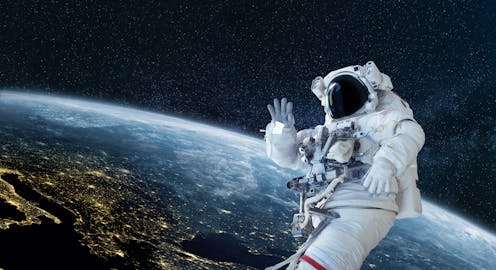
Ceridwen Dovey’s Only the Astronauts[1] is a book of stories about the fantasies that have caused humans since the 1950s to launch items – including themselves – into outer space. The stories are whimsical and, to differing degrees, factual.
This is what gives them their piquancy. The absurdity of the scenario is punctured by the realisation that this – or something very much like this – actually happened. The effect is a little like the work of W.G. Sebald[2], although in a broadly comic register.
Review: Only the Astronauts – Ceridwen Dovey (Hamish Hamilton)
The first story is about a cherry red sportscar that has been launched into space with a mannequin named Starman strapped into the driver’s seat. The premise is patently ridiculous, except that in 2018 Elon Musk did exactly this[3]. The car is, as we speak, slowly orbiting the sun a little further out than earth. It takes 557 earth days for Musk’s Tesla Roadster to complete its solar orbit.

 Fallen Astronaut, Hadley Rille.
NASA, public domain, via Wikimedia Commons[6]
Only the Astronauts is a follow-up to Dovey’s earlier collection, Only the Animals[7] (2014), published a decade ago to general acclaim. In the earlier book, animals, rather than space junk, emerged from the obscurity of history’s footnotes.
Each story in Only the Animals was narrated by the “soul” of an animal that had perished in the shadow of human conflict. Again, the subversiveness of these animals comes not from their rebelliousness, but rather from their heartbreaking loyalty to their masters. A story narrated by the soul of a dog killed in Poland in 1941 begins in a voice that sounds much like Starman’s:
How do I begin to describe my beloved Master and my life with him before I was exiled to the woods?
The excessive loyalty of Dovey’s narrators imbues them with a reliable unreliability. We hear their elaborate apologia in the echo chamber of historical irony.
Dovey is also an aficionado of anticlimax. Her eyes and ears are attuned to the quiet moments that follow the public spectacle. In the detritus of fantasy – in the cast-off objects that embarrass us with their stubborn persistence – she finds all the things that are not captured in the overt action.
In Starman’s plaintive faith that he will be one day reunited with his sublime maker, we can recognise the infantile complement of Musk’s gesture. Launching one of his Tesla sportscars into solar orbit is not just, as he might have it, a “cool” thing to do – and a brilliant publicity stunt for his SpaceX company – but an act in the service of a simple wish: that his father might love him.
Fallen Astronaut, Hadley Rille.
NASA, public domain, via Wikimedia Commons[6]
Only the Astronauts is a follow-up to Dovey’s earlier collection, Only the Animals[7] (2014), published a decade ago to general acclaim. In the earlier book, animals, rather than space junk, emerged from the obscurity of history’s footnotes.
Each story in Only the Animals was narrated by the “soul” of an animal that had perished in the shadow of human conflict. Again, the subversiveness of these animals comes not from their rebelliousness, but rather from their heartbreaking loyalty to their masters. A story narrated by the soul of a dog killed in Poland in 1941 begins in a voice that sounds much like Starman’s:
How do I begin to describe my beloved Master and my life with him before I was exiled to the woods?
The excessive loyalty of Dovey’s narrators imbues them with a reliable unreliability. We hear their elaborate apologia in the echo chamber of historical irony.
Dovey is also an aficionado of anticlimax. Her eyes and ears are attuned to the quiet moments that follow the public spectacle. In the detritus of fantasy – in the cast-off objects that embarrass us with their stubborn persistence – she finds all the things that are not captured in the overt action.
In Starman’s plaintive faith that he will be one day reunited with his sublime maker, we can recognise the infantile complement of Musk’s gesture. Launching one of his Tesla sportscars into solar orbit is not just, as he might have it, a “cool” thing to do – and a brilliant publicity stunt for his SpaceX company – but an act in the service of a simple wish: that his father might love him.
 Ceridwen Dovey.
Shannon Smith/Penguin Random House
Not all of Dovey’s stories quite hit their mark. Some can feel like a joke that stretches on for a bit too long. The premise of The Tamponauts is that, in 1982, NASA thought astronaut Sally Ride would require 100 tampons for the seven days she would be in orbit[8]. For a mission where every gram counted, the suggestion that she would need such a comically large endowment of tampons was a measure of just how terrifying a woman’s period was to NASA’s engineers.
In Dovey’s story, the fictional granddaughter of Rider decides to honour her grandmother’s pioneering work by writing a play in which the key players are menstrual hygiene products (two different kinds of tampon and a latex menstrual cup) that have embarked on the world’s first mission to Mars.
The centrepiece of Dovey’s collection is a long story called Requiem. It is narrated by the International Space Station – once again, endowed with a characteristic childlike sentience – in the last days of its existence. The station’s last crew is making final preparations for its decommissioning, which will involve sending it into earth’s atmosphere and hoping that the larger debris falls in the ocean.
The Space Station reflects on all the people that have come and gone through the years of its active life. Its narration is interspersed with diary entries from various astronauts who made its pressurised modules their home over the decades.
The station exhibits a cosmic sympathy for these astronauts, who were, on the one hand, living every child’s dream, but on the other hand were struggling with all the difficulties that come from the extreme conditions of space life. It speaks from the position of a servant, observing its masters going about their business, but also seeing their private frailties, their dirty underwear, their antidepressant medication.
The final story in Only the Astronauts follows the Voyager One spaceship as it traverses the Oort Cloud[9] at the extreme limit of the solar system. This most distant of terrestrial emissaries is due to reach the cloud in about 300 years.
In Dovey’s story, Voyager has arrived and been granted residency on a micro-planet inhabited by enigmatic metallic beings. There, at the limit of things, Voyager meets the other objects we have seen in the earlier stories. Starman is there. So is Plautus, a tortoise launched into space by the Russians in the 1960s, which featured in Dovey’s earlier collection Only the Animals.
In the Stygian darkness of the Oort Cloud, we reach a utopian moment that might be called the solidarity of objects. Finally beyond the reach of their master’s fantasy, these objects find they have an autonomy in their desire, and a capacity to form relations with others.
Dovey’s Only the Astronauts is an aching and profound book. The moments of farce and pathos highlight the vanity of space, where billionaires and superpowers go to flex. In the background there is Earth, which seems a perfectly good planet. Dovey’s book suggests that, no matter how far we fly, we never really leave it, or the mortal determinations that make life meaningful.
References^ Only the Astronauts (www.penguin.com.au)^ W.G. Sebald (fivedials.com)^ Elon Musk did exactly this (www.whereisroadster.com)^ Kazuo Ishiguro (www.nobelprize.org)^ placed a nine centimetre astronaut figurine in the soft lunar dust of the Hadley Rille crater (www.nytimes.com)^ NASA, public domain, via Wikimedia Commons (commons.wikimedia.org)^ Only the Animals (www.penguin.com.au)^ 100 tampons for the seven days she would be in orbit (www.vox.com)^ Oort Cloud (science.nasa.gov)
Ceridwen Dovey.
Shannon Smith/Penguin Random House
Not all of Dovey’s stories quite hit their mark. Some can feel like a joke that stretches on for a bit too long. The premise of The Tamponauts is that, in 1982, NASA thought astronaut Sally Ride would require 100 tampons for the seven days she would be in orbit[8]. For a mission where every gram counted, the suggestion that she would need such a comically large endowment of tampons was a measure of just how terrifying a woman’s period was to NASA’s engineers.
In Dovey’s story, the fictional granddaughter of Rider decides to honour her grandmother’s pioneering work by writing a play in which the key players are menstrual hygiene products (two different kinds of tampon and a latex menstrual cup) that have embarked on the world’s first mission to Mars.
The centrepiece of Dovey’s collection is a long story called Requiem. It is narrated by the International Space Station – once again, endowed with a characteristic childlike sentience – in the last days of its existence. The station’s last crew is making final preparations for its decommissioning, which will involve sending it into earth’s atmosphere and hoping that the larger debris falls in the ocean.
The Space Station reflects on all the people that have come and gone through the years of its active life. Its narration is interspersed with diary entries from various astronauts who made its pressurised modules their home over the decades.
The station exhibits a cosmic sympathy for these astronauts, who were, on the one hand, living every child’s dream, but on the other hand were struggling with all the difficulties that come from the extreme conditions of space life. It speaks from the position of a servant, observing its masters going about their business, but also seeing their private frailties, their dirty underwear, their antidepressant medication.
The final story in Only the Astronauts follows the Voyager One spaceship as it traverses the Oort Cloud[9] at the extreme limit of the solar system. This most distant of terrestrial emissaries is due to reach the cloud in about 300 years.
In Dovey’s story, Voyager has arrived and been granted residency on a micro-planet inhabited by enigmatic metallic beings. There, at the limit of things, Voyager meets the other objects we have seen in the earlier stories. Starman is there. So is Plautus, a tortoise launched into space by the Russians in the 1960s, which featured in Dovey’s earlier collection Only the Animals.
In the Stygian darkness of the Oort Cloud, we reach a utopian moment that might be called the solidarity of objects. Finally beyond the reach of their master’s fantasy, these objects find they have an autonomy in their desire, and a capacity to form relations with others.
Dovey’s Only the Astronauts is an aching and profound book. The moments of farce and pathos highlight the vanity of space, where billionaires and superpowers go to flex. In the background there is Earth, which seems a perfectly good planet. Dovey’s book suggests that, no matter how far we fly, we never really leave it, or the mortal determinations that make life meaningful.
References^ Only the Astronauts (www.penguin.com.au)^ W.G. Sebald (fivedials.com)^ Elon Musk did exactly this (www.whereisroadster.com)^ Kazuo Ishiguro (www.nobelprize.org)^ placed a nine centimetre astronaut figurine in the soft lunar dust of the Hadley Rille crater (www.nytimes.com)^ NASA, public domain, via Wikimedia Commons (commons.wikimedia.org)^ Only the Animals (www.penguin.com.au)^ 100 tampons for the seven days she would be in orbit (www.vox.com)^ Oort Cloud (science.nasa.gov)