Coles has imposed limits on egg purchases – but is there actually a crisis?
- Written by: Flavio Macau, Associate Dean - School of Business and Law, Edith Cowan University
Australians are no strangers to a supply crunch. During the pandemic and its aftermath, there were shortages of all kinds of products, from AdBlue diesel exhaust fluid to frozen chips.
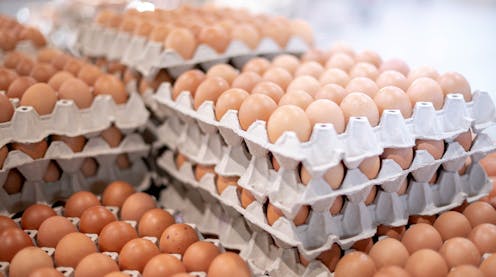
This week, many of us were perhaps worried to find ourselves in an eerily familiar situation when Coles limited egg purchases[1] to two cartons per customer in all stores across the country except Western Australia.
The culprit? An outbreak of avian influenza or “bird flu” in Victoria, leading to culls impacting production at five poultry farms. Importantly, this outbreak was not caused by the aggressive H5N1 strain making headlines globally.
On top of that, the production of free-range eggs fluctuates seasonally anyway, and during winter months it can fall by about 20%[2]. The timing of this latest outbreak likely raised concerns that not enough eggs would reach the shelves.
Currently, there is no particular reason for alarm in Australia. The purchase limits are quite modest and restricted to Coles at this stage. But it is important to understand what is happening, and how it differs from similar crises in the past and others currently occurring around the world.
Read more: With all this bird flu around, how safe are eggs, chicken or milk?[3]
We’ve been here before
Australia has experienced a number of short-lived outbreaks of bird flu since records began in the 1970s. The Department of Agriculture, Fisheries and Forestry (DAFF) closely monitors the situation and oversees actions taken by states and territories to limit the spread.
Recent outbreaks[4] occurred in both New South Wales (2012-13) and Victoria[5] (2020-21). Hundreds of thousands of hens had to be culled to control the damage, costing millions each time – not to mention further costs incurred through lost production.
But Australia’s outbreaks are a far cry from the sheer scale of the crisis that has afflicted the United States since 2022.
According to the US Department of Agriculture, almost 6 million birds[7] were affected in the last month alone.
Falling levels of egg production in the US drove egg prices to record highs[8] in 2022, and prices are now rising again[9] despite the industry’s mitigation measures.
But the situation isn’t necessarily unsalvageable.
In 2021, the UK faced its largest-ever[10] bird flu outbreak. Control measures were effective, however, and ultimately enabled the country to declare itself free of the disease by March this year.
Is Australian egg production in real danger?
Geography can help mitigate risk. Data from Australian Eggs, a member-owned not-for-profit company, shows that egg production in Australia is spread out across the states[11]. While New South Wales leads with about 34% of the supply, Queensland and Victoria are not far behind.
Most supply chains are local with limited commercial interconnection.
But this silo-ing doesn’t eliminate all risk, especially as the industry trends away from using scattered, smaller farms to highly efficient supply chains that rely on industrial scale.
Choice of production method can create its own challenges. Most eggs[12] currently sold in Australian supermarkets are free-range. Free-range production means hens can roam freely and interact, and practice a range of healthy natural behaviours.
But free-range production levels are more prone to fluctuate with climate conditions (typically falling in winter), and it’s harder to control biosecurity[13].
For example, failure to adequately drain waterlogged areas or puddles can create the conditions for contamination. These open areas are not entirely under farmers’ control. Free range means more exposure to natural risks, including diseases.
The current outbreak in Victoria will see hundreds of thousands of birds culled[15]. But that doesn’t mean that farmers in other regions will rise to the challenge and increase their own bird numbers.
The fact it takes three weeks for eggs to hatch, plus 17 weeks for hens to begin laying, means any actions taken now wouldn’t affect egg supply for about five months, when summer is about to start. By then, sunnier and warmer days will likely see free-range egg production rise anyway.
What next?
Since the first detection of bird flu in May, a nationally agreed response plan[16] has been put in place. This plan includes restricting the movement of poultry, poultry products, equipment and vehicles across designated restricted areas.
So far, the measures have been relatively effective. Coles’ decision to limit egg purchases is a precautionary move that may be more related to its own specific supply chain than a widespread drop in egg production. It also serves as a deterrent against panic buying, often triggered by empty shelves.
By springtime, as has happened before (and will again), the situation should return to normal. And Australians will have learned more about managing the fluctuations that have become the norm for eggs and so many other products.
References
- ^ limited egg purchases (www.abc.net.au)
- ^ 20% (www.theguardian.com)
- ^ With all this bird flu around, how safe are eggs, chicken or milk? (theconversation.com)
- ^ Recent outbreaks (www.sciencedirect.com)
- ^ Victoria (agriculture.vic.gov.au)
- ^ Dean Lewins/AAP (photos.aap.com.au)
- ^ 6 million birds (www.aphis.usda.gov)
- ^ record highs (www.ers.usda.gov)
- ^ rising again (www.cbsnews.com)
- ^ largest-ever (www.gov.uk)
- ^ spread out across the states (www.australianeggs.org.au)
- ^ Most eggs (www.australianeggs.org.au)
- ^ harder to control biosecurity (www.tandfonline.com)
- ^ Dewald Kirsten/Shutterstock (www.shutterstock.com)
- ^ hundreds of thousands of birds culled (www.abc.net.au)
- ^ nationally agreed response plan (www.agriculture.gov.au)