


ABC’s new comedy Austin grapples with autism stereotypes – with mixed success
- Written by: Beth Radulski, Manager, Neurodiversity Inclusion, La Trobe University
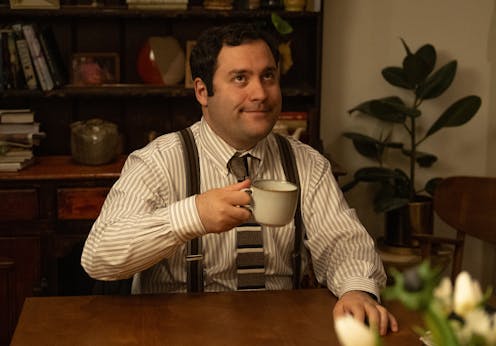
ABC’s new comedy series Austin follows its 28-year-old namesake (played by autistic actor Michael Theo, from the reality dating series Love on the Spectrum), an autistic man connecting for the first time with his biological father, Julian (Ben Miller).
Julian is married with his own family in London, while Austin lives in Canberra. When they connect, Austin must navigate his complex role as an extramarital child, while Julian’s family must adapt to having a young autistic man in their lives – all while Julian, a prominent author, battles a public relations scandal.
Austin is a unique show in its depiction of autism and neurodiversity. Its first season differs drastically between its first and second halves: challenging both Austin’s family, and the audience, to confront, and then reconsider their assumptions about autistic people.
The comedy in autism
In recent years, some stereotypical representations of autism in the media and pop culture have generated controversy[1].
The autistic community has often raised concerns about the predominance of autistic characters who are straight, white, cis-gendered, socially awkward men.
Austin possesses many traits frequently used[2] in depictions of these white male autistic characters. He is extremely literal, often misses sarcasm, and is direct to the point of being brutally honest. He is so rule-bound that running three minutes late is considered a moral failing. His engagement with cultural norms is often mismatched with the context, wearing a full suit and tie to a dinner at home.

These traits will undoubtedly resonate for many autistic people. In several scenes, autistic behaviours are used for comedic effect. But as an autistic viewer myself, at times I felt included in the joke, while others, I felt I was the joke.
In one scene that stands out as particularly infantilising, Austin attempts to assert his independence by telling his mother, Mel (Gia Carides), that their pet guinea pig is loose in the house. An (obviously) plush guinea pig then appears, pulled by a string. Austin picks up the toy and proudly exclaims:
I am perfectly able to deal with the situation […] without any outside assistance. I guess that’s where I am now in life: able to stand on my own two feet and deal with adversity alone.
While Austin is well into adulthood, his family often express concerns he is incapable of independence and requires constant adult oversight. Austin’s mother uses a phone app to track his whereabouts; when Austin joins his biological father on a trip to England, his mother and grandfather Bill (Roy Billing) secretly follow him.
 While Austin is well into adulthood, his family often express concerns he is incapable of independence.
ABC
While Austin is well into adulthood, his family often express concerns he is incapable of independence.
ABC
Austin is repeatedly referred to as “vulnerable”, without context or examples of how social attitudes and inequities generate this vulnerability. Autistic people are at far greater[3] risk of bullying, sexual assault and victimisation. Austin doesn’t fully explore these issues: they are often overlooked in service of the humour. The show could benefit from a deeper understanding.
Finding its stride
Austin’s primary limitation rests on its limited representation of the autistic community’s diversity and priorities in relation to advancing social inequity.
Issues like masking and camouflaging[4] are depicted positively, but their complexity, and the difficulties which come along with these behaviours, are never discussed, unlike in shows like Heartbreak High.
Having said this, Austin has several strengths. By using stereotypes in early episodes, later episodes challenge both the family’s, and the audience’s, reliance upon these stereotypes.
Although Austin’s family presumes he will not cope well with surprises, Austin is thrilled to receive a last-minute ticket to England with his father. While Austin’s mother is convinced he cannot function independently, he successfully traverses the streets of London without a family member present. Throughout this journey, Austin meets a (presumably neurotypical) woman, Lucy (Boni Adeliyi), in London, and is successful in befriending her and developing a shared romantic interest.
 By the second half of the season, the show begins to confront some stereotypes.
ABC
By the second half of the season, the show begins to confront some stereotypes.
ABC
The show also avoids a common pitfall by avoiding the trope of an autistic person as a burden[5]. This trope is acknowledged through a storyline where Julian is encouraged to participate in filming a documentary, pitched as an opportunity to recover from his public relations scandal. When Julian advises his manager and agent Austin is autistic, they both exchange looks of excitement: it is implied Julian will appear to be a heroic, selfless individual for connecting with his autistic son.
The humour is found not in autism itself, but in Julian’s saviour complex. This storyline not only problematises the representation of autism as a burden, but also pushes back against the neurotypical saviour trope[6], by openly portraying it as problematic.
While there is room to progress further in some areas, there are many steps in the right direction, and a great foundation laid for growth in season two.
Austin is now streaming on ABC iView.
References
- ^ generated controversy (www.smh.com.au)
- ^ frequently used (www.liebertpub.com)
- ^ far greater (www.frontiersin.org)
- ^ masking and camouflaging (www.karger.com)
- ^ trope of an autistic person as a burden (doi.org)
- ^ neurotypical saviour trope (chrissalazar868.medium.com)










