Kangaroo teeth grow forever – and keep a record of their owner’s age and sex
- Written by: William Parker, PhD Candidate, Monash University
How do you find out the age of a wild animal? For some Australian marsupials, we have discovered you can tell from their teeth.
In a new paper published in Archives of Oral Biology[1], we show that the front teeth of kangaroos record their age in a number of different ways – and they can even tell us if the roo is male or female.
Long in the tooth
Finding out the age of a wild animal can be important for vets, ecologists and conservationists. Wildlife welfare and assessing the overall health of a population both depend on knowing the age of the animals involved.
With no-one counting birthdays in the bush, scientists often turn to the teeth of wild animals to work out how old they are.
Most of Australia’s marsupials are members of a group called Diprotodontia. This name refers to the animals having large, straight incisor teeth in their lower jaws.
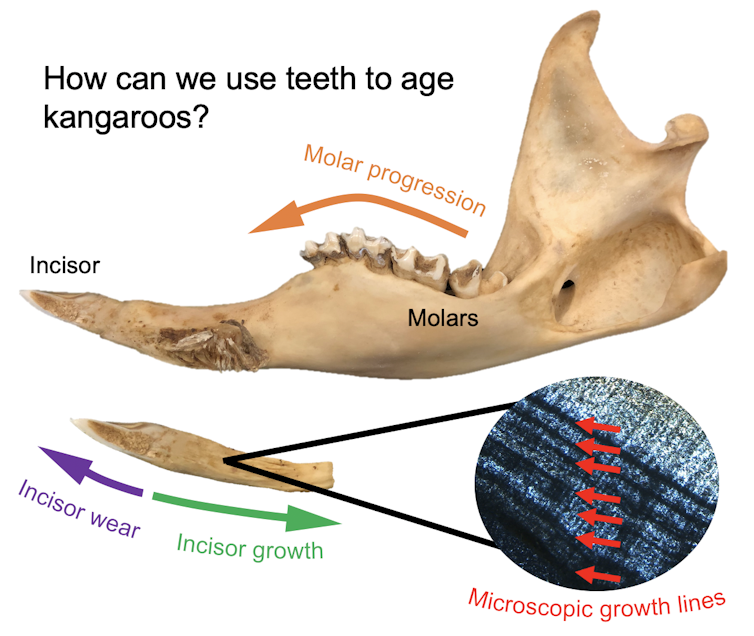
Kangaroos, wallabies, koalas, wombats and possums are all diprotodontian marsupials. In our study, we measured the growth of these incisor teeth in kangaroos and honey possums and found they never stop growing.
We can use this continuous growth to age marsupials by exactly how long they’ve grown in the tooth.
Tree rings and tooth lines
Much like trees have growth rings, teeth have growth lines[2]. These lines form as the different hard tissues that make up a tooth (enamel, dentine and cementum) are added over time.
We looked at the growth lines in kangaroo incisor teeth to see if there’s a record of age there as well. It turns out that yearly growth lines can be found in two different regions of these teeth.
Marching molars
Another weird way we can tell the age of a kangaroo is by measuring the movement of its molars.
Because eating grass can rapidly wear teeth down, kangaroos have a special adaptation where their molar teeth move forward in their jaws over time. Old, worn teeth are pushed forwards and fall out to make way for new, unworn teeth that are much better at chewing. It’s a bit like a conveyor belt of teeth. This process keeps going until the oldest kangaroos have only a couple of teeth left.
Scientists have measured the rate at which molar progression happens and found that it corresponds accurately with age[3]. Elephant teeth move in a very similar way and this technique works to age them as well[4].

Teeth tell more than age
As part of our study, we looked to see if there were differences in the incisor teeth between male and female kangaroos. We found incisors belonging to male kangaroos generally grow faster and can wear down more quickly than the incisors of females.
Information like this is important for understanding animal ecology, as it points to males and females foraging and feeding differently in the wild[5]. Across the animal kingdom, teeth can tell us a remarkable amount about feeding behaviours[6], different diets[7] and patterns of evolution[8].
Insights into the lives of ancient kangaroos
There are four species of kangaroo alive today. The largest species is the red kangaroo, and the biggest males grow to around 90 kilograms.
Thousands of years ago, Australia had a wonderful diversity of giant long- and short-faced kangaroos[9]. Some of these likely ran instead of hopped[10] and weighed around 250 kilograms.
Our new methods will help scientists learn more about the lives of these extinct giants. It can be very difficult to determine the age of an extinct animal from a fossil and to work out if that fossil came from a male or female – but we hope that our new methods will bring insight from incisors.
References
- ^ published in Archives of Oral Biology (doi.org)
- ^ teeth have growth lines (theconversation.com)
- ^ it corresponds accurately with age (era.daf.qld.gov.au)
- ^ works to age them as well (www.ncbi.nlm.nih.gov)
- ^ males and females foraging and feeding differently in the wild (www.mdpi.com)
- ^ feeding behaviours (theconversation.com)
- ^ different diets (theconversation.com)
- ^ patterns of evolution (theconversation.com)
- ^ giant long- and short-faced kangaroos (www.abc.net.au)
- ^ likely ran instead of hopped (journals.plos.org)