Sports policy focuses on the grassroots – is this missing from arts policies?
- Written by: Margaret Seares, Emeritus Professor and Senior Honorary Research Fellow, The University of Western Australia
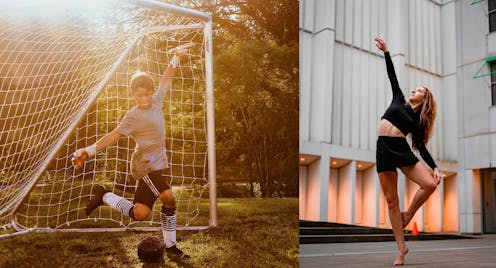
Every election, state and federal, we can expect to see plenty of politicians wearing sporting scarves, attending footy games and posing with elite athletes.
But why don’t we tend to see them attending performances, galleries and posing with our leading actors, musicians, dancers and artists?
Perhaps it is partly due to differences in the way governments fund and engage with the two sectors.
Sports policies in Australia focus on increasing participation at the grassroots, understanding the benefits for both amateur individuals and for elite sports in Australia. By contrast, arts policies in Australia tend to talk not so much about participation, but about audiences.
Planning for Australians in sport
Sports funding in Australia is very focused upon participation, fostering the clubs and associations that engage millions[1].
Engagement and participation for everyone is at the fore in the Australian Sports Commission’s Corporate Plan 2023–27[2] with the goal “involve more Australians with sport at all levels”.
There are very specific targets, such as reaching the goal of[3] 47% of children aged 5–14 years participating in “at least two hours per week of organised sport outside of school hours”.

The plan also links to Australia’s High Performance 2032+ Sports Strategy[4] and the National Sports Participation Strategy[5], reflecting a system which connects sports in the community through to elite international sport.
The states also emphasise participation in sport.
The New South Wales Office for Sport has the goal[6] “everyone in NSW [is] participating in sport and active recreation throughout their whole life”.
 The New South Wales Office for Sport wants us to participate in active recreation throughout our whole life.
pics five/Shutterstock[7]
The New South Wales Office for Sport wants us to participate in active recreation throughout our whole life.
pics five/Shutterstock[7]
The top goal of Sport and Recreation Victoria[8] is to ensure “greater access and opportunities for participation in sport and recreation by all Victorians”.
In Queensland, the blueprint for recreation and sport[9] has “inclusion and lifelong participation” as a core theme.
In Western Australia the aspiration is[10] “to increase the number of Western Australians playing sport and enjoying active recreation”.
These models of participation which government sports departments talk to are quite different to the goals of most government arts departments.
Arts are about audiences
Looking to the arts, the emphasis shifts from participation towards audience engagement. Creative Australia’s corporate plan 2023–27[11] states they “[enable] artists and cultural organisations to expand their reach to audiences”.
The section of the plan titled[12] “removing barriers to equity and participation” speaks of Australians being able to “participate as audiences, as creators, as workers and as leaders”. The key goals give primacy to more broadly engaging and enriching audiences.
 Arts policies are more likely to talk about audiences than participation.
AAP Image/Mark Brake
Arts policies are more likely to talk about audiences than participation.
AAP Image/Mark Brake
Audience engagement is also reflected one way or another in the strategies of the states.
In a number of the states there is a strong emphasis on supporting professional artists and organisations, for the benefit of audiences. Arts South Australia describes one of its key roles[13] as being to “encourage cultural and creative industries to thrive by providing targeted financial support to artists, arts organisations and events”.
Create NSW describes its role[14] as being to “grow and support the arts, screen and cultural sectors in NSW for everyone to enjoy”.
In WA and Victoria support for the arts and culture sectors is increasingly complemented by an emphasis on economic benefits derived from the arts.
In WA, the Department of Local Government, Sport and Cultural Industries’ Strategic Plan 2024–29 talks of delivering an arts and culture strategy[15] which “creates strong employment and economic growth in the creative industries”.
 Fostering arts and culture activities community members participate in are absent from policy documents.
David Fowler/Shutterstock
Fostering arts and culture activities community members participate in are absent from policy documents.
David Fowler/Shutterstock
In a similar vein, Victoria’s Creative State 2025[16] “aims to engender stability, create opportunity and stimulate growth for Victoria’s creative workers, businesses and industries”.
Queensland’s arts policy, Creative Together[17], has a slightly broadened emphasis, noting:
Evidence […] shows the value of arts in developing skills in problem solving, risk taking, empathy, critical thinking and teamwork, especially in an education setting. Creative Together will support arts, cultural and creative engagement that drives positive change for Queenslanders and their communities.
Absent from most of these plans are explicit policies to foster the many arts and culture activities that community members participate in. Community theatre, choirs, bands, dance studios and local art classes operate under the radar and are little recognised in government bureaucracies. They are better known to local governments, which often provide[18] cash or in kind support.
There are signs that this might be starting to change, with the latest state budget for SA going some way towards bridging this arts/sports gap: “sports vouchers” for young people to participate in extracurricular sports activities will now be expanded[19] to include music lessons.
However, data over the crossover between community arts activities and the funded sector is in very short supply.
The community sector comprises a large grassroots cohort of potential arts advocates. Up to 44% of Australians[20] say they “creatively participate” in the arts. This includes playing an instrument, writing creatively, engaging in visual arts and craft, and dancing, as well as being involved with community choirs and community theatre.
 Up to 44% of Australians say they ‘creatively participate’ in the arts.
BearFotos/Shutterstock[21]
Up to 44% of Australians say they ‘creatively participate’ in the arts.
BearFotos/Shutterstock[21]
However, it is not clear how those data map onto the goals and strategies of Creative Australia or those of most of the states.
The sports sector has flourished under an organised system that connects data on sports participation through to its key goals and strategies, side by side with strong support for elite performance.
Is it time for the arts to do the same?
References
- ^ engage millions (www.health.gov.au)
- ^ Australian Sports Commission’s Corporate Plan 2023–27 (www.sportaus.gov.au)
- ^ the goal of (www.transparency.gov.au)
- ^ Australia’s High Performance 2032+ Sports Strategy (www.winwell2032.au)
- ^ National Sports Participation Strategy (www.ausport.gov.au)
- ^ has the goal (www.sport.nsw.gov.au)
- ^ pics five/Shutterstock (www.shutterstock.com)
- ^ Sport and Recreation Victoria (sport.vic.gov.au)
- ^ blueprint for recreation and sport (www.dts.qld.gov.au)
- ^ aspiration is (www.dlgsc.wa.gov.au)
- ^ Creative Australia’s corporate plan 2023–27 (creative.gov.au)
- ^ titled (creative.gov.au)
- ^ key roles (www.dpc.sa.gov.au)
- ^ its role (www.nsw.gov.au)
- ^ arts and culture strategy (www.dlgsc.wa.gov.au)
- ^ Creative State 2025 (creative.vic.gov.au)
- ^ Creative Together (www.arts.qld.gov.au)
- ^ often provide (humanities.org.au)
- ^ now be expanded (www.orsr.sa.gov.au)
- ^ 44% of Australians (creative.gov.au)
- ^ BearFotos/Shutterstock (www.shutterstock.com)