NASA smacked a spacecraft into an asteroid – and learned details about its 12-million-year history
- Written by: Eleanor K. Sansom, Research Associate, Curtin University
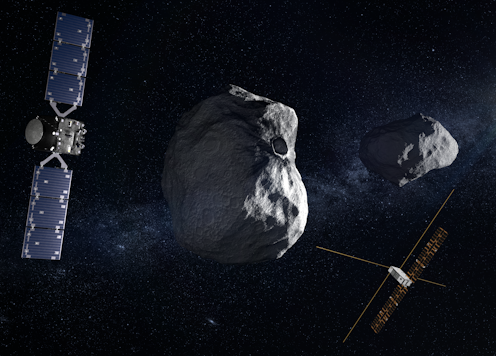
NASA’s DART mission – Double Asteroid Redirection Test[1] – was humanity’s first real-world planetary defence mission.
In September 2022, the DART spacecraft smashed into the companion “moon” of a small asteroid 11 million kilometres from Earth. One goal was to find out if we can give such things a shove[2] if one were headed our way.
By gathering lots of data on approach and after the impact, we would also get a better idea of what we’d be in for if such an asteroid were to hit Earth.
Five new studies published in Nature Communications[3] today have used the images sent back from DART and its travel buddy LICIACube[4] to unravel the origins of the Didymos-Dimorphos dual asteroid system. They’ve also put that data in context for other asteroids out there.

Asteroids are natural hazards
Our Solar System is full of small asteroids – debris that never made it into planets. Those that come close to Earth’s orbit around the Sun are called Near Earth Objects (NEOs). These pose the biggest risk to us, but are also the most accessible.
Planetary defence from these natural hazards really depends on knowing their composition – not just what they’re made of, but how they’re put together. Are they solid objects that will punch through our atmosphere if given the chance, or are they more like rubble piles[6], barely held together?
The Didymos asteroid, and its tiny moon Dimorphos, are what’s known as a binary asteroid system. They were the perfect target for the DART mission, because the effects of the impact could be easily measured in changes to Dimorphos’ orbit.
They are also close(ish) to Earth, or are at least NEOs. And they’re a very common type of asteroid we haven’t had a good look at before. The chance to also learn how binary asteroids form was the icing on the cake.
Quite a few binary asteroid systems have been discovered, but planetary scientists don’t exactly know how they form. In one of the new studies, a team led by Olivier Barnouin[7] from Johns Hopkins University in the United States used images from DART and LICIACube to estimate the age of the system by looking at surface roughness and crater records.
They found Didymos is roughly 12.5 million years old, while its moon Dimorphos formed less than 300,000 years ago. That may still sound like a lot, but it’s much younger than was expected.
A pile of boulders
Dimorphos is also not a solid rock as we’d typically imagine. It is a rubble pile of boulders that are barely held together. Along with its young age, it shows there can be multiple “generations” of these rubble pile asteroids in the wake of larger asteroid collisions.
Sunlight actually causes[8] small bodies like asteroids to spin. As Didymos started to spin like a top, its shape became squashed and bulged in the middle. This was enough to cause large pieces to just roll off the main body, with some even leaving tracks[9].
These pieces slowly created a ring of debris around Didymos. Over time, as the debris started sticking together, it formed the smaller moon Dimorphos.
How the spin of Didymos could have produced its tiny moon Dimorphos. Video by Yun Zhang.Another study, led by Maurizio Pajola[10] from Auburn University in the US used boulder distributions to confirm this. The team also discovered there were significantly more (up to five times) large boulders than have been observed on other non-binary asteroids humans have visited.
Another of the new studies[11] shows us that boulders on all asteroids space missions have visited so far (Itokawa, Ryugu and Bennu) were likely shaped the same way. But this excess of larger boulders on the Didymos system could be a unique feature of binaries.
 The locations of 15 suspected boulder tracks on the surface of Didymos.
Bigot, Lombardo et al., (2024)/Image taken by DRACO/DART (NASA)
The locations of 15 suspected boulder tracks on the surface of Didymos.
Bigot, Lombardo et al., (2024)/Image taken by DRACO/DART (NASA)
Lastly, another paper shows[12] this type of asteroid appears to be more susceptible to cracking. This happens due to the heating–cooling cycles between day and night: like a freeze–thaw cycle but without the water.
This means if something (such as a spacecraft) were to impact it, there would be much more debris thrown up into space. It would even increase the amount of “shove” it could have. But there is a good chance that what lies underneath is much stronger than what we’re seeing on the surface.
This is where the European Space Agency’s Hera mission[13] will step in. It will not only be able to provide higher-resolution images of the DART impact sites, but will also be able to probe the asteroids’ interiors using low-frequency radar.
The DART mission not only tested our ability to protect ourselves from future asteroid impacts, but also enlightened us on the formation and evolution of rubble pile and binary asteroids near Earth.
References
- ^ Double Asteroid Redirection Test (www.nasa.gov)
- ^ give such things a shove (theconversation.com)
- ^ published in Nature Communications (www.nature.com)
- ^ LICIACube (www.asi.it)
- ^ NASA/Johns Hopkins APL (science.nasa.gov)
- ^ more like rubble piles (theconversation.com)
- ^ led by Olivier Barnouin (doi.org)
- ^ Sunlight actually causes (www.sciencedirect.com)
- ^ with some even leaving tracks (doi.org)
- ^ led by Maurizio Pajola (doi.org)
- ^ Another of the new studies (doi.org)
- ^ another paper shows (doi.org)
- ^ Hera mission (www.esa.int)