The complex regional realities the US ignores at its peril
- Written by: Leon Goldsmith, Honorary Senior Lecturer in Middle East and Comparative Politics, University of Otago
After the breakdown of ceasefire talks between the United States and Iran, President Donald Trump has now ordered a blockade of the pivotal Strait of Hormuz[1] in the Persian Gulf.
It’s just the latest and most combustible phase of a broader regional conflict with global impacts[2] and long, complex roots.
But while there has been copious analysis of this “coronary artery” of global oil and gas trade, much less attention has been paid to the history and sociopolitical fabric of the Hormuz region itself.
This is something of a blind spot, because understanding the deeper cultural dynamics of the strait and its surrounds can tell us something of what might now lie ahead.
Indeed, just as the 1956 Suez Crisis[3] marked the eclipse of the old British Empire, the Hormuz crisis of 2026 may be remembered as a turning point for the US-led global order.
Origins of the oil monarchies
Great powers have long sought to control the Strait of Hormuz. Following the expulsion of the Portuguese in the early 17th century, imperial Britain evolved into the chief external power in the region over the next three-and-a-half centuries.
For much of this Pax Britannica[4] commercial shipping through the strait – essential to links with Britain’s imperial territories in South Asia – faced attacks from local raiders in swift dhows[5] that would emerge and quickly disappear into the complex and often foggy coastlines.
Not fully understanding the human and physical geography of the area, the British set out to closely map the coasts and populations. Based on this, Britain switched to co-opting certain tribes and sheikhs with financial incentives.
It also coordinated closely with the powerful sultan of Oman, who presided over an empire extending from the Persian Gulf to Zanzibar in east Africa, to tame the unruly populations of the Hormuz coastline.
This set the pattern of enriching local tribal rulers in the eastern Arabian peninsula that transformed into the contemporary oil monarchies in the 20th century.
The same tribes and clans that Britain privileged in the 19th century remain the ruling families of the United Arab Emirates (UAE), Qatar, Bahrain and Kuwait (Saudi Arabia evolved more independently). The result was long-term secure passage for commercial oil and gas shipping through Hormuz.
When the US inherited security responsibility for the Persian Gulf from the British after 1971, by which time eastern Arabian states were granted formal independence, it focused on these existing ruling families. Other facets of the region’s complex human geography were neglected.
In parallel, local rulers on both sides of the Gulf constructed narrow nationalisms based on Arab Sunni Islamic (apart from Oman, which is partly Ibadi) and Persian Shi'a Islamic identities. The combined effect was an illusion of political and cultural homogeneity.
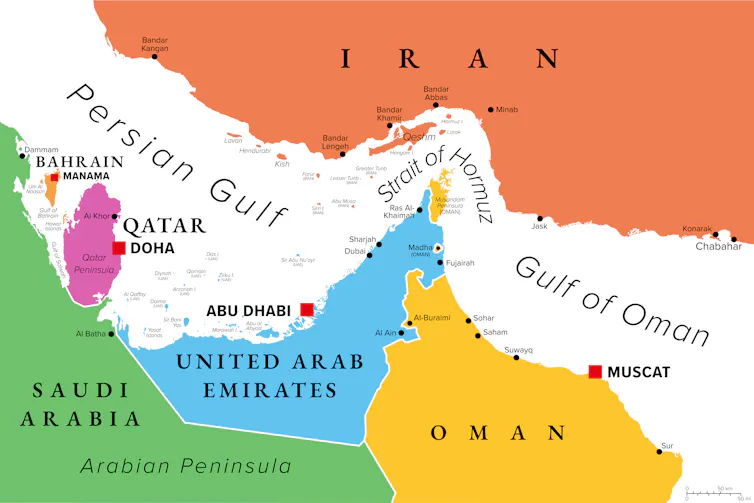
Despite this, highly diverse communities continue to live along both coasts. The northern coast of the Gulf and Strait of Hormuz is home to significant ethnic Arab and Baluchi[7] communities, both of which have long had testy relations with the Persian-dominant Iranian state (as well as with Pakistan).
Even less well known are the populations of the southern coastlines of Hormuz, including Oman’s governorate of Musandam at the tip of the Arabian Peninsula jutting into the Gulf, forming the Strait of Hormuz.
Only directly reachable from the Omani mainland by ferry, it contains a complex archipelago of islands and precipitous fiords and is surrounded by the UAE to the south and west.
Some of the indigenous population speak a unique language called Kumzari, with Arabic and Persian elements. The island communities have lived for centuries, virtually unknown, in a deeply symbiotic relationship with the sea.
For example, Kumzaris’ primary reference for direction is not north, south, east or west, but simply upward (bāla) and downward (zērin) – as a fisherman would perceive the depths of the sea relative to the mountains.
When I visited in 2019, I noted how many Musandam residents seemed relatively uncommitted to their Omani nationality. Many even wore the Emirati dish dasha – the traditional white robes that mark out the separate nationalities of the Gulf states.
This explains the special treatment Musandam residents receive, including social welfare assistance not available in other governorates, as a means of keeping the population loyal to Muscat, the capital of Oman.
Local forces, global tensions
All of this has potential implications for the current crisis.
On one hand, the ideological legitimacy of the Iranian state has increasingly been hollowed out in the face of internal unrest and external attacks by Israel and now the US.
Power in Tehran has been whittled down to a narrow clique within the Iranian Revolutionary Guard Corps. This weakening of state institutions opens the potential for sub-national identities, including those communities adjacent to the Strait of Hormuz, to crystallise and mobilise in the vacuum.
On the other hand, Oman is increasingly at odds with the UAE over Iran and the war. While the UAE is hawkish towards Tehran, Oman – long the Gulf’s most trusted neutral broker – has been implicated with Iran in a plan to establish a toll system for the Strait of Hormuz. Oman has denied this strenuously[8].
Ultimately, Oman’s control of the Musandam peninsula and its closeness to Iran create an uncomfortable tension with Abu Dhabi, the UAE capital.
The potential for the UAE to exploit local identity politics to try and bring the strategic Musandam peninsula under its own control is very real. Whether the US and other Gulf states would stand in the way is not clear.
Omani sensitivity to this possibility is extreme. At a university seminar I attended in Muscat in 2019, a map of the peninsula that failed to designate Musandam as part of Oman sparked a furious response from some in the audience.
More broadly, the fate of the Strait of Hormuz is emblematic of shifting world orders.
In 1956, Britain misread rising grassroots Arab nationalism and a changing world order as it sought to preserve its imperial lifelines through the Suez Canal. The risk for the US now is that it is making similar mistakes in the Strait of Hormuz, failing to adapt to local dynamics as the world changes again.
References
- ^ blockade of the pivotal Strait of Hormuz (www.aljazeera.com)
- ^ global impacts (theconversation.com)
- ^ Suez Crisis (www.iwm.org.uk)
- ^ Pax Britannica (www.historyhit.com)
- ^ dhows (nabataea.net)
- ^ Getty Images (www.gettyimages.co.nz)
- ^ Baluchi (ehrafworldcultures.yale.edu)
- ^ denied this strenuously (alhurra.com)