The Australians caught in a COVID blind spot
- Written by: Amanda Davies, Professor of Human Geography, The University of Western Australia
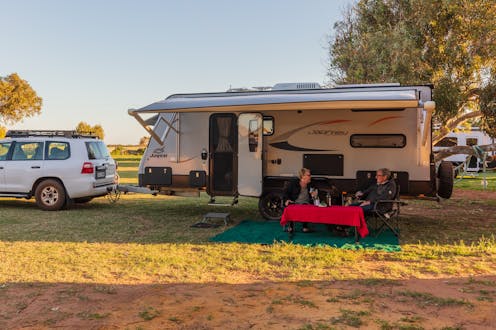
Australians have been told to stay home during lockdowns to prevent the spread of COVID-19. While evidence of the efficacy[1] of this approach as a public health strategy during a pandemic is compelling, lockdowns and mobility restrictions are inevitably disruptive for many – virtually everyone. However, a group that has largely been overlooked is Australia’s nomadic population[2]. Periods of lockdown are particularly challenging for these people, who live in vans, RVs, caravans and boats[3].
The impacts of restrictions on small businesses[4], travellers[5], people in low-paid and insecure jobs[6] who cannot work from home[7], school children[8] and homeless people[9] have all been widely reported. But with little known about Australia’s nomads, this group has been largely left to their own devices to find secure accommodation and navigate through mobility and border restrictions.
Read more: Australia's mishmash of COVID border closures is confusing, inconsistent and counterproductive[10]
While nomads do not have a conventional single residential address, or live in a brick and mortar home, they are not homeless. Their van, RV, caravan or boat enables them to be permanently mobile while living in their permanent home.
The viability of their nomadic lifestyle depends on being able to freely move from place to place. Free movement enables nomads to access work and social networks as well as minimise living costs.
With the focus now on vaccinating Australians and working out longer-term strategies for managing COVID-19, more attention must be given to this permanently mobile population.
Who are nomads?
The recently released US film Nomadland[11] follows the travels of a middle-aged woman who lives permanently in van. The film has raised awareness about the growing nomadic population in the US, and the complex economic and social drivers of this growth[12].
Nomadland: “I’m not homeless, I’m just houseless,” the lead character says. “Not the same thing, right?”In modern societies, nomads are best thought of as a diverse group of people who are consciously seeking an alternative housing solution that enables them to balance their social and economic resources, needs and aspirations. Their lives and lifestyles are closely connected to life on the road. For those still in the workforce, a nomadic lifestyle can enable them to find seasonal work year-round.
In Australia, the term nomad has been most often associated with “grey nomads”, a broad group of people who are typically retired or semi-retired. They travel seasonally[13] to warmer areas for winter and to cooler areas for summer.
Read more: Grey nomad lifestyle provides a model for living remotely[14]
How many nomads live in Australia?
Our new research[15] has revealed the exact size and characteristics of the Australian nomad population are unknown and challenging to determine[16]. Estimates vary dramatically from between 2,500[17] to 40,000[18], depending on how the group is defined.
Our official population statistics struggle to “capture” the realities of a whole range of population subsets that do not have one permanent place of “usual residence”, which compounds the challenge. The Australian Census, for example, has only three categories[19] for residents: being “at home”, “away from home”, or homeless on census night.
Without knowing the size of the nomad population, it is difficult to determine if the population is growing or by how much. However, recent reports from the UK and US suggest that, largely in response to financial pressures, those countries’ nomadic populations have grown.
As Australia’s property market tightens and housing affordability worsens[20], it is plausible that more people may opt to sell up their brick and mortar assets (or rent these out for an income) to live a more affordable nomadic lifestyle.
Read more: Soaring housing costs are pushing retirees into areas where disaster risks are high[21]
Searching for a place to stay
The closure of national and state parks and informal camping grounds has caused problems[22] for permanent grey nomads. While they are not homeless – their van, RV, caravan or boat is their home[23] – the closure of parks and camping grounds forces them to find alternative safe locations.
For those who are working, travel is often planned to align with seasonal work needs in particular areas. Mobility restrictions and border closures are particularly problematic for those who rely on seasonal work.
COVID-19 lockdowns have left many of Australia’s nomads stranded.An underpinning assumption of Australia’s public health measures to restrict the spread of COVID is that homes are generally not mobile and that people can remain within a location – albeit with disruption. Better information about the size, routes and characteristics of Australia’s nomad population may improve capacity to support them during periods of restrictions.
The rise of the digital nomad
While COVID-19 restrictions have thrown up many challenges, it appears opportunities are also emerging. Globally, many workplaces are moving work online and the digital nomad population has grown[24].
Digital nomads[25] are people who work online to maintain a nomadic lifestyle.
Read more: What inspired digital nomads to flee America's big cities may spur legions of remote workers to do the same[26]
So, while there is an urgent need to better ensure Australia’s nomads receive the supports and services they need during COVID-19 lockdowns and more broadly, it’s also worth keeping an eye on the growth of the digital nomad population. We need to consider what might be necessary to support this growing population into the future.
References
- ^ evidence of the efficacy (theconversation.com)
- ^ Australia’s nomadic population (edition.cnn.com)
- ^ live in vans, RVs, caravans and boats (www.australianpopulationstudies.org)
- ^ small businesses (theconversation.com)
- ^ travellers (www.abc.net.au)
- ^ low-paid and insecure jobs (theconversation.com)
- ^ cannot work from home (theconversation.com)
- ^ school children (www.deakin.edu.au)
- ^ homeless people (www.aph.gov.au)
- ^ Australia's mishmash of COVID border closures is confusing, inconsistent and counterproductive (theconversation.com)
- ^ Nomadland (en.wikipedia.org)
- ^ economic and social drivers of this growth (www.theguardian.com)
- ^ travel seasonally (www.sciencedirect.com)
- ^ Grey nomad lifestyle provides a model for living remotely (theconversation.com)
- ^ new research (www.australianpopulationstudies.org)
- ^ challenging to determine (www.sciencedirect.com)
- ^ 2,500 (www.abs.gov.au)
- ^ 40,000 (edition.cnn.com)
- ^ three categories (www.australianpopulationstudies.org)
- ^ housing affordability worsens (www.aihw.gov.au)
- ^ Soaring housing costs are pushing retirees into areas where disaster risks are high (theconversation.com)
- ^ caused problems (www.smh.com.au)
- ^ their van, RV, caravan or boat is their home (9now.nine.com.au)
- ^ digital nomad population has grown (theconversation.com)
- ^ Digital nomads (www.liveworkplay-australia.com)
- ^ What inspired digital nomads to flee America's big cities may spur legions of remote workers to do the same (theconversation.com)
Read more https://theconversation.com/our-own-nomadland-the-australians-caught-in-a-covid-blind-spot-161907