Australians are embracing 'mindful drinking' — and the alcohol industry is also getting sober curious
- Written by: Tamara Bucher, Senior Researcher, University of Newcastle
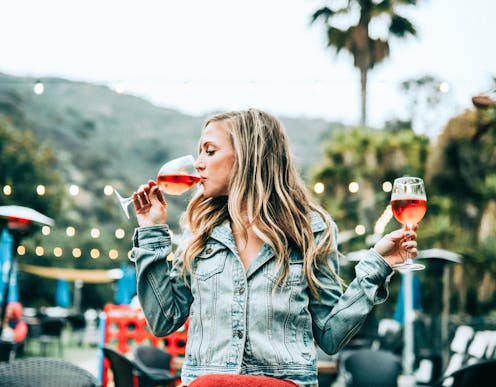
In 2020, Australia’s first non-alcoholic bar opened in Brunswick[1]. Sydney quickly followed suit. Major liquor retailers are dedicating more and more shelf space for the growing range of no-alcohol and low-alcohol drinks.
Alcohol-free wines, beers and spirits are increasingly sophisticated, driven by consumers taking more care in what they drink — and how they choose to drink.
Over the past 15 years, alcohol consumption has decreased in Australia[2], from 10.8 litres per capita per year down to 9.4 litres, the lowest seen in 50 years. Similar trends have been seen globally.
The reduction has been particularly stark for the younger age groups: the number of people in their 20s abstaining from alcohol[3] increased from 8.9% in 2001 to 22% in 2019.
Saying no to excessive drinking is the new act of youth rebellion.
‘Sober curious’ and ‘mindful drinking’
Drinking or not drinking was once seen as binary: you were a drinker, or you were sober. But recent years has seen a rise of the “sober curious[4]”, or the “mindful drinking” movement.
This might mean pausing to consider your need to drink, or how much you will drink. Maybe replacing your midweek glass of wine or beers with a non-alcoholic alternative. It’s about stopping to ask yourself why you want to have a drink, and if each and every drink needs to be alcoholic.
This moves away from the extremes of teetotallers vs binge drinkers and opens up the idea of drinking – or not – on any given occasion.
We could also call these people moderate drinkers: they embrace mindful drinking as a lifestyle, using social media hashtags such as #soberissexy[5] #sobercurious[6] and #hangoverfree[7]. These hashtags show images of health, happiness, empowerment, and success — people living life to the full.
Read more: #WineMom: Humour and empowerment or binge drinking and mental health challenges?[8]
This idea of conscious or controlled drinking has generated a new culture of consumers who celebrate, share and hashtag their non- or low-alcohol drinking.
It’s not grape juice
This shift in consumer attitudes has driven product innovation. Global alcohol brands are exploring alternatives, and several new brands have emerged with a focus on producing high-quality alcohol-free drinks that feel at home on any fashionable cocktail list[9].
Alcohol-free wine isn’t grape juice. To be classified as wine in Australia[10], a product must be made from fermentation of fresh grapes. During fermentation, yeast converts fruit sugars to alcohol[11].
Fermentable sugars can be reduced by harvesting fruits early, creating wines naturally lower in alcohol, or alcohol can be removed from a finished wine product after fermentation.
Alcohol-free wines have been around for a while — the first non-alcoholic wines were produced more than 100 years ago[12], but the technological methods for “dealcoholisation” have seen drastic improvements.
Dealcholisation once resulted in drinks lacking aroma, flavour quality and the characteristics we associate with drinking a glass of wine. But alcohol can now be removed without destroying the flavour compounds of the wine — and in a cost-effective way at large scale.
Even with the rise of the sober curious, consumers think these drinks are of lower value[13]. There is a belief because these drinks do not contain alcohol they should cost less. In practice, the production of high-quality alcohol-free wine and beer is more expensive and the potential savings on alcohol taxes are not making up for the increased costs.
Non-alcoholic wines are reported to be one of Australia’s fastest growing drink categories[14], valued at more than A$4.5 million last year, predicted to be worth $15 million by the end of this year. Despite the growth, they still account for less than 1%[15] of Australia’s total wine consumption.
But … what is the point?
So, why not just drink water, or a soft drink? Drinking is not just about quenching your thirst, or just about intoxication. Drinking is a social event, a ritual, a reward and an experience. Drinks are paired with food and are to be enjoyed.
Wine drinkers know it is more than just a drink or source of alcohol. A particular pour may be chosen for reasons such as health (think resveratrol[16] in red wine), food pairings (a dry Chardonnay with crispy-skinned Barramundi), style (sipping an award-winning wine), intellectual challenge (sampling different grape varieties and regions) or tradition and fun (popping the cork of a sparkling white).
Many of these needs can be fulfilled by non-alcoholic wine.
Alcohol does contribute to the flavour profile of alcoholic drinks, and removing alcohol does change the taste. But today’s makers are creative.
Wine does contain antioxidants, and moderate consumption has been linked with good health[17]. But alcohol removal can give consumers the benefits of the antioxidants without risking adverse effects.
Read more: Non-alcoholic drinks: how healthy are they?[18]
And while you’re unlikely to think of beer as a sports drink, savvy marketers are thinking differently: Australians can now buy non-alcoholic “sports beers”. ZERO+ Sports Beer claims these beers contain similar minerals and isotonic properties as sports drinks[19].
The future is mindful
Drinking alcohol is seen as a way to relax, socialise and gain a sense of pleasure.
But the mindful drinker gains their sense of pleasure and enjoyment through abstaining or moderating their drinking.
Embracing mindful drinking has been shown to generate positive feelings[20] such as a sense of self-determination, building self-esteem, and feeling comfortable with one’s social identity.
Consumers want alternatives and are excited by new products and innovation.
Some dealcoholised beers[21] and wines[22] have even won awards against standard strength wines — so the mindful drinker may be getting the pick of the shelf.
References
- ^ opened in Brunswick (www.goodfood.com.au)
- ^ alcohol consumption has decreased in Australia (www.abs.gov.au)
- ^ abstaining from alcohol (www.aihw.gov.au)
- ^ sober curious (www.rubywarrington.com)
- ^ #soberissexy (www.instagram.com)
- ^ #sobercurious (www.instagram.com)
- ^ #hangoverfree (www.instagram.com)
- ^ #WineMom: Humour and empowerment or binge drinking and mental health challenges? (theconversation.com)
- ^ any fashionable cocktail list (www.winemag.com)
- ^ classified as wine in Australia (www.legislation.gov.au)
- ^ fruit sugars to alcohol (winefolly.com)
- ^ more than 100 years ago (carljungwines.com)
- ^ lower value (doi.org)
- ^ fastest growing drink categories (www.smh.com.au)
- ^ less than 1% (www.wineaustralia.com)
- ^ resveratrol (theconversation.com)
- ^ linked with good health (doi.org)
- ^ Non-alcoholic drinks: how healthy are they? (theconversation.com)
- ^ minerals and isotonic properties as sports drinks (www.sportsbeer.com.au)
- ^ mindful drinking has been shown to generate positive feelings (doi.org)
- ^ beers (au.bigdropbrew.com)
- ^ wines (www.arielvineyards.com)