What's the new COVID vaccine indemnity scheme? Two legal experts explain
- Written by: Bill Madden, Adjunct Professor, Australian Centre for Health Law Research, School of Law, Queensland University of Technology
On Monday night, Prime Minister Scott Morrison announced a new vaccine indemnity scheme.
An indemnity scheme would mean health practitioners who are found liable to pay compensation for any serious adverse events suffered by people receiving COVID vaccines, will have the compensation paid for them by the Commonwealth of Australia.
Morrison also said[1] if people under 60 wish to access to the AstraZeneca vaccine, they can “go and speak to their doctor”.
The media reporting that followed suggests there’s some confusion as to what all this means, for people and health practitioners.
So how does an indemnity scheme work, and does it provide any benefits to people in the very rare event they get a serious adverse reaction to a COVID vaccine?
Wait, what was announced?
Currently, Pfizer is the preferred vaccine for under-60s in Australia.
But the national cabinet media release said[2] “GPs can continue to administer AstraZeneca to Australians under 60 years of age with informed consent”.
The expert panel of immunisation experts which advises the federal government has always said people under 60 can get AstraZeneca if the benefits are likely to outweigh the risks[3], and if they make an informed decision to consent.
Read more: Under-40s can ask their GP for an AstraZeneca shot. What's changed? What are the risks? Are there benefits?[4]
The prime minister also said[5] the new COVID-19 vaccine indemnity scheme “will provide confidence to medical practitioners to administer both AstraZeneca and Pfizer vaccines to Australians”.
The proposed indemnity scheme is designed to support health practitioners, and reduce real or perceived barriers to them administering the AstraZeneca vaccine to under-60s.
However most, if not all, relevant health practitioners already have indemnity insurance in place, either through private medical indemnity insurers or through their employers.
The proposed new vaccine indemnity scheme therefore appears to shift exposure to claims for compensation from the existing insurers to the Commonwealth of Australia. It’s unlikely to prohibit health practitioners being sued, for example, for negligent advice in relation to the risks and benefits of a particular vaccine.
It’s also worth noting this doesn’t just apply to GPs, but other health practitioners too, such as nurses.
What does the new vaccine indemnity not do?
The new vaccine indemnity doesn’t provide automatic access to the AstraZeneca vaccine for anyone who simply asks for it.
A health practitioner will use their professional judgement as to whether the AstraZeneca vaccine is suitable for a particular patient.
Some patients may have pre-existing conditions which make them unsuitable, and in those circumstances a health practitioner may well refuse to provide that vaccine.
It’s also worth noting individual health-care practitioners aren’t protected from facing complaints or disciplinary action if they engage in any unsatisfactory professional conduct. Perhaps seriously inappropriate advice or treatment could give rise to disciplinary action.
Are there new benefits for you?
Australia doesn’t have a no-fault vaccine injury compensation scheme or bespoke COVID-19 vaccine compensation scheme. Countries such as the United States[6] and United Kingdom[7] do have such schemes, even if they are perhaps imperfect.
In these countries and some others, in the very rare instance you have a really bad reaction to a COVID vaccine and, for example suffer a prolonged or permanent disability, you can access compensation.
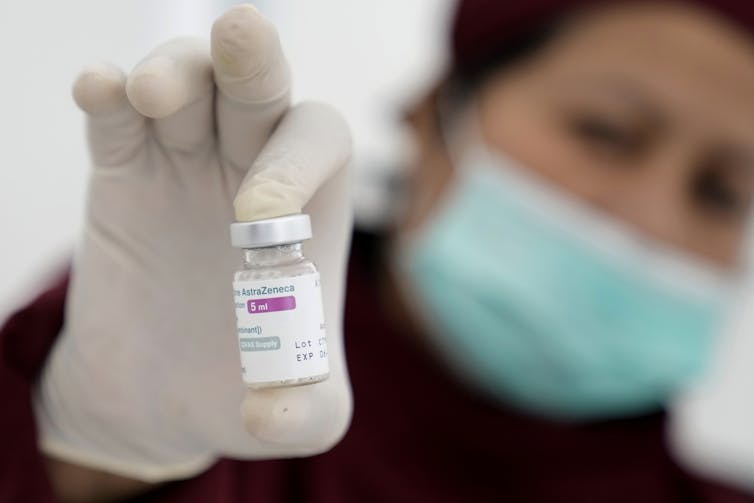 Unlike some of its counterparts, Australia does not have a vaccine injury compensation scheme in place.
Dita Alangkara/AP/AAP
Unlike some of its counterparts, Australia does not have a vaccine injury compensation scheme in place.
Dita Alangkara/AP/AAP
Some media reports interpreted Australia’s new vaccine indemnity announcement as including such a “no-fault” injury compensation scheme to compensate Australian patients who suffer adverse reactions to COVID-19 vaccines.
Adding to the confusion was that on Tuesday federal Chief Medical Officer Paul Kelly mentioned[8] such a scheme was coming.
Details of the proposed indemnity scheme have not been released[9]. But the prime minister’s announcement made no direct reference to no-fault compensation.
Without a special vaccine compensation scheme, patients may only get compensation if a health practitioner fails to exercise reasonable care or acts in breach of Australian Consumer Law. Sometimes actions against vaccine manufacturers are also possible.
One exception might be an injury flowing from a vaccination related to someone’s employment.
In other words, compensation almost always requires fault on the part of the health practitioner or the vaccine manufacturer.
Could I get compensation without a vaccine injury compensation scheme in place?
There are existing pathways for people to obtain financial assistance when there’s been no fault on the part of the health practitioner advising or administering a vaccine.
Subject to meeting eligibility requirements, people may obtain sickness benefits from Centrelink, or in cases of persisting disability, a disability support person.
Financial supports under the National Disability Insurance Scheme are also available, but only for people under 65 who suffer significant permanent disabilities.
In the very rare event a vaccine causes someone to die, accessing assistance for their dependants is somewhat more complex.
What should happen next?
The new vaccine indemnity may encourage health practitioners to provide the AstraZeneca vaccine more broadly, by reducing financial risks to them and their insurers.
Most people seeking vaccination will be purely motivated by the health benefits. But some people might like the idea of being compensated in the very rare instance something goes badly wrong. One group of researchers from the UK argue[10] that a better financial safety net for patients would encourage more people to seek vaccination, more quickly. Whether this will happen in Australia is a question the national cabinet could consider.
We will know more when the details of the new vaccine indemnity scheme are released. It seems unlikely at this stage but perhaps we’ll be pleasantly surprised by the inclusion of a benefit scheme for anyone who suffers a serious adverse event from a COVID vaccine.
References
- ^ Morrison also said (www.abc.net.au)
- ^ national cabinet media release said (www.pm.gov.au)
- ^ the benefits are likely to outweigh the risks (theconversation.com)
- ^ Under-40s can ask their GP for an AstraZeneca shot. What's changed? What are the risks? Are there benefits? (theconversation.com)
- ^ also said (www.pm.gov.au)
- ^ United States (www.nejm.org)
- ^ United Kingdom (urldefense.com)
- ^ mentioned (www.phaa.net.au)
- ^ have not been released (www.theaustralian.com.au)
- ^ argue (www.biicl.org)