As Sydney's lockdown continues, what support is available — and needed — for people losing income?
- Written by: Peter Whiteford, Professor, Crawford School of Public Policy, Australian National University
Greater Sydney is in its third week of lockdown, with no clear end in sight. The situation calls for support both for businesses and households suffering severe income loss in the weeks ahead.
Greater Sydney makes up about one-fifth of the Australian population, so is a significant chunk of our economy and community.
It’s worth noting when the (now extinct) Coronavirus Supplement was announced on March 22 2020, there were 179 new cases per day[1] for all of Australia. When the (also now extinct) JobKeeper Payment was announced a week later, there were 383 new cases per day.
There were 112 new cases announced in NSW alone on Monday.
A federal government responsibility
In June, Prime Minister Scott Morrison indicated[2] business support was a state government responsibility. But income support for households is a federal government responsibility.
In 2020, the Morrison government showed great flexibility. JobKeeper supported employers to maintain part-wages for workers who would otherwise be stood down, and the Coronavirus Supplement gave additional support to those who lost their jobs.
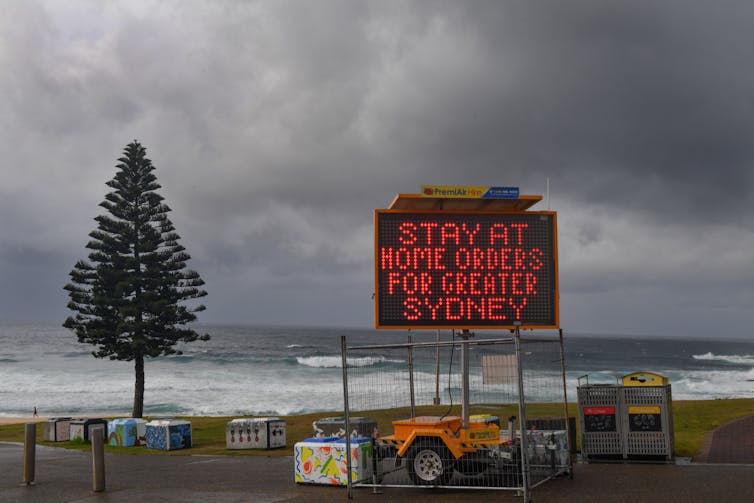 Sydney had been in lockdown since June 26.
Mick Tsikas/AAP
Sydney had been in lockdown since June 26.
Mick Tsikas/AAP
These programs went a long way towards addressing a weakness of Australia’s social security system — the lack of insurance against sudden income loss when workers are laid off (for whatever reason). Indeed, for a while, the Coronavirus Supplement also worked to address another major weakness, the below-poverty line income for the long-term unemployed.
JobKeeper and the Coronavirus Supplement ended earlier this year. Most recently, the federal government has built on existing schemes to assist people during natural disasters, to support those during lockdowns or quarantine.
The last few months in Melbourne and Sydney show the COVID crisis is far from finished. Morrison has flagged that further financial support is being considered by the government. Treasury is reportedly[3] working on options.
There are currently two main forms of support.
The COVID-19 Disaster Payment
The first main support is the COVID-19 Disaster Payment[4]. This kicks in once a lockdown has gone on for more than a week. For those losing under 20 hours work, the payment is $325 per week, and for those losing 20 hours or more of work, the payment is $500 per week.
Read more: There's a new temporary COVID disaster payment – who can get it? Who is missing out?[5]
There are several eligibility criteria: recipients must be unable to attend work and have lost income, they can’t have access to appropriate paid leave and they can’t be receiving an income support payment[6], a state pandemic payment or the Pandemic Leave Disaster Payment[7] for the same period.
Last week, Morrison announced[8] the liquid assets limit of $10,000 would be waived from the third week of a lockdown.
Pandemic leave payment
The second key support is the Pandemic Leave Disaster Payment[9], where an appropriate local health authority[10] has told people to self-isolate or quarantine, or for those who need to care for someone with COVID-19. This includes Australian residents and those with a working visa.
The payment is $1,500 for each 14-day period someone needs to self-isolate or quarantine. A new claim must be made each 14-day period and Services Australia has set up accelerated application processes.
As with the COVID disaster payment, those with any income from paid work or other leave entitlements, or on income support payments[11], are not eligible.
How adequate are these measures?
Whether support is adequate depends on the spread of the virus and its economic impact in coming weeks. But there are already gaps in support.
It is confusing to have two payments at different levels, with people required to quarantine receiving greater support than those locked down, even when financial losses may be similar.
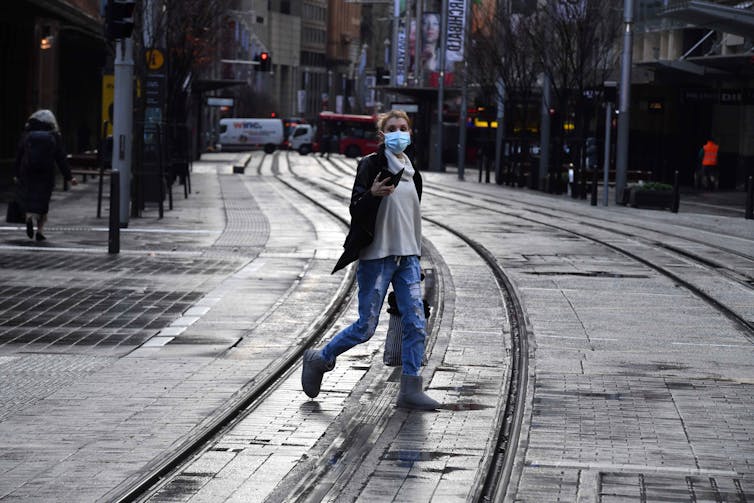 The Delta variant has turned the Sydney CBD into a ghost town.
Mick Tsikas/AAP
The Delta variant has turned the Sydney CBD into a ghost town.
Mick Tsikas/AAP
The Pandemic Leave Disaster Payment[12] is comparable to JobKeeper, but the Covid-19 Disaster Payment[13] is considerably less (although higher than JobSeeker Payment for the unemployed).
As we have already noted, both payments have significant exclusions. With the COVID-19 payment, apart from being unavailable for the first week, people must submit a new claim for each additional week of lockdown.
What about those already on welfare?
While the government increased the base rate[14] of JobSeeker Payment earlier this year, Australia still has the second lowest[15] “replacement rate” (relative to wages) for the unemployed in all OECD countries.
Another significant gap is most of the current help cannot go to people already receiving income support, although many of them may lose income in lockdown.
Read more: Unemployment support will be slashed by $300 this week. This won't help people find work[16]
Welfare recipients who have to go into isolation or quarantine can access a one-off crisis payment[17] (equal to a week’s pay at the maximum basic rate of their payment), but this is only available twice in a six month period.
According to Australian government data, in May, nearly one in four people receiving Youth Allowance (Other)[18] and more than 20% of those receiving JobSeeker had part-time earnings, which is crucial to help people paying rent and bills. If they lose earnings, their benefits will increase, but by less than half the earnings lost.
Business support
We keep hearing reports[19] about how small business is suffering badly.
Small businesses have many fixed costs — most notably rent — that will not be supported. More generally, so far, most of the costs of the lockdowns have been borne by either employees, employers in locked down industries, or government.
But a wider sharing of the costs via rent and interest moratoriums for affected businesses and households should be considered. This requires co-ordinated action by the state and federal governments.
Importantly, state governments are looking at their own measures. Last week, Victoria announced[20] it would trial up to five days of sick or carer’s leave, at minimum wage rates, to workers in high-risk industries, including aged care, cleaners, supermarket workers, hospitality workers and security guards. However, this will not start until early 2022.
NSW has been pushing the federal government to jointly devise a new scheme[21] to save jobs. An announcement is expected imminently.
Whatever this is, governments need to be realistic about what businesses and households are facing. The longer lockdown lasts, the more people will need longer-term solutions to costs they can’t get away from, like mortages, rents and basic living expenses.
References
- ^ 179 new cases per day (ourworldindata.org)
- ^ indicated (www.sbs.com.au)
- ^ is reportedly (www.theguardian.com)
- ^ COVID-19 Disaster Payment (www.servicesaustralia.gov.au)
- ^ There's a new temporary COVID disaster payment – who can get it? Who is missing out? (theconversation.com)
- ^ income support payment (www.servicesaustralia.gov.au)
- ^ Pandemic Leave Disaster Payment (www.servicesaustralia.gov.au)
- ^ announced (www.abc.net.au)
- ^ Pandemic Leave Disaster Payment (www.servicesaustralia.gov.au)
- ^ appropriate local health authority (www.servicesaustralia.gov.au)
- ^ income support payments (www.servicesaustralia.gov.au)
- ^ Pandemic Leave Disaster Payment (www.servicesaustralia.gov.au)
- ^ Covid-19 Disaster Payment (www.servicesaustralia.gov.au)
- ^ increased the base rate (theconversation.com)
- ^ second lowest (theconversation.com)
- ^ Unemployment support will be slashed by $300 this week. This won't help people find work (theconversation.com)
- ^ crisis payment (www.servicesaustralia.gov.au)
- ^ Youth Allowance (Other) (www.dss.gov.au)
- ^ reports (www.news.com.au)
- ^ Victoria announced (www.theguardian.com)
- ^ new scheme (www.smh.com.au)