Why the federal government's COVID-19 fear appeal to Sydney residents won't work
- Written by: Jane Speight, Foundation Director, Australian Centre for Behavioural Research in Diabetes, Deakin University
On Sunday July 11, the federal government released two new COVID-19 campaigns.
The first[1], shared across Australia, is a call to “arm yourself” (and others) against the virus by getting vaccinated as soon as you’re eligible.
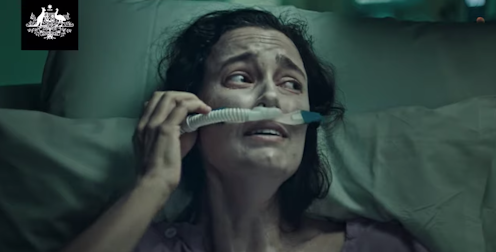
The second[2] is a graphic fear appeal, broadcast only in New South Wales, which shows a young woman in a hospital bed struggling to breathe. The advert has the caption: “COVID-19 can affect anyone. Stay home. Get tested. Book your vaccination”.
It’s clearly intended to leave the NSW audience shaken by the severity of the virus, and with the knowledge that residents, particularly younger people, are susceptible to the virus.
It’s easy to see why fear-based campaigns are appealing. Some may even think focusing the public’s attention on the severity of COVID is necessary to combat complacency in the wake of the low number of deaths in Australia overall.
Unfortunately, a fear appeal about COVID, particularly in NSW at this point in time, is highly unlikely to be effective, and certainly not as effective as some other approaches could be.
Fear appeals can have unintended consequences
The underlying assumption of fear appeals[3] is that, when people are confronted emotionally with the potential severity of a threat, they will act accordingly to prevent it. The reasoning is simple enough, but it’s only true when certain other conditions are met.
This COVID vaccine advert addresses motivation, but it ignores other key elements of behaviour change. That is, do people have the capability and opportunity[4] to make the change(s)?
When one or both are absent, people are likely to react defensively[5]. They tend to become more, not less, distressed, and this doesn’t necessarily translate to behaviour change.
Indeed, increasing fear may actually be unhelpful. Fear drives panic, stigma and further fears. It acts as a barrier to an effective community response.
Fear can discourage people from adopting protective behaviours, such as hand hygiene, physical distancing or self-isolation; from seeking health-care for screening or treatment; and from disclosing their illness, to avoid discrimination and/or abuse. There are also numerous accounts of people panic-buying in supermarkets.
Psychological theory and evidence[6] do not support fear appeals overall.
Threatening communications are effective only when people have high “self-efficacy[7]” to undertake the behaviours. This means the target audience needs to be confident they can actually change their behaviours.
Can people change their behaviour in this context?
When we examine the three behaviours the federal government promotes in this campaign, it’s clear that capability and opportunity are, at best, variable across the community.
Let’s take a look:
1. “Stay home”
People’s ability to stay home is based not only on their perception of threat, but also on their personal, economic and social circumstances.
For example, it has been evident during the pandemic that some people cannot or do not stay at home because they have insecure or low-paid work with no sick leave entitlements[8].
Read more: 'Far too many' Victorians are going to work while sick. Far too many have no choice[9]
2. “Get tested”
When people know they have engaged in potentially risky behaviours, like shopping or visiting family and friends, they are likely to be anxious about what a COVID test will reveal. This can lead to avoidance of the test.
They may well also be concerned about the potential consequences beyond the threat to their health. They might wonder whether they will be punished[10] with fines they cannot afford, or shamed by the media[11] for their behaviour.
Read more: 10am brunch, 1pm Kmart: when the media pokes fun at someone's lifestyle, it's harder for the next person to get COVID tested[12]
3. “Book your vaccination”
Australia’s problem with vaccine hesitancy[13] is well-documented. But, we need strategies to encourage people to make the right decisions, not beat them into submission.
Especially so, given the federal government’s vaccine supply and rollout program, which is currently an international embarrassment[14]. According to the latest figures[15], Australia has delivered 35 vaccine doses per 100 people. That compares to 126 in Israel, 118 in the UK, 99 in the USA, and 44 worldwide.
Read more: Australia has not learned the lessons of its bungled COVID vaccine rollout[16]
In many ways, this campaign is unethical
It’s also unethical to use distressing campaigns when many people, particularly younger people, are already experiencing considerable mental health impacts[17] due to the pandemic. When many don’t have the financial security[18] to stay at home. When they are genuinely confused by the risks[19] associated with the vaccines, and many remain unable to access the vaccine. When the reality[20] is the Australian health-care system has the capacity (currently) to ensure no-one would be left alone in hospital gasping for breath.
And when the NSW government itself has done a 180-degree turnaround in its messaging in a single day from: we may need to give up on lockdown and live with the Delta variant[21] to NSW “can’t live reasonably[22]” with the Delta variant — and now expects a similarly rapid U-turn from the public.
It’s not surprising young people (and many others) are already expressing their outrage[23] at this government advert.
We need the government to leave behind the draconian fear appeals[24] of the 1980s, and instead embrace the lessons learned[25] about “gain-framing” from multiple, evidence-based mass communication campaigns.
Gain-framed messages focus on the positive consequences of adopting the behaviour rather than on the losses associated with not doing the behaviour.
Recent COVID vaccine campaigns in Europe have been uplifting. Some dare us to dream of a COVID-free future, for example one French campaign[26].
And some, like one UK campaign[27], even use a little humour.
At this point in the pandemic, we don’t need scare tactics. What we need is for everyone to feel encouraged, empowered and supported to do the right thing to protect their own health and that of the wider NSW and Australian community.
And we need governments to understand and use the theory and evidence supporting an effective approach.
References
- ^ first (www.health.gov.au)
- ^ second (www.youtube.com)
- ^ fear appeals (www.tandfonline.com)
- ^ capability and opportunity (www.nature.com)
- ^ react defensively (www.tandfonline.com)
- ^ Psychological theory and evidence (www.tandfonline.com)
- ^ self-efficacy (www.tandfonline.com)
- ^ no sick leave entitlements (theconversation.com)
- ^ 'Far too many' Victorians are going to work while sick. Far too many have no choice (theconversation.com)
- ^ punished (www.9news.com.au)
- ^ shamed by the media (www.theguardian.com)
- ^ 10am brunch, 1pm Kmart: when the media pokes fun at someone's lifestyle, it's harder for the next person to get COVID tested (theconversation.com)
- ^ vaccine hesitancy (theconversation.com)
- ^ international embarrassment (www.bbc.com)
- ^ figures (ourworldindata.org)
- ^ Australia has not learned the lessons of its bungled COVID vaccine rollout (theconversation.com)
- ^ considerable mental health impacts (www.abc.net.au)
- ^ financial security (www.theguardian.com)
- ^ confused by the risks (www.smh.com.au)
- ^ reality (twitter.com)
- ^ give up on lockdown and live with the Delta variant (www.abc.net.au)
- ^ can’t live reasonably (www.news.com.au)
- ^ outrage (www.sbs.com.au)
- ^ draconian fear appeals (www.tandfonline.com)
- ^ lessons learned (www.tandfonline.com)
- ^ French campaign (www.abc.net.au)
- ^ UK campaign (www.youtube.com)