Tasmanian author Amanda Lohrey wins prestigious Miles Franklin Literary Award for The Labyrinth
- Written by: Jen Webb, Dean, Graduate Research, University of Canberra
And the winner of 2021’s Miles Franklin Literary Award[1] is The Labyrinth, by Amanda Lohrey!
Two of Lohrey’s previous novels (Camille’s Bread in 1996 and The Philosopher’s Doll in 2005) have been shortlisted for the prestigious $60,000 prize. Her latest has been recognised as the literary volume that best presents Australian life now. She is the second Tasmanian author to ever win the prize.
As a long-time fan of Lohrey’s voice and eye, and someone with a lifetime of longing for more recognition of women’s achievements, I am thrilled to see her novel and her protagonist Erica achieve this standing.
Read more: The saddest of stories, beautifully told: your guide to the Miles Franklin 2021 shortlist[2]
Prickly but appealing
Erica is an often prickly but generous and appealing character. Though she grows up “in an asylum, a manicured madhouse”, her childhood is much happier than is the norm for characters in literary fiction. Her father, the chief medical officer of the hospital, trains his children in diversity. All of us are “lunatics”, he teaches them, in that “we are all affected by the moon”. “Evil,” he tells them, is no more than “a chemical malfunction in the brain”.
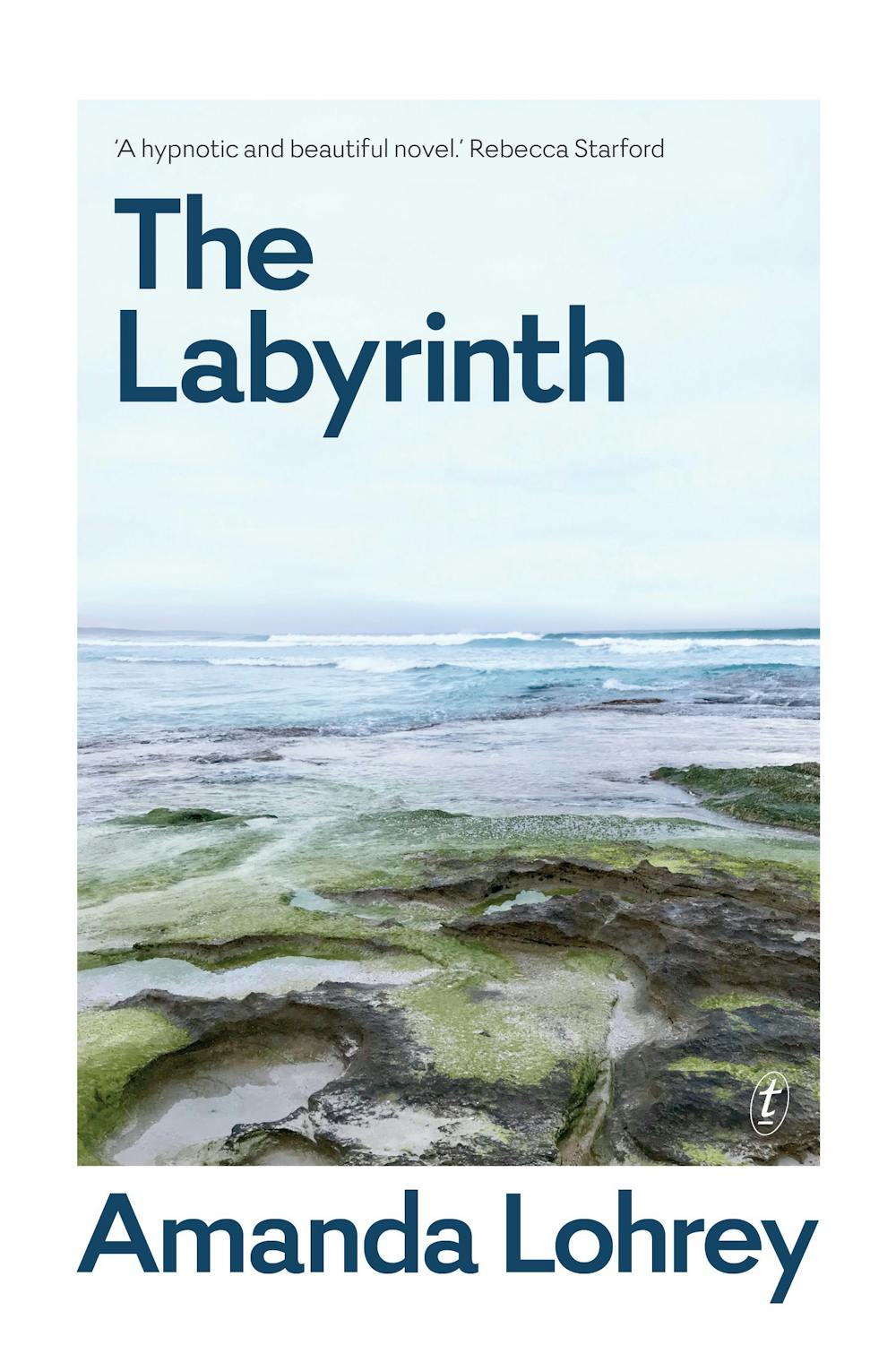 Text Publishing
This is an excellent foundation for someone who, in later life, finds herself with a son whose “chemical malfunction” leads him to commit an inadvertent but terrible crime. The beach shack she purchases to be near him, and far from everyone else she knows, is as disorganised and disreputable as her child. But it gives her somewhere to review her life and re-imagine a future.
That future circles around the concept of the labyrinth. Much of the novel is a masterclass in types of these mazes and the meanings and feelings the various designs afford.
A way through
All this operates as a healing process following the agony of her son’s act, trial and imprisonment. She — or rather, her planned labyrinth — gradually draws the attention of other isolates who live in the same coastal community. Various people become closely connected to her and one, Jurko, happens to know about labyrinths and their construction.
The young man, “an illegal immigrant who has overstayed his visa”, is a stonemason (a master of that ancient art) and he gradually inserts himself into her home and her life to become her “surrogate son”.
Sand, he explains, is the best foundation for a labyrinth, and this captures Erica’s attention:
I am struck by the paradox here: sand so volatile in its essence and yet so firm a basis for the rigidity of concrete.
For the reader, this becomes the novel’s coda: though everything seems so unstable, it still affords a firm foundation for our difficult, drifting lives.
As the novel unfolds, Erica’s deepening relationships with her new neighbours, and shared responsibilities and understandings, form a sort of labyrinth that leads her to the point where she can declare: “The fugue is over.”
Text Publishing
This is an excellent foundation for someone who, in later life, finds herself with a son whose “chemical malfunction” leads him to commit an inadvertent but terrible crime. The beach shack she purchases to be near him, and far from everyone else she knows, is as disorganised and disreputable as her child. But it gives her somewhere to review her life and re-imagine a future.
That future circles around the concept of the labyrinth. Much of the novel is a masterclass in types of these mazes and the meanings and feelings the various designs afford.
A way through
All this operates as a healing process following the agony of her son’s act, trial and imprisonment. She — or rather, her planned labyrinth — gradually draws the attention of other isolates who live in the same coastal community. Various people become closely connected to her and one, Jurko, happens to know about labyrinths and their construction.
The young man, “an illegal immigrant who has overstayed his visa”, is a stonemason (a master of that ancient art) and he gradually inserts himself into her home and her life to become her “surrogate son”.
Sand, he explains, is the best foundation for a labyrinth, and this captures Erica’s attention:
I am struck by the paradox here: sand so volatile in its essence and yet so firm a basis for the rigidity of concrete.
For the reader, this becomes the novel’s coda: though everything seems so unstable, it still affords a firm foundation for our difficult, drifting lives.
As the novel unfolds, Erica’s deepening relationships with her new neighbours, and shared responsibilities and understandings, form a sort of labyrinth that leads her to the point where she can declare: “The fugue is over.”
 ‘It’s a tremendous honour to be associated with the remarkable Stella Miles Franklin, one of the great Australian mavericks,’ said winning author Amanda Lohrey.
Miles Franklin Award
Read more:
The Flanagan effect: Tasmanian literature in the limelight[3]
‘It’s a tremendous honour to be associated with the remarkable Stella Miles Franklin, one of the great Australian mavericks,’ said winning author Amanda Lohrey.
Miles Franklin Award
Read more:
The Flanagan effect: Tasmanian literature in the limelight[3]
References
- ^ Miles Franklin Literary Award (www.perpetual.com.au)
- ^ The saddest of stories, beautifully told: your guide to the Miles Franklin 2021 shortlist (theconversation.com)
- ^ The Flanagan effect: Tasmanian literature in the limelight (theconversation.com)