Why the US won't be able to shirk moral responsibility in leaving Afghanistan
- Written by: Michael Blake, Professor of Philosophy, Public Policy and Governance, University of Washington
The majority of the remaining American troops in Afghanistan were withdrawn recently, with the rest due to leave by the end of August 2021[1]. This withdrawal marks the end of nearly 20 years of American military presence in Afghanistan[2].
Support for the withdrawal is widespread in the United States, with the majority of Americans – regardless of political affiliation[3] – in favor of ending American military operations in Afghanistan. The war has been, and would continue to be, costly[4], both in financial terms and in terms of American lives.
But the present regime in Afghanistan is unstable, and some experts estimate it may collapse within the year[5]. If it does so, the resulting power gap would likely be filled by the Taliban, whose history of human rights[6] abuses include violence against women and children[7].
There are significant moral costs at stake in either remaining in or withdrawing from Afghanistan. As a political philosopher[8] whose work focuses on international affairs, I have tried to understand how ethical reasoning might be applied to such cases.
The first, and most important, ethical question might be: Is the United States justified in withdrawing its troops from Afghanistan?
A second question might involve asking about how the moral wrongs that are likely to emerge in Afghanistan should weigh upon the American conscience. Should American political leaders regard these wrongs as, in some fashion, their responsibility?
More broadly, is it sometimes possible that, in doing the best available thing, we are nonetheless guilty of doing something morally wrong?
Power and moral tragedy
Many philosophers have disliked the idea that someone might make the best choice available and nonetheless be thought to have committed a moral wrong. Immanuel Kant[9], for one, thought this vision was fundamentally in conflict with the purposes of morality – which is to tell people what it is they ought to do.
If a moral theory told us that, sometimes, there is no option open to us that does not involve doing wrong, then that theory would sometimes imply that even a perfect moral agent might end up having to become a wrongdoer.
That sort of theory would mean that there might be situations in which we could not escape from doing wrong. If we were unlucky enough to end up in those situations, we would become liable for wrongdoing because of this bad luck. Kant thought this sort of “moral luck[10]” was simply implausible. For Kant, if we do what is best, we can regard ourselves as having avoided doing wrong[11].
Other philosophers, however, have been more willing to entertain the possibility of moral tragedy[12], which is understood as a state of affairs in which all options open to us involve serious moral wrongdoing.
Michael Walzer[13], a political philosopher at the Institute for Advanced Study in Princeton, New Jersey, argues that those who exercise power over others may frequently find themselves unable to do good for some without doing serious wrong to others[14]. Instead of thinking that the good they do outweighs the wrong, Walzer argues, individuals ought to accept that the wrong continues to be a genuine wrong.
For example, the politician who must make a deal with a corrupt colleague in order to help protect vulnerable children does wrong in the name of a greater good. This individual does their best but nonetheless stains their soul in the doing.
On this view, politicians who do wrong while trying to do what is right may do the best thing, but they should also be understood as having done wrong, and having stained their consciences in the doing. For Walzer, it is difficult for a person to be both good at politics and a genuinely good person.
Afghanistan and moral responsibility
If Walzer is right about politicians, his analysis might also help in understanding the morality of international relations – and the morality of withdrawing from Afghanistan.
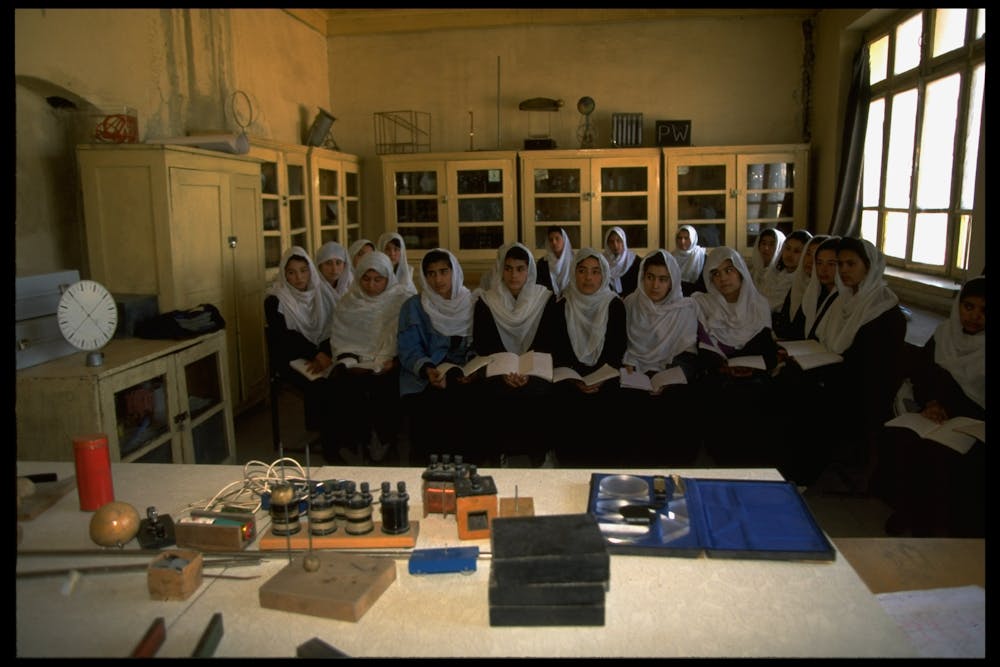 There are fears that the Taliban might once again impose restrictions on girls once U.S. troops withdraw from the country.
Robert Nickelsberg/Getty Images[15]
There are fears that the Taliban might once again impose restrictions on girls once U.S. troops withdraw from the country.
Robert Nickelsberg/Getty Images[15]
Taken in this context, the benefits of withdrawal may be sufficient to make it the right act. However, the rights violations that are likely to follow in the aftermath of this withdrawal are genuinely wrong, and they are rightly attributed to the United States. The women and girls of Afghanistan are likely to face human rights abuses, and the inhabitants of Afghanistan will likely face significant violence as the Taliban seek to reassert their rule. This ought to trouble the politicians who defend the withdrawal[16], and those voters who gave power to those politicians.
[You’re smart and curious about the world. So are The Conversation’s authors and editors. You can read us daily by subscribing to our newsletter[17].]
This vision of international politics is echoed in former Secretary of State Colin Powell’s advice to then-President George W. Bush about the invasion of Iraq – codified as the “Pottery Barn rule[18]” after the perceived store policy: If you break it, you bought it. That is: If you make yourself the ruler over others, you are responsible for them, and what happens to them should be on your conscience.
There are at least two things that might follow this moral vision. The first is that, even if the withdrawal entails taking ownership of some moral wrongs, the United States has an obligation to ensure that such wrong is minimized.
It might therefore acquire, for instance, an obligation to provide refuge to those people who have borne particular risks in the name of the United States, such as the translators who worked on the military bases[19] within Afghan territory and have been targeted by the Taliban for their work.
The second is, more broadly, that the United States works to ensure that it avoids entering into such morally tragic situations in the future. If Walzer’s analysis is correct, it might be impossible to avoid situations in which the United States is responsible for serious moral wrongs. Having power over others always involves the risk of moral bad luck, and the United States has exceptional power[20] in the global community.
But it might at least be expected that the United States, in future conflicts, take account of what philosopher Brian Orend[21] calls justice after war[22] and enters into such conflicts only with some clarity about how and when to end them well.
The article has been updated to clarify that Michael Walzer is a scholar at Institute for Advanced Study in Princeton, New Jersey.
References
- ^ by the end of August 2021 (www.politico.com)
- ^ 20 years of American military presence in Afghanistan (www.cfr.org)
- ^ regardless of political affiliation (newrepublic.com)
- ^ costly (www.usnews.com)
- ^ within the year (www.wsj.com)
- ^ history of human rights (www.amnesty.org)
- ^ violence against women and children (www.peacewomen.org)
- ^ political philosopher (phil.washington.edu)
- ^ Immanuel Kant (plato.stanford.edu)
- ^ moral luck (plato.stanford.edu)
- ^ doing wrong (doi.org)
- ^ moral tragedy (doi.org)
- ^ Michael Walzer (www.ias.edu)
- ^ serious wrong to others (www.jstor.org)
- ^ Robert Nickelsberg/Getty Images (www.gettyimages.com)
- ^ defend the withdrawal (www.whitehouse.gov)
- ^ You can read us daily by subscribing to our newsletter (theconversation.com)
- ^ Pottery Barn rule (www.google.com)
- ^ translators who worked on the military bases (www.npr.org)
- ^ exceptional power (www.bbc.co.uk)
- ^ Brian Orend (uwaterloo.ca)
- ^ justice after war (doi.org)