Gamers know the power of 'flow' — what if learners could harness it too?
- Written by: Simon McCallum, Senior Lecturer in Software Engineering, Te Herenga Waka — Victoria University of Wellington
One of the constant challenges in education is keeping the learner engaged, motivated and connected[1] in a world increasingly filled with distractions. Social media, streaming TV and video games all compete for students’ increasingly fragmented attention.
COVID-19 lockdowns only increased the opportunity for those distractions to interfere with learning. But, as we look hopefully towards a post-COVID world, perhaps we can take inspiration from the things many students are clearly drawn to — in particular, video games.
Of course, borrowing from video games and their design to inform educational practice isn’t new. Some have talked this up as “gameducation[2]”, whereby courses are like games with trophies for participation and engagement.
It’s clear learning this way can be fun, but there is another important element of that experience that deserves closer examination — “flow[3]”.
Gamers (athletes, too) experience this flow state when totally engaged in the game. Living in the moment and the experience, the activity is effortless and there is no sense of time passing.
Students can also experience flow, and this is when learning is at its most productive. So, the challenge in education is to plan for and achieve that level of engagement. Flow is and always will be the gold standard.
 Online learning in the age of COVID-19: paying attention to each other or paying attention to the screen?
www.shutterstock.com
Online learning in the age of COVID-19: paying attention to each other or paying attention to the screen?
www.shutterstock.com
Learning as social activity
Learning has always been a deeply social activity, with the student connected to the institution, as Nietzsche put it, “by the ear, as a hearer[4]”.
Schools relied on classrooms full of children learning the same material together, their shared attention helping to reduce distractions during focused moments of teaching.
Over time, various strategies for combating distraction have been developed, including offering students a smorgasbord of learning experiences[5], or cutting the length of lectures to account for the tyranny of concentration spans.
Read more: How student-designed video games made me rethink how I teach history[6]
But COVID-mandated videoconferencing deprives both students and lecturers, and drains the richness from these social interactions. Furthermore, learning mediated by screens simply amplifies the myriad distractions available online[7].
Even with cameras on, we’re not necessarily paying attention to each other, we’re paying attention to the screen.
But maybe this is where the qualities that define video games come into their own. After all, gaming is also a deeply social activity that allows for complex interactions and learning without the physical presence of anything more than a screen.
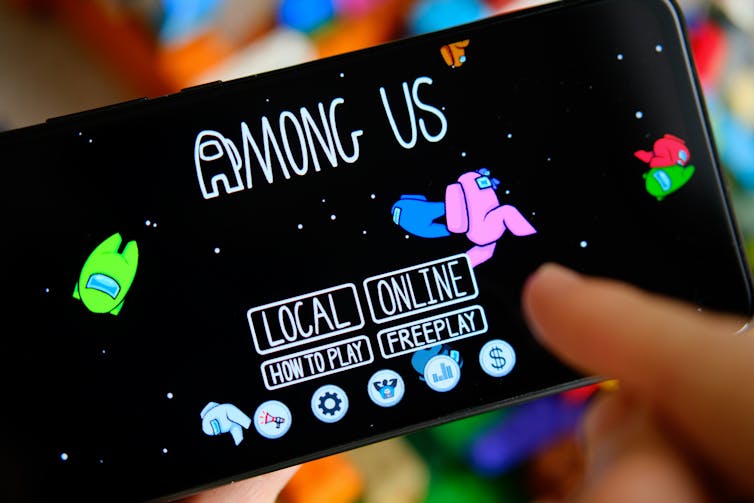 Popular online game Among Us: the tasks are actually the distractions.
www.shutterstock.com
Popular online game Among Us: the tasks are actually the distractions.
www.shutterstock.com
Harnessing distraction
Online games have already partly substituted for the things COVID-19 has affected — sports events, concerts and music festivals, parties and weddings.
Take the game Among Us[8], for example, which in September 2020 alone had 200,000 people going online to watch “impostors” try to eliminate “crewmates” from teams before they can complete a set of tasks or identify which players are the impostors.
Within the context of the game, the tasks are actually the distractions that prevent players from focusing on who is really an impostor. It is about observation, memory and insight — a game full of learning opportunities that teaches participants how to control distractions.
Read more: How teachers can use video games to motivate students[9]
The social cohesion created in the teams of Among Us players[10] offers a template for teachers looking for ways to create engaging digital learning environments. Creating teams, allocating individual tasks that help the team and regularly changing team members all help to engage and stimulate students.
With online teaching making it harder for institutions to control the learning environment, it becomes imperative to making learning activities themselves more engaging in a screen-mediated environment.
Learning with distraction
As Marshall McLuhan famously said, “the medium is the message[11]”. Understanding how games grab and hold attention can help with the design and implementation of new online learning tools.
Even some politicians are learning from games[12] and using them to engage with the public. Gamification is also enhancing academic research[13] and teaching.
Read more: How playful design is transforming university education[14]
The key lies in our definition of distraction. Screen learning must involve distracting students towards the things that really matter. In education, as in gaming, we can “court risk[15]” without the fear of failing.
Rather than admonishing learners for not focusing when sitting at desks in school or in front of screens, we should work within our distracted world. We need to play with distraction, work with distraction and learn with distraction.
Paradoxically, distraction may not be the enemy, it could be the gateway to more attentive learning.
References
- ^ engaged, motivated and connected (www.newsroom.co.nz)
- ^ gameducation (www.researchgate.net)
- ^ flow (positivepsychology.com)
- ^ by the ear, as a hearer (la.utexas.edu)
- ^ smorgasbord of learning experiences (www.chronicle.com)
- ^ How student-designed video games made me rethink how I teach history (theconversation.com)
- ^ distractions available online (www.gie.unsw.edu.au)
- ^ Among Us (innersloth.com)
- ^ How teachers can use video games to motivate students (theconversation.com)
- ^ Among Us players (www.tandfonline.com)
- ^ the medium is the message (web.mit.edu)
- ^ learning from games (www.theguardian.com)
- ^ enhancing academic research (onlinelibrary.wiley.com)
- ^ How playful design is transforming university education (theconversation.com)
- ^ court risk (www.researchgate.net)