5 ways Americans often misunderstand Cuba, from Fidel Castro's rise to the Cuban American vote
- Written by: Caroline McCulloch, Professor of International Relations, Florida International University
Cuba recently erupted in the largest protests[1] seen there in six decades, reflecting popular anger over a crippling economic crisis, scarce food and medicines and a half-century of repression.
Cuba remains largely an enigma to outsiders, and especially to Americans. Myths prevail because of Cuban government censorship and the United States’ historic tendency – born of the Cold War – to stereotype and simplify the communist island.
“The truth is that Cuba is often more talked about, idealized or vilified than known,” wrote Martín Mosquera[2], editor of the Latin American edition of Jacobin, a leftist publication, recently.
This article examines five common areas of confusion about Cuba, Cuban Americans and the U.S.-Cuba relationship.
#1. The Cuban Revolution
Fidel Castro and a band of guerrillas overthrew the brutal U.S.-backed[3] dictatorship of Fulgencio Batista in 1959. At the time, Castro’s political ideology was unclear[4]; he had not yet publicly committed to communism. Anti-communist revolutionaries[5] allied with him.
In Castro’s famous 1953 “History Will Absolve Me[6]” speech, he said his revolution would return “power to the people” and proclaimed Cuba’s liberal democratic 1940 Constitution as “the Supreme Law of the State” until “the people should decide to modify or change it.”
The revolution was a nationalist revolution for most Cubans, then, not a communist one. When Castro installed a socialist economy and a one-party political system, many fellow revolutionaries felt betrayed[7]. Cubans fought to form a government that would answer to the Cuban people, rather than foreign interests. They got Castro’s Soviet-backed regime.
Many poor Cubans revered Castro for implementing policies that promoted equity and minimized discrimination, including major reforms[8] in land, agriculture, education and housing.
Others fled because of fear and persecution. Exiles included large landowners, Batista supporters, religious leaders, the middle class and revolutionaries who opposed Fidel’s manner of governing.
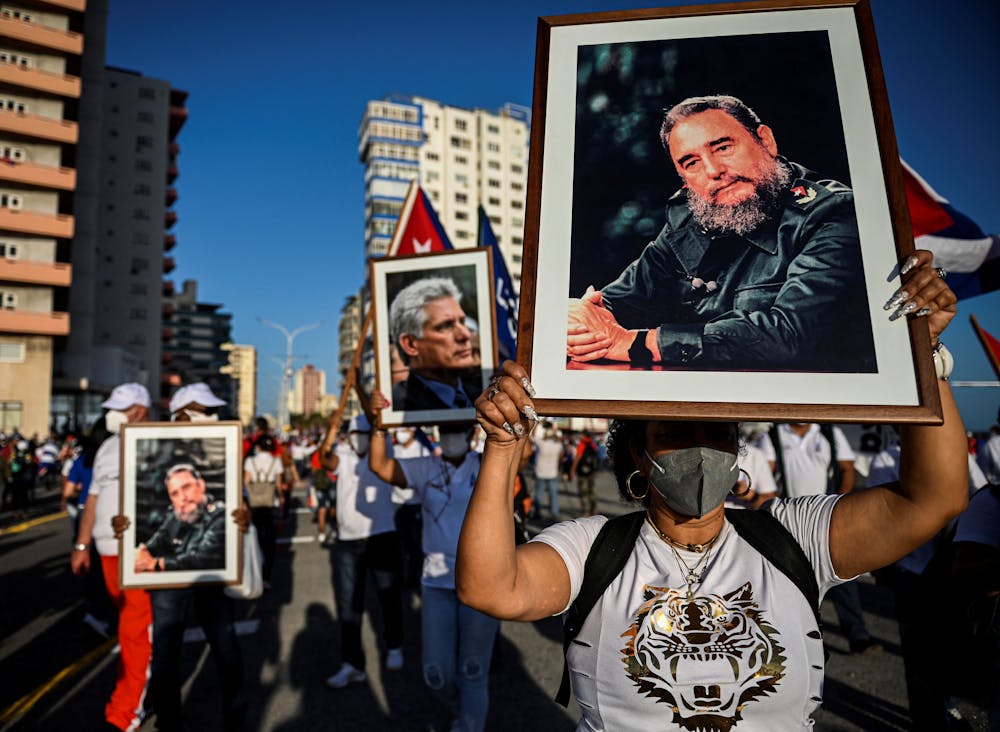 A counterprotest of Cubans who defend Castro’s revolution against the anti-government marches of July 2021.
YAMIL LAGE/AFP via Getty Images[9]
A counterprotest of Cubans who defend Castro’s revolution against the anti-government marches of July 2021.
YAMIL LAGE/AFP via Getty Images[9]
#2. The US embargo
The Cuban government blames the United States[10] for poverty on the island, but many of Cuba’s economic problems are homegrown.
The U.S. embargo originated in the early 1960s to prevent the spread of communism from Cuba to other Latin American countries. It also sought to compel Cuba’s new government to compensate American corporations for property expropriated by the regime and to prevent further confiscations.
Today the embargo has evolved to include six separate pieces of legislation.
Some laws[11] put pressure on the Castro regime in the 1990s, when Cuba’s economy was vulnerable after the fall of the Soviet Union. They deny U.S. visas to leaders of companies that invest in Cuba. Additional embargo policies restrict Americans from traveling or sending money to Cuba – though there are loopholes[12] enabling U.S. Treasury-licensed food and medical supply sales to Cuba.
The 60-year-old embargo inhibits the fledgling Cuban private sector and makes it harder to obtain the goods they need.
Many people[13] in the U.S. and beyond are urging President Joe Biden to lift the embargo to ease Cuba’s current food and medical shortages. But the president of the United States cannot do that unilaterally. Lifting the embargo would require Congress to either certify that Cuba has become sufficiently democratic according to the 1996 Libertad Act[14] or pass a new bill overturning it.
However, the embargo is not the primary reason Cuban people are struggling.
The Cuban government has a history of political repression and fiscal mismanagement, both of which harm the economy. For example, it tightly controls who may obtain state-issued licenses to start their own businesses. It bans independent labor unions[15], which would protect workers from exploitation.
Finally, few countries[16] still limit trade or diplomatic relations with Cuba because of the embargo. They have created laws[17] that help protect their businesses from retaliatory U.S. legal action when operating in Cuba.
#3. US interference in Cuba
Just as it blames the U.S. embargo for poverty in Cuba, the Cuban government blames U.S. interference for political unrest there, as it did after protests[18] erupted on July 11.
Indeed, the U.S. government has upheld Cuban dictators – before Castro – and employed wide-ranging coercive sanctions against the country. The United States even occupied Cuba[19], in the early 20th century. After Castro took power, the U.S. supported anti-Castro uprisings[20].
Ultimately, though, the Cuban government’s long record[21] of human rights abuses[22] and repression created the current political instability.
Cuba has a well-documented history of harassing, intimidating and imprisoning activists and dissidents[23]. Over 700[24] Cuban protesters have been detained or disappeared[25] since July 11, according to the human rights organization Cubalex.
The government continues to suppress freedom of expression and closely monitor civilians, which has spurred resistance[26] from artists, journalists and civil society organizations. LGBTQ people still face persecution[27].
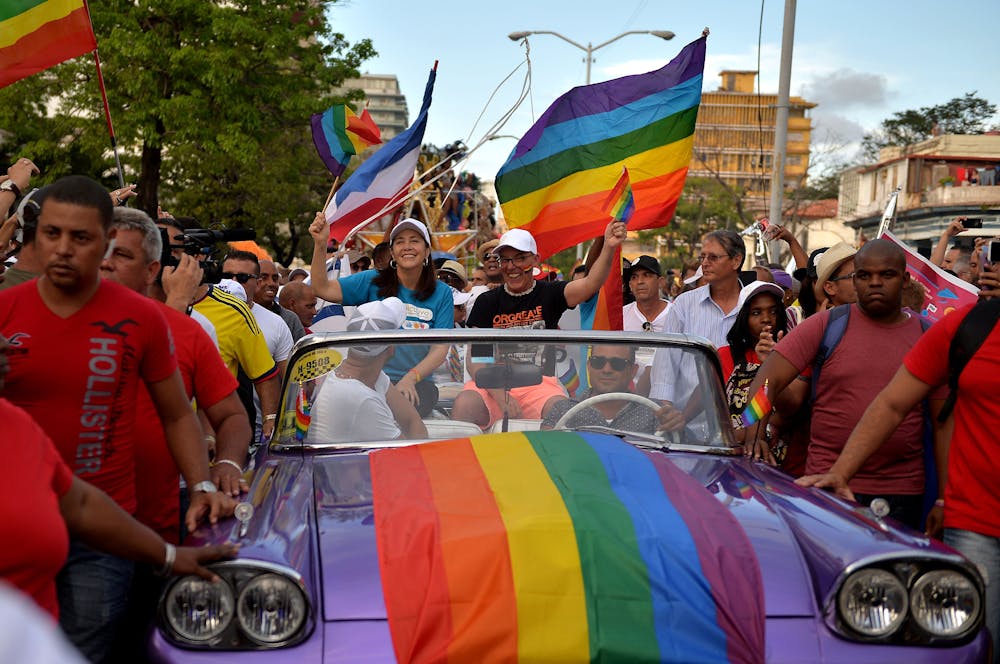 Mariela Castro, center, daughter of Cuban former President Raul Castro, advocates for LGBTQ rights at the 2018 Havana Pride parade.
YAMIL LAGE/AFP via Getty Images[28]
Mariela Castro, center, daughter of Cuban former President Raul Castro, advocates for LGBTQ rights at the 2018 Havana Pride parade.
YAMIL LAGE/AFP via Getty Images[28]
#4. Cuban Americans
The media often stereotypes Cuban Americans as overwhelmingly conservative. But they are a racially, economically and politically heterogeneous community[29].
Cubans who’ve come to the U.S. since 1990[30] are even more diverse than the largely white first waves of exiles who came after the Cuban Revolution[31].
Cuban Americans’ political opinions differ depending on their race, socioeconomic status, gender and age[32]. Cuban Americans as a group became overwhelmingly Republican after Ronald Reagan courted them[33] in the 1980s, but they are increasingly independent voters[34]. In the 2020 presidential election, around 55% of Cubans in Florida[35] voted for Donald Trump.
#5. Race and equality in Cuba
Castro’s Communist revolution brought disadvantaged Cubans greater access to education[36] and universal health care[37]. Many poor Cubans became world-class doctors, scholars and scientists.
However, Cuba is not an egalitarian society. Its political leaders are overwhelmingly white and male, and the government does not treat all Cubans equally[38].
Afro-Cubans, who comprise at least one-third[39] of Cuba’s 11.3 million people, experience widespread discrimination[40]. As a result, they have higher poverty rates, less access to stable currency and low rates of property ownership. Afro-Cubans also suffer more police violence[41] than white Cubans.
[Over 100,000 readers rely on The Conversation’s newsletter to understand the world. Sign up today[42].]
Black and brown Cuban artists are leading[43] the current protests. The rap song “Patria y Vida[44]” – which means “Homeland and Life,” a word play on the revolutionary slogan “Homeland or Death” – has become an anthem for Cuban government opposition.
References
- ^ largest protests (theconversation.com)
- ^ wrote Martín Mosquera (jacobinlat.com)
- ^ U.S.-backed (www.nytimes.com)
- ^ political ideology was unclear (www.nytimes.com)
- ^ Anti-communist revolutionaries (atom.library.miami.edu)
- ^ History Will Absolve Me (library.brown.edu)
- ^ felt betrayed (www.pbs.org)
- ^ major reforms (www.ascecuba.org)
- ^ YAMIL LAGE/AFP via Getty Images (www.gettyimages.com)
- ^ blames the United States (diariodecuba.com)
- ^ Some laws (www.congress.gov)
- ^ there are loopholes (www.treasury.gov)
- ^ Many people (www.letcubalive.com)
- ^ Libertad Act (www.congress.gov)
- ^ independent labor unions (www.hrw.org)
- ^ few countries (misiones.minrex.gob.cu)
- ^ created laws (www.ibanet.org)
- ^ after protests (www.reuters.com)
- ^ occupied Cuba (www.pbs.org)
- ^ supported anti-Castro uprisings (www.jfklibrary.org)
- ^ long record (ccdhrn.org)
- ^ human rights abuses (www.hrw.org)
- ^ harassing, intimidating and imprisoning activists and dissidents (www.politifact.com)
- ^ Over 700 (docs.google.com)
- ^ detained or disappeared (www.cibercuba.com)
- ^ spurred resistance (www.amnesty.org)
- ^ still face persecution (www.bbc.com)
- ^ YAMIL LAGE/AFP via Getty Images (www.gettyimages.com)
- ^ racially, economically and politically heterogeneous community (theconversation.com)
- ^ since 1990 (www.pewresearch.org)
- ^ exiles who came after the Cuban Revolution (www.migrationpolicy.org)
- ^ race, socioeconomic status, gender and age (cri.fiu.edu)
- ^ Ronald Reagan courted them (www.washingtonpost.com)
- ^ independent voters (www.sun-sentinel.com)
- ^ 55% of Cubans in Florida (www.nbcnews.com)
- ^ access to education (theconversation.com)
- ^ universal health care (journals.sagepub.com)
- ^ does not treat all Cubans equally (www.washingtonpost.com)
- ^ one-third (www.onei.gob.cu)
- ^ widespread discrimination (minorityrights.org)
- ^ suffer more police violence (foreignpolicy.com)
- ^ Sign up today (theconversation.com)
- ^ artists are leading (www.washingtonpost.com)
- ^ Patria y Vida (www.youtube.com)