Earth's energy budget is out of balance – here's how it's warming the climate
- Written by: Scott Denning, Professor of Atmospheric Science, Colorado State University
You probably remember your grade school science teachers explaining that energy can neither be created nor destroyed. That’s a fundamental property of the universe.
Energy can be transformed, however. When the Sun’s rays reach Earth, they are transformed into random motions of molecules that you feel as heat. At the same time, Earth and the atmosphere are sending radiation back into space. The balance between the incoming and outgoing energy is known as Earth’s “energy budget.”
Our climate is determined by these energy flows. When the amount of energy coming in is more than the energy going out, the planet warms up.
That can happen in a few ways, such as when sea ice that normally reflects solar radiation back into space disappears and the dark ocean absorbs that energy instead. It also happens when greenhouse gases build up in the atmosphere and trap some of the energy that otherwise would have radiated away.
Scientists like me[1] have been measuring the Earth’s energy budget[2] since the 1980s using instruments on satellites, in the air and oceans, and on the ground. You’ll be hearing more about those measurements and Earth’s energy budget when the United Nations Intergovernmental Panel on Climate Change report[3] is released on Aug. 9.
Here’s a closer look at how energy flows and what the energy budget tells us about how and why the planet is warming.
Balancing energy from the Sun
Virtually all the energy in the Earth’s climate system comes from the Sun. Only a tiny fraction is conducted upward from the Earth’s interior[4].
On average, the planet receives 340.4 watts of sunshine per square meter[5]. All sunshine falls on the daytime side, and the numbers are much higher at local noon.
Of that 340.4 watts per square meter:
99.9 watts are reflected back into space by clouds, dust, snow and the Earth’s surface.
The remaining 240.5 watts are absorbed – about a quarter by the atmosphere and the rest by the surface of the planet. This radiation is transformed into thermal energy within the Earth system. Almost all of this absorbed energy is matched by energy emitted back into space. A tiny residual – 0.6 watts per square meter – accumulates as global warming. That may not sound like much, but it adds up.
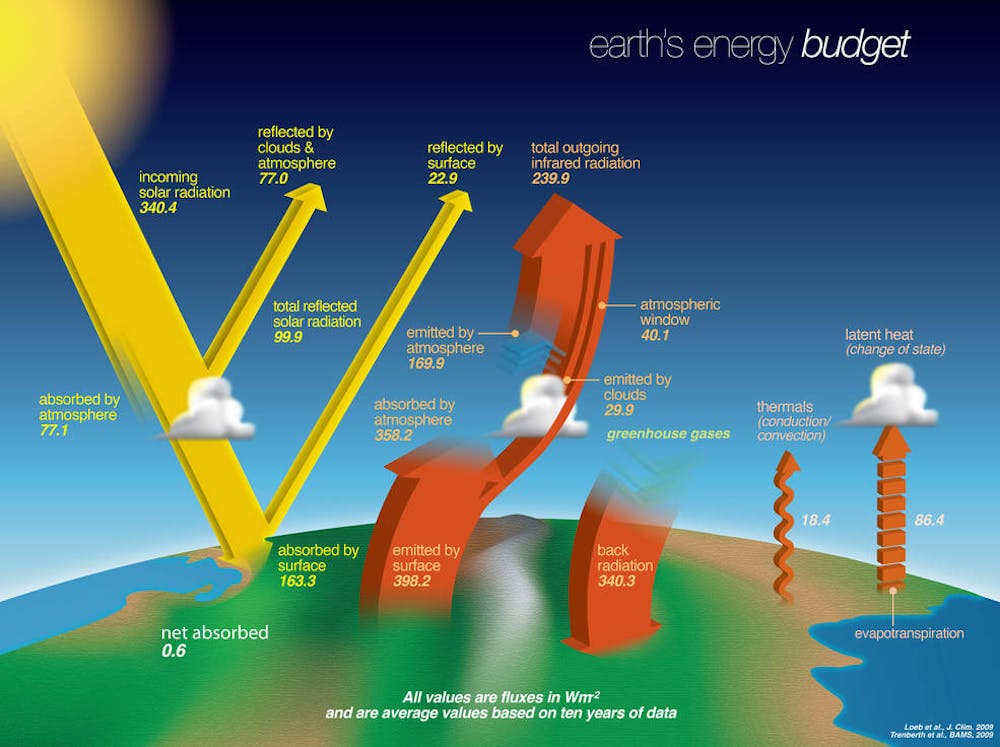 Earth’s energy budget.
NASA[6]
Earth’s energy budget.
NASA[6]
The atmosphere absorbs a lot of energy and emits it as radiation both into space and back down to the planet’s surface. In fact, Earth’s surface gets almost twice as much radiation from the atmosphere as it does from direct sunshine. That’s primarily because the Sun heats the surface only during the day, while the warm atmosphere is up there 24/7.
Together, the energy reaching Earth’s surface from the Sun and from the atmosphere is about 504 watts per square meter. Earth’s surface emits about 79% of that back out. The remaining surface energy goes into evaporating water and warming the air, oceans and land.
The tiny residual between incoming sunshine and outgoing infrared is due to the accumulation of greenhouse gases[7] like carbon dioxide in the air. These gases are transparent to sunlight but opaque to infrared rays[8] – they absorb and emit a lot of infrared rays back down.
Earth’s surface temperature must increase in response until the balance between incoming and outgoing radiation is restored.
Another look at Earth’s energy budget. Credit: California Academy of SciencesWhat does this mean for global temperatures?
Doubling of carbon dioxide would add 3.7 watts of heat to every square meter[9] of the Earth. Imagine old-fashioned incandescent night lights spaced every 3 feet over the entire world, left on forever.
At the current rate of emissions, greenhouse gas levels would double from preindustrial levels by the middle of the century.
Climate scientists calculate that adding this much heat to the world would warm Earth’s climate by about 5 degrees Fahrenheit (3 C)[10]. Preventing this would require replacing fossil fuel combustion, the leading source of greenhouse gas emissions, with other forms of energy.
[Over 100,000 readers rely on The Conversation’s newsletter to understand the world. Sign up today[11].]
References
- ^ Scientists like me (scholar.google.com)
- ^ measuring the Earth’s energy budget (www.tandfonline.com)
- ^ Intergovernmental Panel on Climate Change report (www.ipcc.ch)
- ^ is conducted upward from the Earth’s interior (agupubs.onlinelibrary.wiley.com)
- ^ planet receives 340.4 watts of sunshine per square meter (www.nasa.gov)
- ^ NASA (www.nasa.gov)
- ^ greenhouse gases (www.sciencedirect.com)
- ^ transparent to sunlight but opaque to infrared rays (earthobservatory.nasa.gov)
- ^ 3.7 watts of heat to every square meter (agupubs.onlinelibrary.wiley.com)
- ^ would warm Earth’s climate by about 5 degrees Fahrenheit (3 C) (climate-dynamics.org)
- ^ Sign up today (theconversation.com)