4 ways college students can make the most of their college library
- Written by: Carrie M. Macfarlane, Director of Research and Instruction, Middlebury
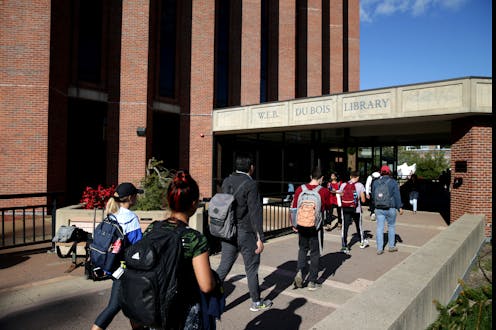
If you’re a student about to go to college, then perhaps you’ve scanned college orientation websites and social media feeds for glimpses of your new life. As a college librarian[1], I believe you should explore your college library, too.
This is based on countless discussions I’ve had with graduating college seniors who told me they regret they didn’t learn more about the library back in their first year of college. To help students avoid a similar fate, here are four things to know about libraries now.
1. Libraries can save you money on course readings
According to the College Board, colleges estimate that students spend approximately $1,200 per year on books and supplies[2]. Students can cut down on that cost by borrowing books from the library instead of purchasing them from a bookstore.
Library staff work hard to make textbooks more affordable[3]. One of the things we’re doing is putting assigned readings on reserve.
What’s “reserve”? It’s a place where we keep course materials that faculty request for their classes. The print reserves collection is for physical books and, in some cases, printed “coursepacks” – which are photocopies of readings that have been bound together like a paperback book. Usually you’ll be able to check out reserve items for a few hours at a time. Sometimes the library will have several copies of each title.
In most libraries you’ll find print reserves at the circulation desk. The circulation desk is the place where all books are checked out, and it’s usually near the library entrance.
Many libraries also offer electronic reserves, with e-books and digital copies of book chapters and journal articles. You’ll usually find a link to electronic reserves on the library homepage.
Not all faculty members use reserves, so you’ll need to sleuth out how to find books and articles elsewhere in the library, too. Go to the library website and look for a link to the catalog, where you’ll find the titles and locations of all the books that the library owns.
For articles, look instead for links to journal indexes and databases. Unfortunately, these may be labeled with a variety of different names. You can always ask a librarian for advice.
2. Using the library can help you earn better grades
Research has shown that students who use the library tend to have higher GPAs than those who don’t[4]. For this reason, it’s helpful to overcome any library anxiety[5] – a term that describes the discomfort some people experience when they imagine walking into a library that is larger or more complex than any to which they are accustomed.
One of the best ways to overcome library anxiety is to get to know the library staff. Librarians regularly teach students how to find and use library resources. Educators who analyze student outcomes have found that making connections with staff and faculty bolsters students’ social capital, and social capital helps students succeed[6]. Social capital is an asset that you earn by having a connection with another person.
Most librarians are accessible via email, chat or in person.
3. Libraries offer ideas for study breaks
Studying all night might seem efficient, but it doesn’t always work. Cognitive science says that when you memorize something, then set it aside, you’re helping your brain absorb the new information[7]. You can start to envision potential study breaks at the library now.
Browse the library events calendar for yoga classes and stress-management workshops. Search the library catalog for self-help books, graphic novels and blockbuster movies. Follow the library’s social media feed and be alerted to stress-buster activities with board games, crafts and even cuddly puppies.
Since libraries now provide resources and services[8] to promote student well-being[9], it’s easier than ever to take a study break when you’re at the library.
4. Get a job at the library to become a library expert
College can be expensive, even for students who receive financial aid[10]. While some campus jobs make it difficult to carve out enough hours for both homework and paid work[11], library jobs can help you combine these two essential endeavors. When you work at the library, you’ll get paid to learn how to use the library. Then, you can apply what you learn in your classes.
Go to the college’s student employment website to search for part-time jobs at the library. There’s often a lot of competition, so be sure to contact the hiring manager at the library, too. If there aren’t any openings now, ask if your name can be put on a list to be considered for jobs in the future.
Students who work at libraries can list many benefits of their jobs[12]. Students who staff service desks are taught how to use such essential library resources as the library catalog, article databases and interlibrary loan. They become power library users. They often tell me that they’re the go-to experts among their friends.
[Get the best of The Conversation, every weekend. Sign up for our weekly newsletter[13].]
References
- ^ college librarian (theconversation.com)
- ^ $1,200 per year on books and supplies (research.collegeboard.org)
- ^ work hard to make textbooks more affordable (doi.org)
- ^ tend to have higher GPAs than those who don’t (doi.org)
- ^ library anxiety (doi.org)
- ^ social capital helps students succeed (eric.ed.gov)
- ^ helping your brain absorb the new information (www.theguardian.com)
- ^ libraries now provide resources and services (doi.org)
- ^ promote student well-being (doi.org)
- ^ even for students who receive financial aid (pellinstitute.org)
- ^ carve out enough hours for both homework and paid work (doi.org)
- ^ list many benefits of their jobs (doi.org)
- ^ Sign up for our weekly newsletter (theconversation.com)