480 million-year-old fossil spores from Western Australia record how ancient plants spread to land
- Written by: Clinton Foster, Honorary professor, Australian National University
When plants first ventured onto the land, evolving from freshwater-dwelling algae, more than 500 million years ago, they transformed the planet. By drawing carbon dioxide from the air, they cooled Earth, and by eroding rock surfaces they helped build the soil that now covers so much land.
These changes to the planet’s atmosphere and land surface paved the way for the evolution of the biosphere we know. Land plants make up around 80% of Earth’s biomass.
The pioneering plants were small and moss-like, and they had to overcome two big challenges to survive on land: avoiding drying out, and surviving the Sun’s harsh ultraviolet light.
In rock samples from Canning Basin in the north of Western Australia, we have discovered 480 million-year-old fossilised spores from early land plants alongside spores from ancestral water-dwelling algae. These are the oldest land plant spores found, and they give us new clues about when and where plants made the jump to land and also how they managed to survive. The research is published[1] in Science.
When plants colonised land
Estimates of the initial timing of the colonisation of land by plants are based on large fossilised plant remains, calculations of how long it has taken different species to evolve (called “molecular clock[2]” data), and the record of plant spores.
Molecular clock data suggests land colonisation occurred around 515 million years ago (in the Cambrian period), while the earliest plant stem fossils occur around 430 million years ago (in the mid-Silurian period). These early small plants did not have root systems or hard woody tissue, which may explain why their fossil remains are rare.
Read more: The evolution of land plants may have cooled the planet millions of years ago[3]
Alternatively, we can look at the spores of plants. Spores are simple reproductive units that carry genetic material (much simpler than seeds, which did not evolve until much later). For successful reproduction, the spore walls of land plants had to be strong enough to resist drying out and damage from ultraviolet radiation.
These resilient spore walls are also what allows the spores to be preserved for hundreds of millions of years in ancient sediments, and to be extracted from those sediments using strong acids as used in this study. We then studied the shapes of the spores under the microscope.
The shape of spores
The spores of the earliest land plants occur as more or less regular geometrically arranged groups of two or four cells. Such spores and have been found in sediments as old as 465 million years (in the Ordovician period), which places them at least 35 million years before any known larger plant fossils.
However, older spores (from around 505 million years ago) have also been found in the United States. Paul Strother (of Boston College, my co-author on the new Canning Basin research) and his colleagues have shown these older spores are likely to derive from freshwater algae called charophytes.
These older spores occur as irregularly shaped “packets” of cells. These same “packets” of spores also occur in the fossils we found in the Canning Basin, dated to around 25 million years later.
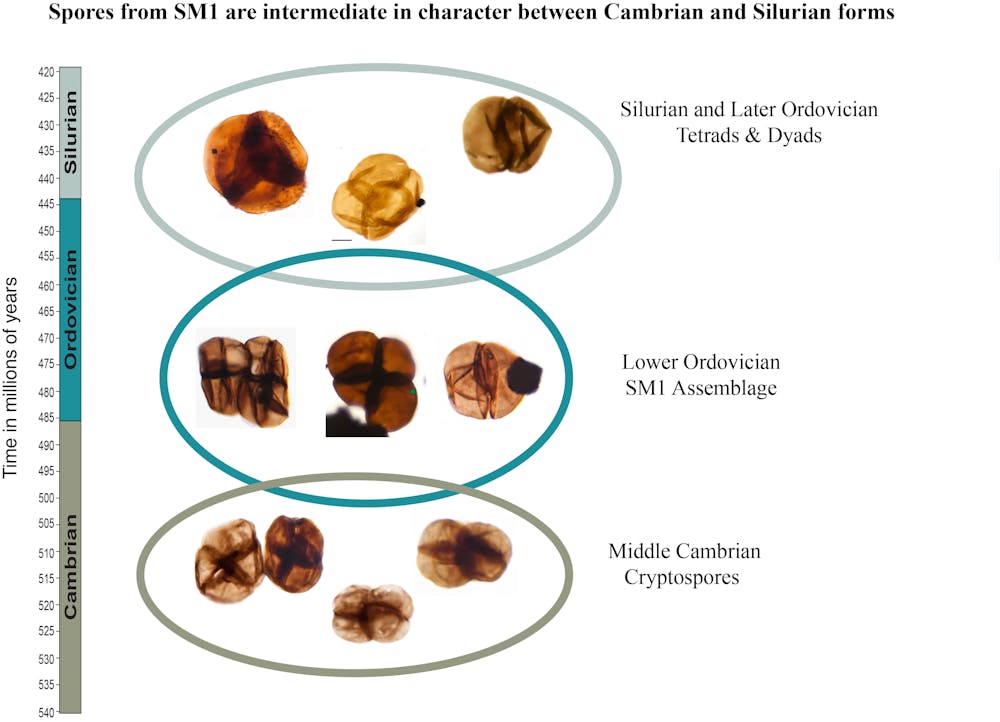 Newly discovered fossil spores (middle) bridge the gap between older (bottom) and newer forms (top).
Paul Strother, Author provided
Newly discovered fossil spores (middle) bridge the gap between older (bottom) and newer forms (top).
Paul Strother, Author provided
Charophyte algae live semi-aquatically. To survive in this situation they developed genes to resist desiccation and the damaging affects of UV.
The earliest land plants either captured parts of that ancestral algal genome, perhaps through “horizontal gene transfer” in which bacteria move genes from one organism to another, or developed similar genes on their own.
Given the time frame of millions of years, it suggests the origin of the land plants did not occur as a singular event. We found both land plant spores, with either two or four cells, and irregularly packaged algal spores in the Canning Basin assemblage, which shows land plants and their algal ancestors existed together in the same area at the same time.
It also shrinks the time gap between estimates of land colonisation from molecular clock data (515 million years ago) and fossil evidence. At around 480 million years old, the Canning Basin record is the oldest yet found anywhere in the world.
Where did land plants get their start?
Our discovery follows from earlier studies of land plant spores in Canning Basin. In 1991 spores dated around 440-445 million years ago[4] were found, and more dated to 460 million years ago[5] were found in 2016.
Those two records were only found after examination of extracts from about 100 core samples in efforts to determine the age of the rock sequences, which shows the spores are rare. The sediments deposited in the Canning Basin in this period are mainly from marine environments, as we can see from shelly fossils and microfossils such as conodonts[6].
Read more: Ancient teeth sharpest to date[7]
The early land plants, like their charophyte algae ancestors, grew in freshwater settings at the fringes of the sea. Spores and sediments were washed into these areas. So the fossil records that have come down to us depend on the geography of the ancient world.
In 2020 Geoscience Australia in collaboration with the Geological Survey of Western Australia drilled a well in the southern part of the Canning Basin to understand the geology of the subsurface rocks. After acid extraction of rock samples from a geological formation called the Nambeet Formation, which dates to the Early Ordovician period (485 million to 470 million years ago), we identified land plant spores with the typical regular arrangements of two or four cells.
As part of that work, we examined preparations of plant spores, already mounted on glass slides, from the original section of the Nambeet Formation drilled in 1958. And here we found the first record of land plant spores associated with spores from their algal ancestors. Our discovery would not have been possible without the access to these earlier materials provide by the WA government.
Further studies are needed to determine where additional algal and land plant spores occur in Australian sediments from the late Cambrian and Ordovician periods. New data may also shed light on where the land plants got their start: was it on this continent, as others have suggested?
The present work has emphasised the importance of access to previous data and materials, and we acknowledge the critical science infrastructure role of curating geological samples and data by the WA government.
References
- ^ published (science.sciencemag.org)
- ^ molecular clock (www.nature.com)
- ^ The evolution of land plants may have cooled the planet millions of years ago (theconversation.com)
- ^ around 440-445 million years ago (www.tandfonline.com)
- ^ dated to 460 million years ago (www.sciencedirect.com)
- ^ conodonts (australian.museum)
- ^ Ancient teeth sharpest to date (theconversation.com)