George Kennan urged American leadership and patience to counter the Soviets. Instead, the Cold War ensued
- Written by: Stephen Hoadley, Associate Professor, University of Auckland
This piece is part of a new series in collaboration with the ABC’s Saturday Extra program. Each week, the show will have a “who am I” quiz for listeners about influential figures who helped shape the 20th century, and we will publish profiles for each one. You can read the other pieces in the series here[1].
George Kennan stands second only to Henry Kissinger as one of the most influential and respected American geo-political thinkers of the mid-20th century.
His greatest achievement was providing the historical and conceptual underpinning of the US resistance to Soviet expansionism during the Cold War. That posture became known as the “Containment Doctrine” and Kennan himself became known as “the Father of Containment[2]”, though he was ambivalent about its subsequent military emphasis.
Kennan’s diplomatic career was substantial but modest. His highest ranks were ambassador to the Soviet Union and Yugoslavia and director of the US State Department’s policy planning staff.
However, he was a quintessential advisor — thoughtful, articulate and persuasive. He attracted the attention and respect of post-war leaders such as the secretaries of state, George Marshall and Dean Acheson, Secretary of the Navy James Forrestal, and ultimately President Harry Truman, as they steered the US from collaboration to conflict with the USSR in the period from 1945–50.
One of America’s few true Soviet experts
A Yale education, a studious nature, and years of service in the Moscow embassy made Kennan one of America’s few true experts on Soviet affairs.
In 1946, as acting ambassador (charge d'affaires), Kennan drafted his now famous “long telegram[3]” to Washington.
He argued that the insecure Soviet leaders would relentlessly pursue expansionist policies to retain power and fulfil their communist dogma. They would use ideological proselytising, espionage, and the subversion of neighbouring states to achieve this — not only by military means, but also through economic coercion.
This warning was not welcomed by American and European liberals and optimists who hoped to continue wartime collaboration, or at least peaceful coexistence, with the Soviets. But Kennan’s advice convinced the leaders of the departments of state, war and navy (defence after 1948) — as well as the Truman administration — that a US response to Russia’s outreach was urgently needed.
Popular awareness of the Soviet threat was heightened when Kennan expanded his telegram into an article in 1947 entitled The Sources of Soviet Conduct[4] for Foreign Affairs, America’s premier foreign policy journal. Kennan signed it “X” to deflect speculation that it articulated official US policy, although it soon became so. Its principal theme was clear:
The main element of any United States policy toward the Soviet Union must be that of a long-term, patient but firm and vigilant containment of Russian expansive tendencies.
Leading media commentators amplified and popularised Kennan’s analysis. Public opinion soon crystallised into the Cold War mindset of suspicion of all things Soviet.
How Kennan envisioned ‘containment’
Soviet actions following the second world war seemed to bear out Kennan’s warning. These included clandestine support of communist parties in Italy and France, aid to insurgents in Turkey and Greece, subversion of Czechoslovakia’s democratic government, and the blockade of West Berlin.
Mao Zedong’s communist victory in China in 1949 was supported by then-Soviet leader Joseph Stalin, as was North Korea’s attack on South Korea in 1950.
So, Kennan’s diagnosis of Soviet expansionism was timely. It was widely adopted by American leaders and the public, and in Europe and Asia, as well.
But what was his policy prescription? Kennan avoided impulsive solutions, such as confrontation and counter-attack, which were advocated by hawkish leaders. Instead, he recommended vigilance and defensive firmness.
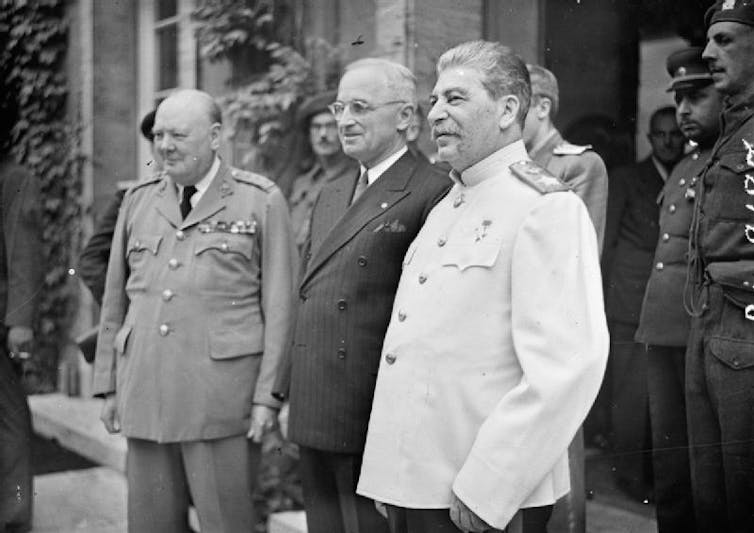 (From left) Winston Churchill, Harry Truman and Joseph Stalin at the Potsdam conference in July 1945.
Imperial War Museums/Wikimedia Commons
(From left) Winston Churchill, Harry Truman and Joseph Stalin at the Potsdam conference in July 1945.
Imperial War Museums/Wikimedia Commons
His preference was to build the economic strength of the US and its allies. This would reduce the appeal of communist command economics in the countries outside the Soviet bloc. It would also project an attractive example of the success of western liberal democratic and free market systems.
This is what became known as “containment”, or preventing Soviet expansionism through not only military strength but also superior economic achievement and diplomatic leadership. This, and sensitive diplomacy, would enhance America’s global leadership.
Military responses might sometimes be necessary, Kennan acknowledged, but this would be secondary to economic and diplomatic responses. The ultimate outcome of this containment policy, he surmised, would be the intensification of tensions and contradictions within the Soviet system and its eventual collapse.
In fact, this occurred in 1991, and the Cold War never escalated into another global conflict.
Read more: Speaking with: Tony Kevin on his return to Moscow and the new Cold War with Russia[5]
The Truman Doctrine
The Truman administration initially applied Kennan’s prescriptions. In 1947, in what became known as the Truman Doctrine[6], the US extended aid to Greece and Turkey and Secretary of State George Marshall unveiled the European Recovery Program (more popularly known as the Marshall Plan) as a way of diluting creeping Soviet influence in western European countries.
Two years later, Truman also announced a plan of economic aid to poor countries called the Point Four Program[7], which became a fixture of US economic diplomacy.
However, Soviet military initiatives in Eastern Europe, the Middle East, and Asia, as well as the Soviets’ testing of an atomic bomb in 1949, brought a policy shift in the direction of US military preparedness.
Read more: World politics explainer: The Great War (WWI)[8]
Paul Nitze, Kennan’s successor as director of the State Department’s policy planning staff, drafted a top-secret national security memorandum[9] in 1950 that inspired an increasingly hawkish posture by US leaders and legitimised an American military build-up to deter further Soviet threats.
Alliances with European and Asian partners followed. And the Cold War, marked by proxy wars and the nuclear arms race, emerged as the dominant geo-political feature of the next four decades.
At this point, Kennan demurred. He advised against military responses and arms build-ups, regarding them as unnecessarily provocative and risky. But his admonitions failed to resonate amid the anti-communist hysteria that swept the US in the early 1950s, exploited by Senator Joseph McCarthy and the “witch hunts” that ensued.
Kennan’s reputation was overshadowed not only by events such as the Korean and Vietnam wars — both of which he criticised — but also by Kissinger’s rise to prominence.
Kennan’s writings were discounted by “realists” as too abstract to be of use to decision-makers facing day-to-day challenges. Among hawks, he was thought to be too accommodating to enemies when he advocated “disengagement”, that is, yielding on certain US interests to avoid confrontations with the Soviets or Chinese.
After his final posting, Kennan retired from the State Department and began a scholarly life attached to the Princeton Institute for Advanced Study[10]. There, he wrote thoughtful books and articles on American diplomacy and security.
Read more: How Andrei Sakharov went from Soviet hero to dissident — and forced the world to pay attention to human rights[11]
How is Kennan relevant today?
Is Kennan relevant today? I believe three of his themes apply to the current US strategic rivalry with China and Russia.
First, Kennan counselled officials to study and respect US rivals, not just oppose them blindly and reactively.
Second, he had faith that judicious compromises would facilitate coexistence with adversaries with minimum cost and risk of war.
Third, he advocated setting an example of US strength through economic achievement and diplomatic leadership, rather than relying on military muscle.
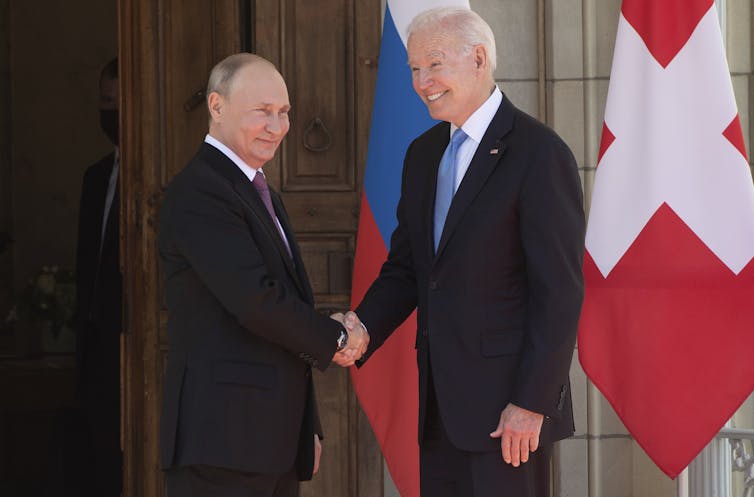 Biden is so far taking a similar approach to Kennan in his dealings with Russia.
Saul Loeb/Pool AFP
Biden is so far taking a similar approach to Kennan in his dealings with Russia.
Saul Loeb/Pool AFP
The Biden administration is thus far acting in accordance with Kennan’s themes: seeking engagement with Russia and China from a position of reinvigorated American economic strength, commitment to liberal principles, and international cooperation. Kennan, in fact, would likely approve of Biden’s promises in his inaugural address[12]:
“We will lead not merely by the example of our power, by the power of our example.”
References
- ^ here (theconversation.com)
- ^ the Father of Containment (www.ket.org)
- ^ long telegram (digitalarchive.wilsoncenter.org)
- ^ The Sources of Soviet Conduct (www.foreignaffairs.com)
- ^ Speaking with: Tony Kevin on his return to Moscow and the new Cold War with Russia (theconversation.com)
- ^ Truman Doctrine (history.state.gov)
- ^ Point Four Program (en.wikipedia.org)
- ^ World politics explainer: The Great War (WWI) (theconversation.com)
- ^ top-secret national security memorandum (en.wikipedia.org)
- ^ Princeton Institute for Advanced Study (www.ias.edu)
- ^ How Andrei Sakharov went from Soviet hero to dissident — and forced the world to pay attention to human rights (theconversation.com)
- ^ his inaugural address (www.theweek.in)