Students are returning to school with anxiety, grief and gaps in social skills – will there be enough school mental health resources?
- Written by: Sandra M. Chafouleas, Professor of Educational Psychology, University of Connecticut
Even before COVID-19, as many as 1 in 6[1] young children had a diagnosed mental, behavioral or developmental disorder. New findings suggest a doubling of rates[2] of disorders such as anxiety and depression among children and adolescents during the pandemic. One reason is that children’s well-being is tightly connected to family and community conditions[3] such as stress and financial worries.
Particularly for children living in poverty, there are practical obstacles[4], like transportation and scheduling, to accessing mental health services. That’s one reason school mental health professionals[5] – who include psychologists, counselors and social workers – are so essential.
As many kids resume instruction this fall, schools can serve as critical access points for mental health services[6]. But the intensity of challenges students face coupled with school mental health workforce shortages[7] is a serious concern.
Key issues
As school psychology professors[8] who train future school psychologists[9], we are used to requests by K-12 schools for potential applicants to fill their open positions. Never before have we received this volume of contacts regarding unfilled positions[10] this close to the start of the school year.
As researchers on school mental health, we believe this shortage is a serious problem given the increase in mental health challenges, such as anxiety, gaps in social skills and grief, that schools can expect to see in returning students.
Anxiety should be expected given current COVID-related[11] uncertainties. However, problems arise when those fears or worries prevent children from being able to complete the expected tasks of everyday life.
Meanwhile, school closures and disruptions have led to lost opportunities for students to build social skills. A McKinsey & Co. analysis found[12] the pandemic set K-12 students back by four to five months, on average, in math and reading during the 2020-2021 school year. Learning loss also extends to social skills. These losses may be particularly profound for the youngest students[13], who may have missed developmental opportunities such as learning to get along with others.
And it’s important to remember the sheer number of children under 18 who have lost a loved one during the pandemic. A study published in July 2021 estimates that more than 1 out of every 1,000 children in the U.S.[14] lost a primary caregiver due to COVID-19.
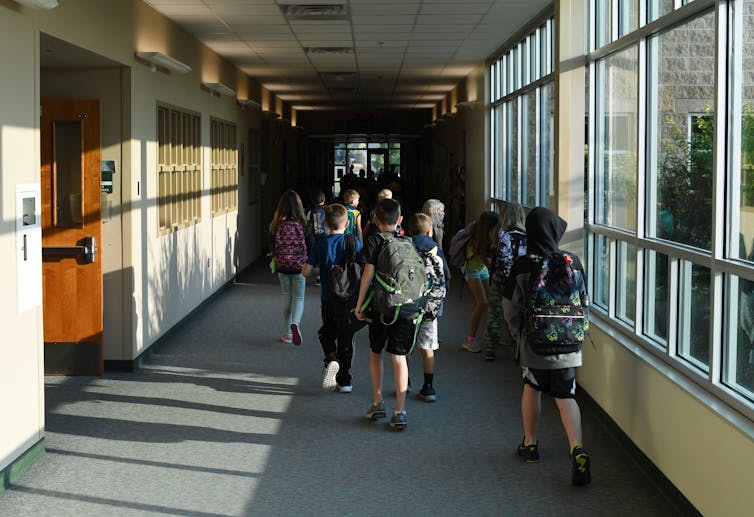 Schools can help kids and their families get mental health support they might not otherwise have access to.
RJ Sangosti/MediaNews Group/The Denver Post via Getty Images[15]
Schools can help kids and their families get mental health support they might not otherwise have access to.
RJ Sangosti/MediaNews Group/The Denver Post via Getty Images[15]
Hiring more school psychologists
Hiring more school psychologists may not be simple. The National Association of School Psychologists[16] recommends a ratio of 1 psychologist for every 500 students. Yet current estimates suggest a national ratio of 1-to-1,211. It’s like having to teach a class of 60 instead of 25 students.
Shortages are particularly severe[17] in rural regions. There are also not enough culturally and linguistically diverse[18] school psychologists.
Scarcity of school mental health personnel affects important student outcomes from disciplinary incidents to on-time graduation rates – especially for students attending schools in high-poverty communities[19].
To address these shortages, legislators have proposed federal bills[20] that aim to expand the school mental health workforce. Meanwhile, local school districts and state education agencies[21] are using American Rescue Plan funds to increase mental health training, hire additional mental health staff or contract with community mental health agencies.
Preparing all school personnel
We believe increasing the number of mental health providers in schools is important. Workforce increases, however, must be coupled with attention to readying all school personnel to cope with students’ anxiety, grief and gaps in social skills.
For example, when it comes to anxiety, schools can help students build both tolerance of uncertainty and coping skills[22] through strategies such as seeking support, positive reframing[23], humor and acceptance. School mental health professionals can train other staff members on simple strategies to use in a nurturing relationship. Long-term benefits such as sense of belonging can happen when each student has an informal mentoring relationship[24] that offers emotional nurturance and practical help.
More schools have adopted social-emotional learning curriculums[25] in recent years. However, additional time may be needed to teach and reinforce basic skills such as taking turns and sharing.
In addition, school mental health personnel can assist with defining a clear process for identifying who needs help, and be ready to share resources about grief[26] and how kids respond[27] to loss.
Partnering with families and communities
Even with these efforts, schools cannot be expected to identify and meet all young people’s mental health needs. Strong partnerships with families and communities are critical.
Seeking input from families may offer valuable information about student experiences. This might be done, for example, by adding questions[28] to beginning-of-the-year student forms. Knowing how families are experiencing loss or insecurities, for example, can help school mental health personnel plan for and target supports.
The youth mental health crisis[29] requires a comprehensive response. We believe the priority should be ensuring equitable access to a mental health professional through school settings.
[Get the best of The Conversation, every weekend. Sign up for our weekly newsletter[30].]
References
- ^ 1 in 6 (www.cdc.gov)
- ^ doubling of rates (www.doi.org)
- ^ community conditions (doi.org)
- ^ practical obstacles (doi.org)
- ^ school mental health professionals (www.schoolmentalhealth.org)
- ^ critical access points for mental health services (doi.org)
- ^ shortages (www.nasponline.org)
- ^ school psychology professors (scholar.google.com)
- ^ train future school psychologists (scholar.google.com)
- ^ unfilled positions (www.ctreap.net)
- ^ COVID-related (www.sciencemag.org)
- ^ McKinsey & Co. analysis found (www.mckinsey.com)
- ^ youngest students (www.wsj.com)
- ^ more than 1 out of every 1,000 children in the U.S. (doi.org)
- ^ RJ Sangosti/MediaNews Group/The Denver Post via Getty Images (www.gettyimages.com)
- ^ National Association of School Psychologists (www.nasponline.org)
- ^ particularly severe (www.nasponline.org)
- ^ culturally and linguistically diverse (www.nasponline.org)
- ^ high-poverty communities (doi.org)
- ^ proposed federal bills (www.nasponline.org)
- ^ state education agencies (www.ed.gov)
- ^ tolerance of uncertainty and coping skills (psycnet.apa.org)
- ^ positive reframing (sdlab.fas.harvard.edu)
- ^ mentoring relationship (www.doi.org)
- ^ social-emotional learning curriculums (doi.org)
- ^ resources about grief (www.unicef.org)
- ^ how kids respond (health.tki.org.nz)
- ^ adding questions (csch.uconn.edu)
- ^ youth mental health crisis (www.sciencedaily.com)
- ^ Sign up for our weekly newsletter (theconversation.com)