How would planting 8 billion trees every year for 20 years affect Earth's climate?
- Written by: Karen D. Holl, Professor of Restoration Ecology, University of California, Santa Cruz
 Curious Kids[1] is a series for children of all ages. If you have a question you’d like an expert to answer, send it to curiouskidsus@theconversation.com[2].
If we planted 8 billion trees a year for 20 years, what would happen on Earth? – Shivam K., age 14, Nawada, Bihar, India
Politicians[3], business leaders, YouTubers[4] and celebrities[5] are calling for the planting of millions, billions or even trillions of trees to slow climate change.
There are currently almost 8 billion people on Earth[6]. If every single person planted a tree each year for the next 20 years, that would mean roughly 160 billion new trees.
Could massive tree planting actually slow climate change?
Trees and carbon
Carbon dioxide is the main gas that causes global warming[7]. Through photosynthesis[8], trees and other plants transform carbon dioxide from the atmosphere into carbohydrates, which they use to make stems, leaves and roots.
The amount of carbon a tree can store varies a great deal. It depends on the tree species, where it is growing and how old it is.
Let’s say the average tree takes up 50 pounds of carbon dioxide a year[9]. If a person planted a tree every year for 20 years – and each one survived, which is highly unlikely – those 20 trees would take up about 1,000 pounds, or half a ton, of carbon dioxide per year.
The average person in the United States produces a whopping 15.5 tons of carbon dioxide[10] a year compared with 1.9 tons for an average person in India[11]. This means that if each person in the U.S. planted one tree per year it would offset only about 3% of the carbon dioxide they produce each year, after all 20 trees had matured. But, it would offset 26% for somebody in India.
Planting trees is certainly part of the solution to climate change, but there are more important ones.
Curious Kids[1] is a series for children of all ages. If you have a question you’d like an expert to answer, send it to curiouskidsus@theconversation.com[2].
If we planted 8 billion trees a year for 20 years, what would happen on Earth? – Shivam K., age 14, Nawada, Bihar, India
Politicians[3], business leaders, YouTubers[4] and celebrities[5] are calling for the planting of millions, billions or even trillions of trees to slow climate change.
There are currently almost 8 billion people on Earth[6]. If every single person planted a tree each year for the next 20 years, that would mean roughly 160 billion new trees.
Could massive tree planting actually slow climate change?
Trees and carbon
Carbon dioxide is the main gas that causes global warming[7]. Through photosynthesis[8], trees and other plants transform carbon dioxide from the atmosphere into carbohydrates, which they use to make stems, leaves and roots.
The amount of carbon a tree can store varies a great deal. It depends on the tree species, where it is growing and how old it is.
Let’s say the average tree takes up 50 pounds of carbon dioxide a year[9]. If a person planted a tree every year for 20 years – and each one survived, which is highly unlikely – those 20 trees would take up about 1,000 pounds, or half a ton, of carbon dioxide per year.
The average person in the United States produces a whopping 15.5 tons of carbon dioxide[10] a year compared with 1.9 tons for an average person in India[11]. This means that if each person in the U.S. planted one tree per year it would offset only about 3% of the carbon dioxide they produce each year, after all 20 trees had matured. But, it would offset 26% for somebody in India.
Planting trees is certainly part of the solution to climate change, but there are more important ones.
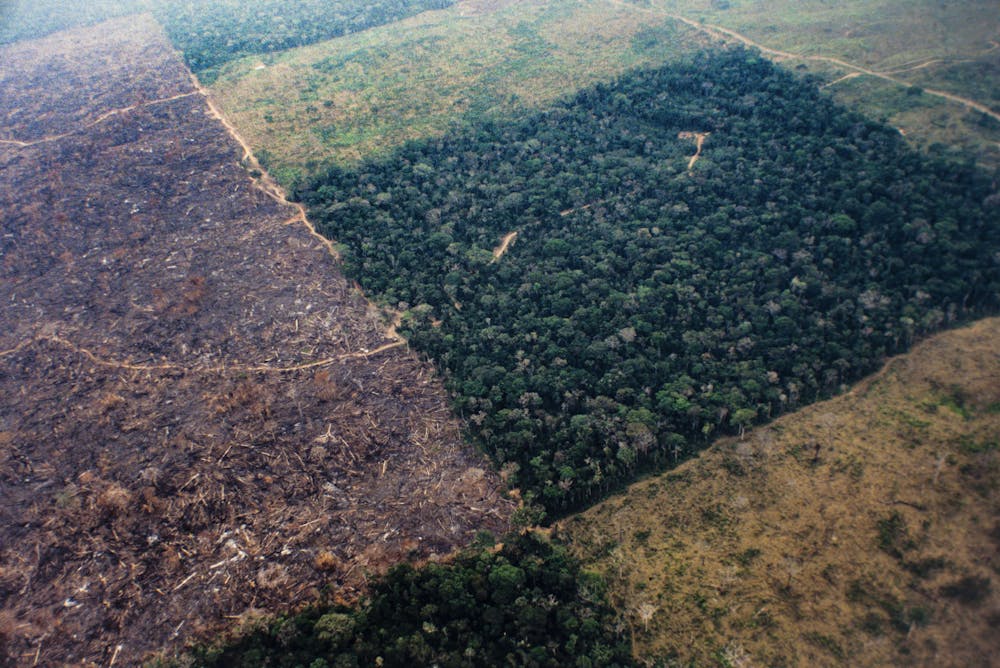 Clearing the Amazon rainforest for livestock farms in Brazil in 2017.
Brazil Photos/LightRocket via Getty Images[12]
Protecting the trees we have
There are about 3 trillion trees on Earth[13], which is only half as many as 12,000 years ago, at the start of human civilization[14].
People cut down an estimated 15 billion trees each year[15]. A lot of those trees are in tropical forests, but deforestation is happening all over the planet[16].
Protecting existing forests makes sense. Not only do they absorb carbon dioxide in the trees and the soil, but they provide habitat for animals. Trees can provide firewood and fruit for people. In cities, they can offer shade and recreational spaces.
But trees should not be planted where they didn’t grow before, such as in native grasslands[17] or savannas[18]. These ecosystems provide important habitat for their own animals and plants – and already store carbon if they are left undisturbed.
Doing more
To slow climate change, people need to do much more than plant trees. Humans need to reduce their carbon dioxide and other greenhouse gas emissions quickly by transitioning to renewable energy sources[19], like solar and wind. People should also reduce the amount they drive and fly[20] – and eat less meat, as meat has a much larger carbon footprint per calorie than grains and vegetables[21].
It is important that everybody – businesses, politicians, governments, adults and even kids – do what they can to reduce fossil fuel emissions. I know it can seem pretty overwhelming to think about what you as one person can do to help the planet. Fortunately, there are many options.
Volunteer with a local conservation organization, where you can help protect and restore local habitats. Discuss with your family new lifestyle choices, like biking, walking or taking public transit rather than driving.
Two Girl Scouts take a stand against deforestation.And don’t be afraid to lead an effort to protect trees, locally or globally. Two 11-year-old Girl Scouts, concerned about the destruction of rainforests for palm oil plantations, led an effort to eliminate palm oil in Girl Scout cookies[22].
Sometimes change is slow[23], but together people can make it happen.
Hello, curious kids! Do you have a question you’d like an expert to answer? Ask an adult to send your question to CuriousKidsUS@theconversation.com[24]. Please tell us your name, age and the city where you live.
And since curiosity has no age limit – adults, let us know what you’re wondering, too. We won’t be able to answer every question, but we will do our best.
Clearing the Amazon rainforest for livestock farms in Brazil in 2017.
Brazil Photos/LightRocket via Getty Images[12]
Protecting the trees we have
There are about 3 trillion trees on Earth[13], which is only half as many as 12,000 years ago, at the start of human civilization[14].
People cut down an estimated 15 billion trees each year[15]. A lot of those trees are in tropical forests, but deforestation is happening all over the planet[16].
Protecting existing forests makes sense. Not only do they absorb carbon dioxide in the trees and the soil, but they provide habitat for animals. Trees can provide firewood and fruit for people. In cities, they can offer shade and recreational spaces.
But trees should not be planted where they didn’t grow before, such as in native grasslands[17] or savannas[18]. These ecosystems provide important habitat for their own animals and plants – and already store carbon if they are left undisturbed.
Doing more
To slow climate change, people need to do much more than plant trees. Humans need to reduce their carbon dioxide and other greenhouse gas emissions quickly by transitioning to renewable energy sources[19], like solar and wind. People should also reduce the amount they drive and fly[20] – and eat less meat, as meat has a much larger carbon footprint per calorie than grains and vegetables[21].
It is important that everybody – businesses, politicians, governments, adults and even kids – do what they can to reduce fossil fuel emissions. I know it can seem pretty overwhelming to think about what you as one person can do to help the planet. Fortunately, there are many options.
Volunteer with a local conservation organization, where you can help protect and restore local habitats. Discuss with your family new lifestyle choices, like biking, walking or taking public transit rather than driving.
Two Girl Scouts take a stand against deforestation.And don’t be afraid to lead an effort to protect trees, locally or globally. Two 11-year-old Girl Scouts, concerned about the destruction of rainforests for palm oil plantations, led an effort to eliminate palm oil in Girl Scout cookies[22].
Sometimes change is slow[23], but together people can make it happen.
Hello, curious kids! Do you have a question you’d like an expert to answer? Ask an adult to send your question to CuriousKidsUS@theconversation.com[24]. Please tell us your name, age and the city where you live.
And since curiosity has no age limit – adults, let us know what you’re wondering, too. We won’t be able to answer every question, but we will do our best.
References
- ^ Curious Kids (theconversation.com)
- ^ curiouskidsus@theconversation.com (theconversation.com)
- ^ Politicians (www.doi.gov)
- ^ business leaders, YouTubers (www.businessinsider.com)
- ^ celebrities (www.vogue.co.uk)
- ^ 8 billion people on Earth (www.census.gov)
- ^ that causes global warming (www.c2es.org)
- ^ photosynthesis (photosynthesiseducation.com)
- ^ 50 pounds of carbon dioxide a year (www.tenmilliontrees.org)
- ^ produces a whopping 15.5 tons of carbon dioxide (www.worldometers.info)
- ^ 1.9 tons for an average person in India (www.worldometers.info)
- ^ Brazil Photos/LightRocket via Getty Images (www.gettyimages.com)
- ^ 3 trillion trees on Earth (www.scientificamerican.com)
- ^ half as many as 12,000 years ago, at the start of human civilization (www.nature.com)
- ^ 15 billion trees each year (www.nationalgeographic.com)
- ^ all over the planet (www.globalforestwatch.org)
- ^ grasslands (www.ducksters.com)
- ^ savannas (www.ducksters.com)
- ^ renewable energy sources (www.ducksters.com)
- ^ reduce the amount they drive and fly (www.nationalgeographic.org)
- ^ as meat has a much larger carbon footprint per calorie than grains and vegetables (www.gokid.mobi)
- ^ led an effort to eliminate palm oil in Girl Scout cookies (www.speakingchange.org)
- ^ change is slow (www.gssne.org)
- ^ CuriousKidsUS@theconversation.com (theconversation.com)