Safety net policies are helping reduce the number of Americans below the poverty line – but that's not the whole story
- Written by: Elena Delavega, Associate Professor of Social Work, University of Memphis
 CC BY-ND[1]
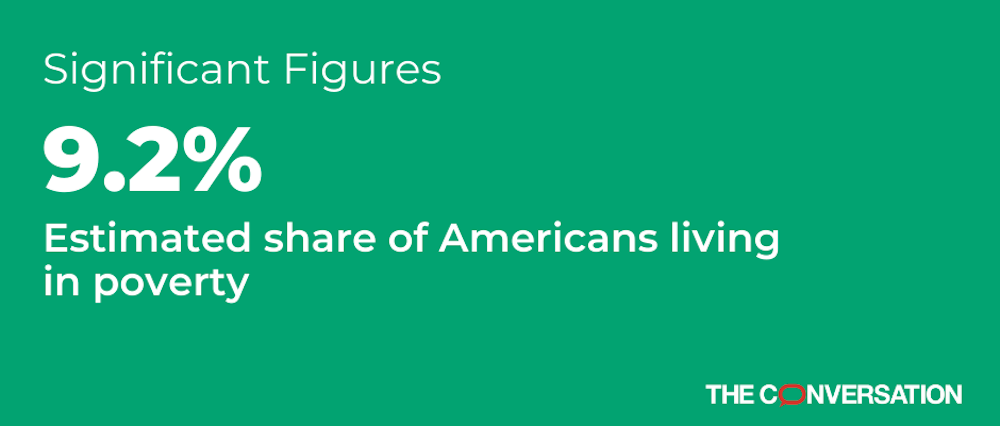
The share of Americans living in poverty shrank to an estimated 9.2% in 2020, according to the Urban Institute[2], a think tank that closely tracks this rate with a widely used model[3]. There were 29.3 million Americans living below the poverty line[4], the institute’s researchers found. Another 10.3 million appear to have been kept out of poverty through government efforts to cushion the blows from massive economic upheaval triggered by the COVID-19 pandemic[5].
This new estimate contradicts many[6] prior predictions[7] and is significantly lower than the 10.5% of the U.S. population[8] the U.S. Census Bureau said was in poverty in 2019, the most recent official data available. If confirmed when the government agency releases official 2020 numbers in September[9], it would signal that that the coronavirus didn’t interrupt a gradual decline in poverty[10]. The rate has been falling since 2010, when it stood at 15.1%.
It makes sense if you find this news surprising.
There were massive job losses when coronavirus-related lockdowns began in 2020[11], particularly among workers without a college degree, who typically earn lower incomes[12]. And as of July 2021, the U.S. jobless rate was 5.4%, well above the 3.5% rate seen in February 2020[13].
Poverty declined even though fewer people were employed[14] because the government stepped up, strengthening the safety net. It halted evictions[15], gave workers who lost their jobs larger unemployment benefits[16], bolstered the Supplemental Nutrition Assistance Program[17] and adopted other policies to assist people facing economic hardship.
Notably, the Internal Revenue Service began to distribute a series of COVID-19 relief and stimulus payments[18] to all but the wealthiest Americans.
Not so straightforward
While on the surface this appears to be good news, as a scholar who researches poverty[19], I believe the situation is much more complex than it appears.
First, the way the government measures poverty[20] is outdated[21].
It does adjust the poverty line for inflation, but poverty today looks very different[22] from what it was like back when statistician Mollie Orshansky[23] based the government’s initial poverty calculation in the early 1960s on 1950s data that suggested people spend one-third of their budget on food. She was figuring out not how much money people needed to thrive, but rather the point below which people would starve. Nor was she trying to devise an indicator to be used in policymaking[24].
There were issues with this formula [25] from the beginning. For one thing, food prices vary from place to place, causing regional differences in how much it costs to put food on the table. For another, families differ in terms of what they need to eat.
Many researchers have found[26] that any family of four living on less than about twice the poverty threshold, which stood at $25,750 in 2019[27], would have trouble making ends meet. The Census Bureau itself calculates a Supplemental Poverty Measure[28], which finds somewhat more people living in poverty than through its original method. The Department of Health and Human Services sets its own federal poverty guidelines[29], which are about the same as the official poverty thresholds. Eligibility for SNAP and other benefits for low-income people[30] is often pegged well above this minimum.
Food insecurity grew
Another reason to not get too excited about a lower 2020 poverty rate is that the share of Americans experiencing food insecurity[31], meaning that they couldn’t get enough of the food needed for a balanced diet, rose to an estimated 13.9% in 2020 from 10.9% in 2019[32].
This increase could be unrelated to income. Many people had new transportation challenges[33], and numerous families had a hard time replacing the food their children would ordinarily consume at school[34], despite government efforts to avoid that problem[35].
It could also indicate that many people scrimped on food to meet other basic needs.
[Over 100,000 readers rely on The Conversation’s newsletter to understand the world. Sign up today[36].]
That’s because more low-income Americans[37] get assistance through a food bank[38] or food pantry as opposed to programs that help them pay their rent[39] or keep up with their car loans[40].
This discrepancy is another reason I believe the government needs to improve how it measures poverty. Something doesn’t add up when there are more Americans who cannot get enough of the food they need than there are living below the poverty line.
CC BY-ND[1]
The share of Americans living in poverty shrank to an estimated 9.2% in 2020, according to the Urban Institute[2], a think tank that closely tracks this rate with a widely used model[3]. There were 29.3 million Americans living below the poverty line[4], the institute’s researchers found. Another 10.3 million appear to have been kept out of poverty through government efforts to cushion the blows from massive economic upheaval triggered by the COVID-19 pandemic[5].
This new estimate contradicts many[6] prior predictions[7] and is significantly lower than the 10.5% of the U.S. population[8] the U.S. Census Bureau said was in poverty in 2019, the most recent official data available. If confirmed when the government agency releases official 2020 numbers in September[9], it would signal that that the coronavirus didn’t interrupt a gradual decline in poverty[10]. The rate has been falling since 2010, when it stood at 15.1%.
It makes sense if you find this news surprising.
There were massive job losses when coronavirus-related lockdowns began in 2020[11], particularly among workers without a college degree, who typically earn lower incomes[12]. And as of July 2021, the U.S. jobless rate was 5.4%, well above the 3.5% rate seen in February 2020[13].
Poverty declined even though fewer people were employed[14] because the government stepped up, strengthening the safety net. It halted evictions[15], gave workers who lost their jobs larger unemployment benefits[16], bolstered the Supplemental Nutrition Assistance Program[17] and adopted other policies to assist people facing economic hardship.
Notably, the Internal Revenue Service began to distribute a series of COVID-19 relief and stimulus payments[18] to all but the wealthiest Americans.
Not so straightforward
While on the surface this appears to be good news, as a scholar who researches poverty[19], I believe the situation is much more complex than it appears.
First, the way the government measures poverty[20] is outdated[21].
It does adjust the poverty line for inflation, but poverty today looks very different[22] from what it was like back when statistician Mollie Orshansky[23] based the government’s initial poverty calculation in the early 1960s on 1950s data that suggested people spend one-third of their budget on food. She was figuring out not how much money people needed to thrive, but rather the point below which people would starve. Nor was she trying to devise an indicator to be used in policymaking[24].
There were issues with this formula [25] from the beginning. For one thing, food prices vary from place to place, causing regional differences in how much it costs to put food on the table. For another, families differ in terms of what they need to eat.
Many researchers have found[26] that any family of four living on less than about twice the poverty threshold, which stood at $25,750 in 2019[27], would have trouble making ends meet. The Census Bureau itself calculates a Supplemental Poverty Measure[28], which finds somewhat more people living in poverty than through its original method. The Department of Health and Human Services sets its own federal poverty guidelines[29], which are about the same as the official poverty thresholds. Eligibility for SNAP and other benefits for low-income people[30] is often pegged well above this minimum.
Food insecurity grew
Another reason to not get too excited about a lower 2020 poverty rate is that the share of Americans experiencing food insecurity[31], meaning that they couldn’t get enough of the food needed for a balanced diet, rose to an estimated 13.9% in 2020 from 10.9% in 2019[32].
This increase could be unrelated to income. Many people had new transportation challenges[33], and numerous families had a hard time replacing the food their children would ordinarily consume at school[34], despite government efforts to avoid that problem[35].
It could also indicate that many people scrimped on food to meet other basic needs.
[Over 100,000 readers rely on The Conversation’s newsletter to understand the world. Sign up today[36].]
That’s because more low-income Americans[37] get assistance through a food bank[38] or food pantry as opposed to programs that help them pay their rent[39] or keep up with their car loans[40].
This discrepancy is another reason I believe the government needs to improve how it measures poverty. Something doesn’t add up when there are more Americans who cannot get enough of the food they need than there are living below the poverty line.
References
- ^ CC BY-ND (creativecommons.org)
- ^ the Urban Institute (www.urban.org)
- ^ widely used model (www.cbpp.org)
- ^ below the poverty line (aspe.hhs.gov)
- ^ massive economic upheaval triggered by the COVID-19 pandemic (theconversation.com)
- ^ contradicts many (theconversation.com)
- ^ prior predictions (www.washingtonpost.com)
- ^ 10.5% of the U.S. population (www.census.gov)
- ^ releases official 2020 numbers in September (www.census.gov)
- ^ gradual decline in poverty (www.census.gov)
- ^ massive job losses when coronavirus-related lockdowns began in 2020 (theconversation.com)
- ^ earn lower incomes (tracktherecovery.org)
- ^ well above the 3.5% rate seen in February 2020 (www.bls.gov)
- ^ fewer people were employed (www.bls.gov)
- ^ halted evictions (www.aarp.org)
- ^ larger unemployment benefits (theconversation.com)
- ^ bolstered the Supplemental Nutrition Assistance Program (theconversation.com)
- ^ COVID-19 relief and stimulus payments (www.irs.gov)
- ^ as a scholar who researches poverty (scholar.google.com)
- ^ the government measures poverty (www.brookings.edu)
- ^ outdated (theconversation.com)
- ^ poverty today looks very different (theconversation.com)
- ^ Mollie Orshansky (www.ssa.gov)
- ^ indicator to be used in policymaking (www.nytimes.com)
- ^ issues with this formula (www.jstor.org)
- ^ researchers have found (www.childtrends.org)
- ^ twice the poverty threshold, which stood at $25,750 in 2019 (doi.org)
- ^ Supplemental Poverty Measure (www.census.gov)
- ^ federal poverty guidelines (aspe.hhs.gov)
- ^ Eligibility for SNAP and other benefits for low-income people (www.thebalance.com)
- ^ food insecurity (theconversation.com)
- ^ 13.9% in 2020 from 10.9% in 2019 (theconversation.com)
- ^ transportation challenges (doi.org)
- ^ food their children would ordinarily consume at school (www.npr.org)
- ^ government efforts to avoid that problem (frac.org)
- ^ Sign up today (theconversation.com)
- ^ more low-income Americans (www.consumerreports.org)
- ^ food bank (theconversation.com)
- ^ pay their rent (www.cbpp.org)
- ^ car loans (apnews.com)