Bushfire survivors just won a crucial case against the NSW environmental watchdog, putting other states on notice
- Written by: Laura Schuijers, Research Fellow in Environmental Law, The University of Melbourne
This week was another big one in the land of climate litigation.
On Thursday, a New South Wales court compelled the state Environment Protection Authority[1] (EPA) to take stronger action to reduce greenhouse gas emissions. It’s the first time an Australian court has ordered a government organisation to take more meaningful action on climate change.
The case challenging the EPA’s current failures was brought by a group of bushfire-affected Australians. The group’s president said[2] the ruling means those impacted by bushfires can rebuild their homes, lives, and communities, with the confidence the EPA will also work to do its part by addressing emissions.
The group’s courtroom success shows citizens can play an important role in bringing about change. And it continues a recent trend of successful climate cases that have held government and private sector actors to account for their responsibility to help prevent climate-related harms.
Who are the bushfire survivors?
Members of the group, the Bushfire Survivors for Climate Action, identify as survivors, firefighters and local councillors impacted by bushfires and the continued threat of bushfire posed by climate change.
Their stories[3] paint a picture of devastating loss, and fear of what might be to come. One member, who lost her home, tells of harrowing hours looking for friends and family amid a dark, alien moonscape. Another, a volunteer firefighter, describes the smell of charred and burnt flesh and the silence of the incinerated forests that haunted him.
 Fiona Lee, a member of the Bushfire Survivors group, stands in the ruins of her home after a bushfire swept through.
Bushfire Survivors for Climate Action
Fiona Lee, a member of the Bushfire Survivors group, stands in the ruins of her home after a bushfire swept through.
Bushfire Survivors for Climate Action
The group argues that because the NSW EPA is required, by law, to protect the environment through quality objectives, guidelines and policies, these instruments also need to cover greenhouse gas emissions.
Their reasoning is hard to fault: climate change is one of the environment’s most significant threats. In today’s world, you can’t protect the environment without addressing climate change.
To establish this point, the bushfire survivors presented the latest report[4] from the Intergovernmental Panel on Climate Change, which was released while the trial was being heard. The report describes how the temperature rise in Australia could exceed the global average, and predicts[5] increasingly hotter and drier conditions.
Read more: Climate change has already hit Australia. Unless we act now, a hotter, drier and more dangerous future awaits, IPCC warns[6]
An unperformed duty
The EPA’s statutory duty to protect the environment was already known before the litigation began. That’s because the duty is contained within the EPA’s own legislation[7].
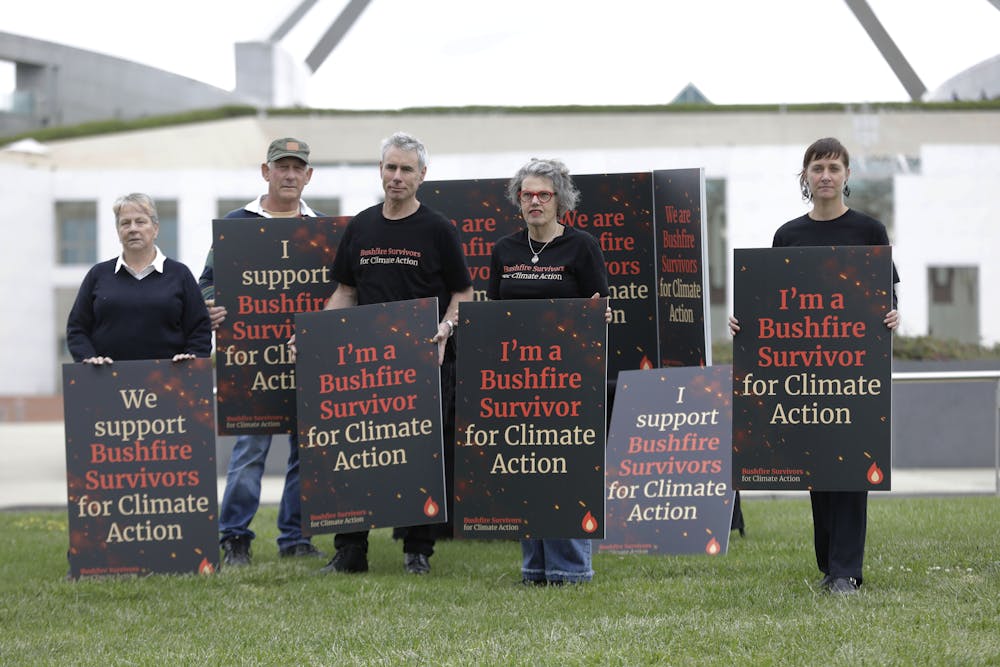 The Bushfire Survivors brought their case to the NSW Land and Environment Court.
Bushfire Survivors for Climate Action
The Bushfire Survivors brought their case to the NSW Land and Environment Court.
Bushfire Survivors for Climate Action
The EPA protects the environment from other types of pollutants by issuing environment protection licences, monitoring compliance, and imposing fines and clean-up orders. The bushfire survivors were seeking to force the EPA to address greenhouse gas emissions as well.
The EPA unsuccessfully tried to establish it is not required to address any specific environmental problem — i.e. climate change. And it argued that even if it is, it has already done enough.
But the court agreed with the bushfire survivors that the EPA’s instruments already in place aren’t sufficient, leaving the duty “unperformed”.
The court didn’t specify exactly how the EPA should remedy the fact it isn’t adequately addressing climate change, meaning the EPA can decide how it develops its own quality objectives, guidelines and policies, in a way that leads to fewer emissions. It is not the court’s job to make policy.
The EPA might, for example, target the highest-emitting industries and activities, via controls or caps on greenhouse gases.
Importantly, however, the court said the EPA doesn’t have to match its actions with a particular climate scenario, such as a global temperature rise of 1.5℃.
Other states on notice
Although this ruling is specific to NSW, other state environment protection authorities also have legal objectives to protect the environment.
This case may cause other Australian environmental authorities to consider whether their regulatory approaches match what the law requires them to do. This might include a responsibility to protect the environment from climate change.
Another thing we know from the NSW case is that simply having policies and strategies isn’t enough.
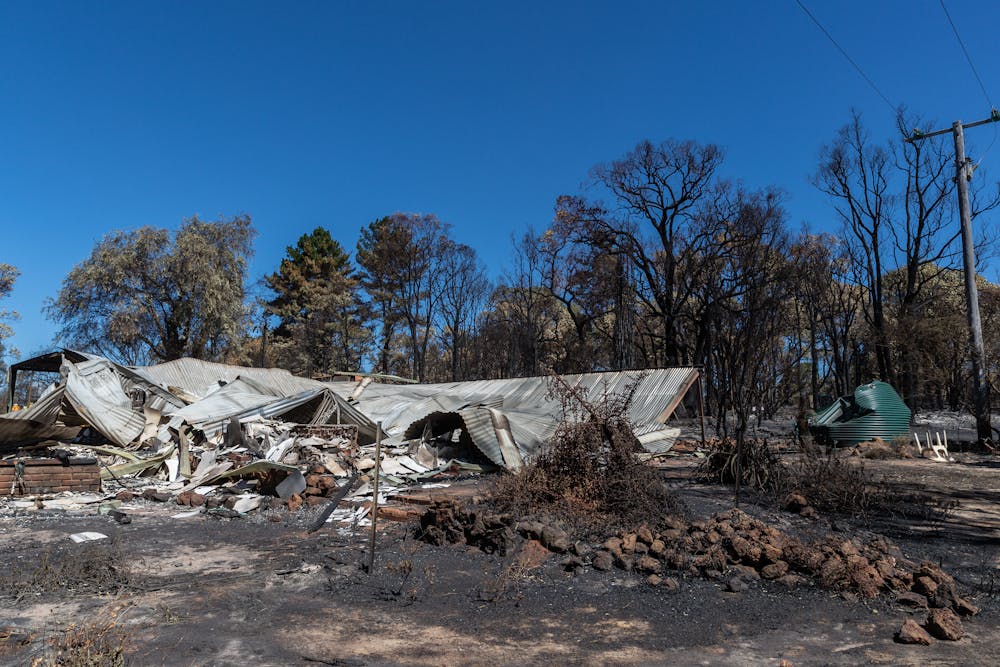 The remains of a house destroyed by a bushfire in Perth, February 2021.
Richard Wainwright/AAP
The remains of a house destroyed by a bushfire in Perth, February 2021.
Richard Wainwright/AAP
The court made it clear aspirational and descriptive plans won’t cut the mustard if there’s nothing to “set any objectives or standards, impose any requirements, or prescribe any action to be taken to ensure the protection of the environment”.
The EPA tried to point to NSW’s Climate Change Framework[8] and Net Zero Plan[9] as a way of showing climate change action. But neither of these was developed by the EPA.
The EPA also presented documents it did develop, including a document about landfill guidelines, a fact sheet on methane, and a regulatory strategy highlighting climate change as a challenge for the EPA.
The court found these weren’t enough to address the threat of climate change and discharge the EPA’s duty, calling the regulatory strategy’s description of climate change “general and trite”.
An Australian first, but not an anomaly
Globally, climate litigation is playing a role in filling gaps in domestic climate governance. Cases in Europe, North and South America, and elsewhere[10] have led to courts pushing governments to do more.
Read more: In a landmark judgment, the Federal Court found the environment minister has a duty of care to young people[11]
One of the world’s first major successful climate change cases, Massachusetts v EPA[12], was similar to the bushfire survivors’ case. Back in 2007, the state of Massachusetts, along with other US states, sued the federal US EPA. They were seeking to force regulatory action on greenhouse gas emissions, and a recognition of carbon dioxide as a pollutant under the Clean Air Act.
While the NSW case comes 14 years after the US case, there has been plenty of courtroom action in Australia in the meantime, with cases against the financial sector, government actors, and corporations.
 The Australasian Centre for Corporate Responsibility just filed a lawsuit against Santos.
Shutterstock
The Australasian Centre for Corporate Responsibility just filed a lawsuit against Santos.
Shutterstock
In fact, on the same morning as the bushfire survivors’ case, a lawsuit was filed against oil and gas giant Santos in the Federal Court.
The Australasian Centre for Corporate Responsibility will argue[13] statements made in Santos’s annual report[14] are misleading and deceptive. These statements include that natural gas is a “clean fuel” and that it has a “clear and credible” plan to achieve net-zero emissions by 2040.
Climate change is an inevitable problem, and one that will be costly. Lawsuits seeking to force action now aim to limit how great the costs will be down the track. By targeting those most responsible, they are a means of seeking justice.
References
- ^ compelled the state Environment Protection Authority (www.caselaw.nsw.gov.au)
- ^ said (www.edo.org.au)
- ^ Their stories (www.bushfiresurvivors.org)
- ^ latest report (www.ipcc.ch)
- ^ and predicts (theconversation.com)
- ^ Climate change has already hit Australia. Unless we act now, a hotter, drier and more dangerous future awaits, IPCC warns (theconversation.com)
- ^ own legislation (legislation.nsw.gov.au)
- ^ Climate Change Framework (www.environment.nsw.gov.au)
- ^ Net Zero Plan (www.environment.nsw.gov.au)
- ^ Europe, North and South America, and elsewhere (www.urgenda.nl)
- ^ In a landmark judgment, the Federal Court found the environment minister has a duty of care to young people (theconversation.com)
- ^ Massachusetts v EPA (perma.cc)
- ^ will argue (www.accr.org.au)
- ^ Santos’s annual report (www.santos.com)