10 things Australia can do to prevent violence against women and children
- Written by: Ben Mathews, Professor, School of Law, Queensland University of Technology
This week’s National Summit on Women’s Safety[1] combines with Child Protection Week[2] to highlight twin challenges for national policy.
Community organisations and experts have identified domestic and family violence as a public health emergency that requires[3] a co-ordinated prevention and response strategy. Further specialised responses have been urged[4] for women and children in diverse Indigenous[5] and other cultural settings.
Politicians, academics and Australian of the Year Grace Tame have called for comprehensive change[6], with greater focus on prevention.
Read more: National summits have their place — but what will it really take to achieve equality for Australian women?[7]
The United Nations Sustainable Development Goals[8] urge national governments to end intimate partner violence against women and girls, and child abuse.
Australian policies have similar goals, contained in the National Plan to Reduce Violence against Women and their Children[9], the National Framework for Protecting Australia’s Children[10] and the National Agreement on Closing the Gap[11].
But we are nowhere near achieving them.
Better prevention is economically essential. Violence against women cost A$21.7 billion[12] in 2015. Child maltreatment cost $6.9 billion in 2020[13], in systems costs alone. Investing in early prevention saves massive costs.
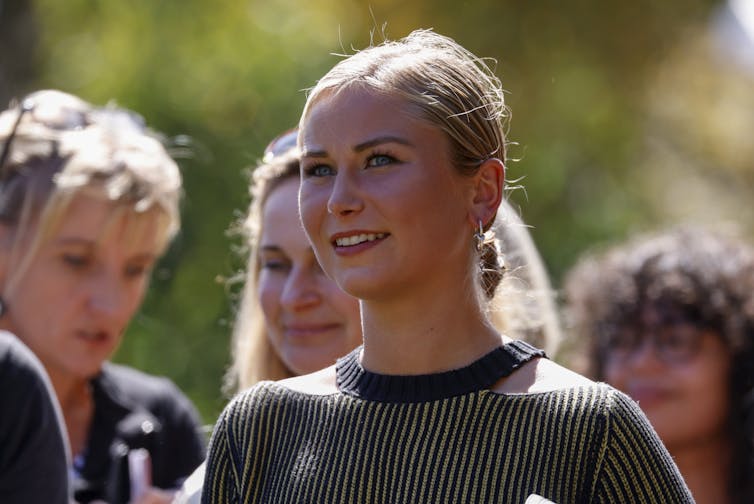 Australian of the Year Grace Tame is among those calling for greater focus on prevention.
Rob Blakers/AAP
Australian of the Year Grace Tame is among those calling for greater focus on prevention.
Rob Blakers/AAP
Far more importantly, prioritising prevention is an absolute moral imperative. Survivors of this violence endure daily terror and extraordinary suffering. If we do not protect women’s and children’s safety, we fail as a nation.
Multiple actions are required. Some are obvious: we urgently need large, sustained increases in crisis intervention, support services and workforce capacity.
Other parts of the solution are more complex, especially if we are serious about prevention and long-term gains – as we must be. What kind of society do we want to be in 2030, 2040 and 2050, and how do we get there?
Here are ten key steps to a public health prevention model.
1) Political will
With genuine political will, we can succeed. But without it, we are doomed to cycles of short-term, piecemeal efforts. We need a generational approach with bipartisan commitment, spanning government and community action. Ring-fenced investment is required; we do this elsewhere (our 2021 defence budget, for example, is $44 billion[14]).
2) A comprehensive public health approach
We need strategically weighted approaches to all three dimensions of prevention: primary, secondary and tertiary. This includes early intervention and effective responses to the root causes of violence.
3) Primary prevention
Strategies to prevent violence at the population level must be the foundation[15] of a public health approach, and take greatest priority. This includes steps to achieve structural gender equality, educate the public, enhance social norms, strengthen legal prohibitions and improve social determinants of health with sensitivity to culture. This includes access to housing, employment and healthcare, and attending to legacies of colonisation and intergenerational trauma.
4) Social norm regeneration
Violence against women and child abuse are both enabled[16] when women’s and children’s rights are not sufficiently recognised. This happens when laws do not prohibit and prosecute serious offending, social norms against such violence are weak, gender inequality persists, constructions of masculinity emphasise dominance, and social determinants of health are unfavourable. Australia’s liberal democracy has many strengths, but a pervasive weakness has allowed violence in the private sphere to remain untouched. We must reshape this social norm.
5) Secondary prevention
Strategies to prevent violence in high-risk populations must be a high priority. Structural, community and individual factors intersect to increase the risk of violence. We need adequate services for those most in need, targeted for prevention and early intervention. This requires massive expansion of workforce capacity. Support is crucial for those with mental health needs, substance abuse and addiction, economic stress and intergenerational trauma.
Read more: Explainer: what is a 'positive duty' to prevent workplace sexual harassment and why is it so important?[17]
6) Tertiary prevention
Strategies to respond to violence and limit its adverse impacts are the apex of the public health pyramid. Appropriate protection of women and children is essential, supported by health services. We must prioritise trauma-informed, culturally sensitive and least-intrusive interventions wherever possible.
7) Use all four public health strategies
A comprehensive approach requires four strategies[18], implemented in a continual cycle.
First, we need to rigorously measure the prevalence of violence and abuse, and monitor prevalence over time to see if it is declining. Nationally, we lack reliable data[19] on the prevalence of child abuse and intimate partner violence, but we will soon have this from a 2021 nationwide survey[20] measuring all types of child abuse and intimate partner violence[21]. Reliable, nuanced prevalence data are also essential to inform targeted prevention policy.
Second, we must identify factors influencing the likelihood of violence, to direct intensive supports to those with greatest need. Violence against women is related to underdeveloped knowledge and attitudes, intergenerational trauma, weakened community connection, and mental illness and addiction.
Third, we need large-scale investment in effective programs to respond to and reduce violence and abuse. These must include broad evidence-based measures and community-designed measures suited to local settings.
Fourth, we must implement programs through required agencies, infrastructure and mechanisms. Governments can use their economic power to support service sectors and health agencies and provide socio-economic supports to survivors.
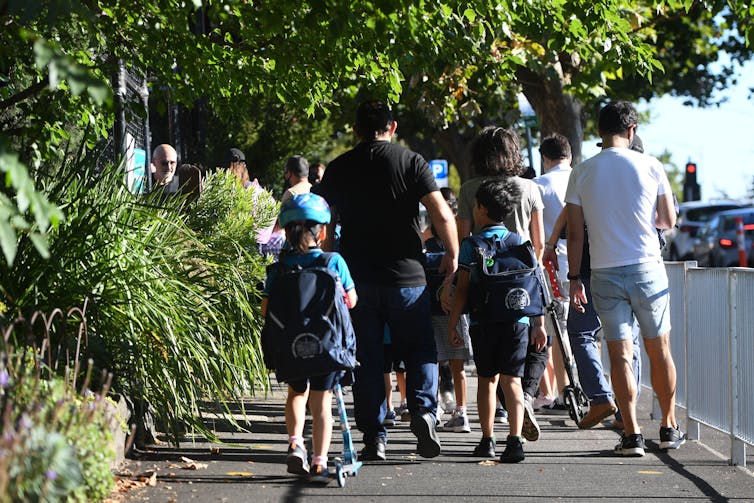 All children need to be educated about sexual violence prevention.
Erik Anderson/AAP
All children need to be educated about sexual violence prevention.
Erik Anderson/AAP
8) Confront the gender problem
Overwhelmingly, violence is inflicted by males[22]. We remain light-years from gender equality, with persistent shortcomings in men’s knowledge and attitudes[23] that facilitate violence. To enhance equality and prevent violence long-term, we need educational programs, beginning in early childhood, to help develop cognitive knowledge (such as knowledge of women’s and children’s rights, and sexual literacy), affective attitudes (towards equality, away from entitlement) and behavioural and psycho-social skills (like self-regulation and empathy).
9) Knowledge is power
Education is a cornerstone. Alongside education focused on boys, we can educate all children about consent, relationships and sexual violence prevention. School-based sexual abuse prevention programs have been shown[24] to improve children’s knowledge, their retention of that knowledge, self-protective behaviours, and disclosures.
Practitioners who work with women and children deserve trauma-informed education about the nature and effects of violence and abuse.
Institutional and societal leaders need to know[25] about the nature and effects of sexual and family violence, and respond empathically.
10) Effective legal systems
Criminal, civil, family, child protection and anti-discrimination (sexual harassment) laws can contribute to prevention, detection and responses to violence. However, laws need to be well designed and implemented as intended by practitioners and courts.
Many challenges arise here. We have inconsistent laws[26] across states and territories, and varying implementation capacity. In addition, our legal systems were not designed to respond to domestic violence, coercive control, and sexual abuse[27].
A robust national public health law approach requires us to make our laws consistent, coherent and conceptually robust (for example, based on sound definitions of concepts like consent[28] and child sexual abuse[29]).
Laws must be calibrated to social contexts and applied by a multi-sectoral collaborative approach. With expertise and commitment, we can make required reforms, embrace innovations like specialised courts[30] and respond to new forms of violence like online surveillance and technology-facilitated abuse[31].
References
- ^ National Summit on Women’s Safety (regonsite.eventsair.com)
- ^ Child Protection Week (www.napcan.org.au)
- ^ that requires (www.abc.net.au)
- ^ urged (www.abc.net.au)
- ^ Indigenous (www.theguardian.com)
- ^ comprehensive change (www.abc.net.au)
- ^ National summits have their place — but what will it really take to achieve equality for Australian women? (theconversation.com)
- ^ Sustainable Development Goals (sustainabledevelopment.un.org)
- ^ National Plan to Reduce Violence against Women and their Children (www.dss.gov.au)
- ^ National Framework for Protecting Australia’s Children (www.dss.gov.au)
- ^ National Agreement on Closing the Gap (www.closingthegap.gov.au)
- ^ A$21.7 billion (www.pwc.com.au)
- ^ $6.9 billion in 2020 (www.pc.gov.au)
- ^ $44 billion (www.aspi.org.au)
- ^ must be the foundation (www.science.org)
- ^ are both enabled (doi.org)
- ^ Explainer: what is a 'positive duty' to prevent workplace sexual harassment and why is it so important? (theconversation.com)
- ^ requires four strategies (dx.doi.org)
- ^ we lack reliable data (doi.org)
- ^ nationwide survey (dx.doi.org)
- ^ child abuse and intimate partner violence (www.australianchildmaltreatmentstudy.org)
- ^ inflicted by males (www.abs.gov.au)
- ^ attitudes (ncas.anrows.org.au)
- ^ have been shown (journals.sagepub.com)
- ^ need to know (link.springer.com)
- ^ inconsistent laws (www.sciencedirect.com)
- ^ sexual abuse (www.austlii.edu.au)
- ^ consent (www.dcj.nsw.gov.au)
- ^ child sexual abuse (doi.org)
- ^ specialised courts (www.fcfcoa.gov.au)
- ^ online surveillance and technology-facilitated abuse (www.esafety.gov.au)