


Trump won’t rule out force to take Greenland – a country with a complex colonial history
- Written by: Darius von Guttner Sporzynski, Historian, Australian Catholic University
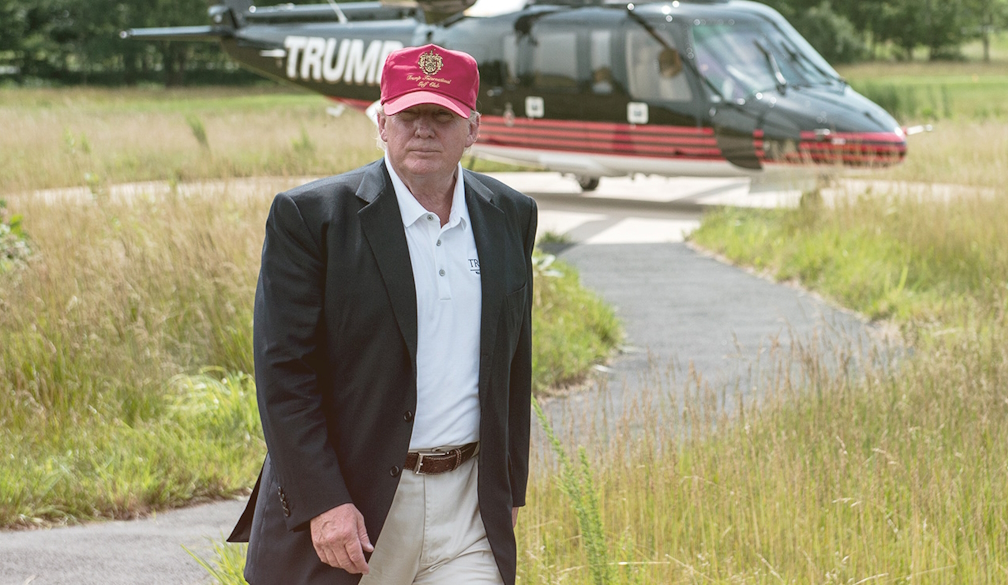
Donald Trump has long been interested in Greenland becoming part of the United States. Yesterday, he told reporters[1] he would not rule out using military force to acquire the Danish territory, saying “we need” it for the “economic security” of the United States. As he spoke, his son Donald Jr was in Greenland[2], on what is described as a private visit.
Last week, Greenland’s prime minister Múte Egede called for independence[3] from Denmark and for the “shackles of the colonial era” to be broken. Last year, on December 23, he explicitly rejected[4] Trump’s interest: “Greenland is ours. We are not for sale and will never be for sale.”
The Danish prime minister similarly dismissed the notion of Trump buying Greenland as absurd[5] when he first raised it in 2019. Yet, Trump’s fascination with the Arctic island persists, reflecting broader geopolitical interests in the region.

As the ice melts, new shipping routes and untapped resources, particularly rare earth minerals[6], have elevated Greenland’s strategic importance[7]. It is the site of one of the world’s largest[8] known rare earth metal deposits. And the Greenland Institute of Natural Resources reports[9] “huge potential for oil exploitation in the waters” offshore.
But while Trump’s rhetoric is outlandish, Greenland’s history tells a deeper story of colonial entanglements, autonomy struggles, and international manoeuvring.
On the map[10], Greenland is nearest to Canada, though also very near Nordic Europe. Canada’s Ellesmere Island lies just 26 km to the north and Iceland is about 320 km to the southeast. While geographically part of North America, Greenland has maintained political and cultural ties with Europe, particularly Norway and Denmark, for over a millennium.
Denmark’s king sends a message
On December 20 2024, Denmark’s king, Frederik X, proclaimed a significant, but not unexpected, update[11] to the royal coat of arms. Gone were the three crowns symbolising the historic Kalmar Union[12] between Denmark, Norway and Sweden, which lasted from 1397 to 1523. In their place, the king opted for symbols more reflective of Denmark’s current realm: a prominent polar bear for Greenland and a ram for the Faroe Islands.
Denmark’s royal household announced[13]: “The King wishes to create a contemporary royal coat of arms that both reflects the Realm and takes into account history as well as the heraldic tradition.”
The change, therefore, is essentially a modernisation[14], giving equal status to all parts of the kingdom. Political commentators[15] around the world interpreted it as a message of solidarity with Greenland and the Faroe Islands at a time of growing tensions, particularly in light of Trump’s aggressive interest and Greenland’s calls for independence.
A brief colonial history of Greenland
Greenland has been inhabited for over 4,500 years[16] by peoples moving there in a series of migrations from regions as diverse as Siberia, Alaska and Arctic Canada[17]. The most recent Inuit migration occurred in the 13th century.
In the 10th century, Erik the Red[18], a Norwegian-born exile from Iceland, settled on the island. He named it Greenland and led expeditions that established several prosperous Norse settlements. Christianity was introduced in the 11th century by Erik’s son, Leif Eriksson[19]. The first bishop’s seat was established in 1126[20].
 Greenland was named by Erik the Red, a Norwegian-born exile from Iceland who settled there in the 10th century. Dana File/AAP
From the 13th century onwards, Norse settlers[21] engaged with the Inuit cultures. However, by the 14th century, climate cooling led to the decline of Norse communities, which were abandoned by the 15th century. Approximately a century later, expeditions from England and Norway arrived in Greenland. By the 17th and 18th centuries, European whalers frequently interacted with the Inuit, leading to extensive trade and Lutheran mission of Norwegian clergyman Hans Egede[22].
The US recognised Danish sovereignty in 1916
Greenland has been under Danish control for centuries, but full sovereignty over the island was not always guaranteed. In fact, a key development came from an unlikely source: the US. On August 4 1916, the US signed a declaration[23] recognising Denmark’s sovereignty over the entirety of Greenland. This agreement was annexed to the sale of the Danish West Indies[24] (now the US Virgin Islands) to the US. This represented a shift in America’s interpretation of its own Monroe Doctrine.
The Monroe Doctrine[25], articulated in 1823, warned European powers against further colonisation or intervention in the Americas. Yet, in 1916, the US effectively supported Denmark’s colonial ambitions by legally recognising its claim to Greenland. At the time, Denmark’s control was limited to settlements along Greenland’s west coast. From the 1880s onwards, Danish outposts expanded into the north and east, culminating in the formal declaration of sovereignty over the entire island in 1921.
This US recognition was critical: it legitimised Denmark’s claim internationally[26], barring objections from Norway, which sought to expand its Arctic fishing territories. Norway’s ambitions were thwarted, solidifying Greenland’s status as a Danish possession.
Colonial legacy and calls for independence
Denmark’s relationship with Greenland has evolved from outright colonisation to the current status of Greenland as an autonomous territory. Since gaining home rule in 1979 and self-government in 2009, Greenland has taken steps toward greater independence[27]. Yet, it remains tied to Denmark in crucial ways, particularly through defence and foreign policy.
 Greenland’s relationship with Denmark has evolved from outright colonisation, and continues to evolve. Mads Claus Rasmussen/Denmark Out/AAP
Despite autonomy, Greenland’s colonial legacy casts a long shadow. Controversies such as the forced contraceptive scandal[28] of the 1960s and 1970s, where Greenlandic women were subjected to coerced sterilisation, have fuelled resentment toward Denmark.
This painful history resurfaced last week, with prime minister Egede accusing Denmark of genocide[29] over the scandal.
Why does Trump want Greenland?
Greenland’s importance on the global stage is multifaceted. Its location in the Arctic makes it a key focus for military strategy, climate research and resource extraction[30].
For Denmark, retaining Greenland is not only a matter of historical continuity, but also geopolitical necessity. Meanwhile, for the US, the Arctic represents a frontier of strategic competition, particularly with Russia and China.
 For Denmark, retaining Greenland is a geopolitical necessity. Ida Marie Odgaard/Denmark Out/AAP
In this context, Trump’s 2019 suggestion to “buy” Greenland seemed tone-deaf but not entirely without precedent. The US has long sought influence in Greenland[31], dating back to World War II, when it established military bases on the island. The 1916 recognition of Danish sovereignty may have been a legal formality, but it underscored the US’s pragmatic interest in Greenland’s strategic location.
Greenland’s future
King Frederik’s decision to emphasise Greenland and the Faroe Islands[32] in Denmark’s coat of arms reflects the kingdom’s current priorities. The new design asserts they are integral parts of Denmark, not negotiable assets to be sold or relinquished.
As Greenland edges closer to independence, its journey reflects the reality of its history, geography and politics. For centuries, Denmark’s control over Greenland was contested and tenuous. Today, the question is not whether Denmark can retain sovereignty, but whether Greenland will choose to remain part of the Danish realm.
Trump’s remarks[33] about “mak[ing] Greenland great again” may have been met with ridicule, but they inadvertently highlight the broader significance of this icy island.
Greenland’s colonial history, evolving autonomy and geopolitical importance ensure it will remain at the centre of global attention.
References
- ^ he told reporters (www.bbc.com)
- ^ was in Greenland (www.reuters.com)
- ^ called for independence (www.politico.eu)
- ^ explicitly rejected (www.reuters.com)
- ^ as absurd (www.politico.eu)
- ^ rare earth minerals (eng.geus.dk)
- ^ Greenland’s strategic importance (www.nextbigfuture.com)
- ^ one of the world’s largest (www.innovationnewsnetwork.com)
- ^ Greenland Institute of Natural Resources reports (www.sbs.com.au)
- ^ the map (www.britannica.com)
- ^ update (www.theguardian.com)
- ^ Kalmar Union (thevikingherald.com)
- ^ announced (www.kongehuset.dk)
- ^ modernisation (www.heraldry-wiki.com)
- ^ Political commentators (www.washingtonpost.com)
- ^ inhabited for over 4,500 years (www.degruyter.com)
- ^ Siberia, Alaska and Arctic Canada (trap.gl)
- ^ Erik the Red (visitgreenland.com)
- ^ Leif Eriksson (www.britannica.com)
- ^ established in 1126 (en.wikipedia.org)
- ^ Norse settlers (www.britannica.com)
- ^ Hans Egede (www.britannica.com)
- ^ signed a declaration (nordics.info)
- ^ sale of the Danish West Indies (2001-2009.state.gov)
- ^ Monroe Doctrine (www.archives.gov)
- ^ legitimised Denmark’s claim internationally (nordics.info)
- ^ steps toward greater independence (nordics.info)
- ^ forced contraceptive scandal (www.bbc.com)
- ^ accusing Denmark of genocide (www.theguardian.com)
- ^ resource extraction (www.highnorthnews.com)
- ^ US has long sought influence in Greenland (visitgreenland.com)
- ^ Faroe Islands (www.britannica.com)
- ^ Trump’s remarks (www.bbc.com)









