Albanese announces more funding for Jewish security, labels synagogue firebomb ‘terrorism’
- Written by: Michelle Grattan, Professorial Fellow, University of Canberra
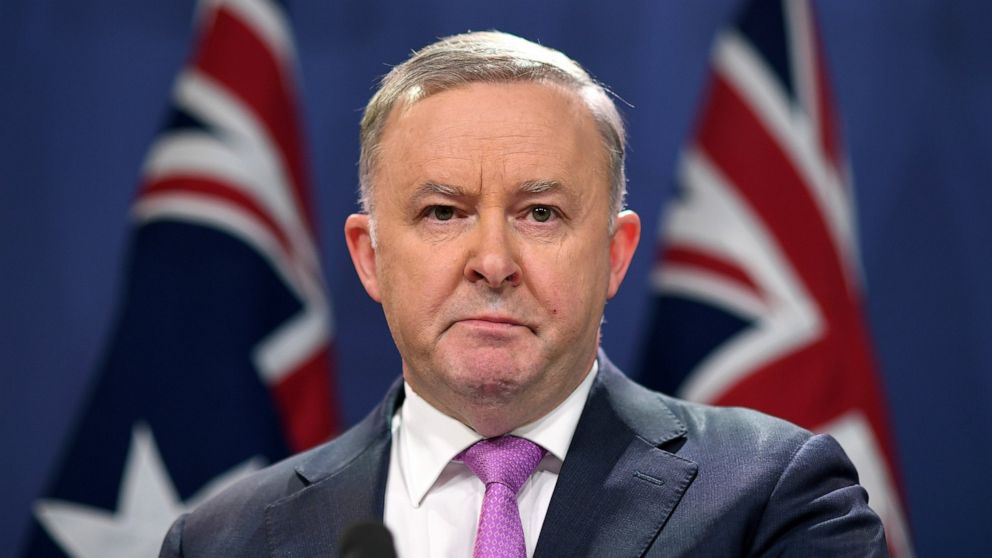
In the reactions to incidents of antisemitism, many people observe a contrast between New South Wales Premier Chris Minns and Prime Minister Anthony Albanese.
Over the past year, Minns has seemed quicker off the mark and more on point than Albanese, even when the PM is saying the right words and doing the right things.
Each projects a different vibe. It may seem a small thing in troubled times, but local Jews pick up on it. One (non-Jewish) observer captures it this way: “Minns gives a sense of himself in his condemnation. With Albanese it’s clearly the prime minister talking, not Anthony Albanese.”
The Middle East conflict – one in which Australia has no role or influence – has now finally fractured Israel-Australian relations. It has also led to increasing criticism of the federal government from the local Jewish community.
Last week brought the perfect storm. Australia voted at the United Nations for a motion calling for Israel to end its “unlawful presence in the Occupied Palestinian Territory as rapidly as possible”. This sparked a sharp reaction from the office of Israeli PM Benjamin Netanyahu.
Then in the early hours of Friday, the firebomb attack on the Adass Israel synagogue in Melbourne left many Jews terrified and angry. It came after months of ugly antisemitism to which some Jewish leaders argue the federal government has not responded adequately.
The Melbourne attack has not just reverberated domestically but has driven a further wedge into Israeli-Australian relations.
Netanyahu quickly took to social media to claim, “Unfortunately, it is impossible to separate this reprehensible act from the extreme anti-Israeli position of the Labor government in Australia”.
This included “the scandalous decision” on the UN vote and stopping a former Israeli minister visiting Australia. The latter was a reference to Immigration Minister Tony Burke blocking Ayelet Shaked, who was due to speak at a conference. Burke pointed to her inflammatory anti-Palestinian statements and said she could undermine social cohesion.
Immediately after the Hamas atrocities of October 7 last year, Australia had a more-or-less bipartisan position on Israel, although the opposition criticised Labor Foreign Minister Penny Wong urging restraint as Israel moved to defend itself.
Ever since, however, the two sides of Australian politics have increasingly diverged. Albanese did not visit Israel, Wong did not visit the massacre sites; Peter Dutton did. Labor has been more even-handed in its attitude to the conflict, showing greater concern about the huge number of casualties in Gaza. As Labor has moved away from Israel, the Coalition has dug in ever more strongly behind Israel.
Partly this has been driven by differences of view. Labor itself has long been internally divided over Israel-Palestine issues. Many years ago, Albanese co-chaired the parliamentary friends of Palestine.
Partly the widening partisan gulf has been driven by immediate political concerns and interests. Labor has a very pro-Palestine constituency in some of its western Sydney seats.
Albanese has now called the Melbourne attack a terrorism incident, while pointing out that label is one assigned by the experts.
“If you want my personal view, quite clearly terrorism is something that is aimed at creating fear in the community, and the atrocities that occurred in the synagogue in Melbourne clearly were designed to create fear in the community, and therefore, from my personal perspective, certainly fulfil that definition or terrorism,” he said on Sunday.
Victorian and federal police will discuss the catagorisation on Monday (although they’ve been somewhat pre-empted).
Albanese announced $32.5 million for the Executive Council of Australian Jewry to further strengthen security at Jewish Community sites including synogogues and schools.
At his news conference in Perth he also defended the government against those who say it hasn’t done enough, listing measures it has taken against antisemitism, including banning the Nazi salute and symbols, criminalising doxing, and appointing an antisemitism envoy.
Former treasurer Josh Frydenberg has called for a national security taskforce of federal and state police on antisemitism. But Albanese said the police should be left to go about their work and noted there was a joint counter-terrorism taskforce already.
At a state level, Minns, in the wake of a protest outside Sydney’s Great Synogogue last week that had people effectively trapped inside, is examining action to protect people from harassment at places of worship.
Jewish Labor MP Josh Burns, who holds the Victorian seat of Macnamara, with a substantial Jewish population, says that as well as measures to improve safety, antisemitism needs to be better combatted at universities, some of which have seen Jewish students experience vilification, intimidation and racism. Burns is chair of a inquiry into antisemitism on campuses, conducted by the parliamentary joint committee on human rights, which will report in February.
Pressed on Netanyahu’s attack on Australia over the UN vote, Albanese again pointed out 157 countries had supported the resolution including New Zealand, Canada and New Zealand, which are Five Eyes partners.
The split between Australia and Israel won’t be repaired in the foreseeable future without a change of government in one or both countries.
Bipartisanship over foreign policy on the Middle East is gone. But, despite the temptations posed by an approaching election, the parties need to unite behind combatting local antisemitism, before social cohesion is further undermined.