How did the Liberals’ first female leader find herself on the mat in under a year?
- Written by: Michelle Grattan, Professorial Fellow, University of Canberra
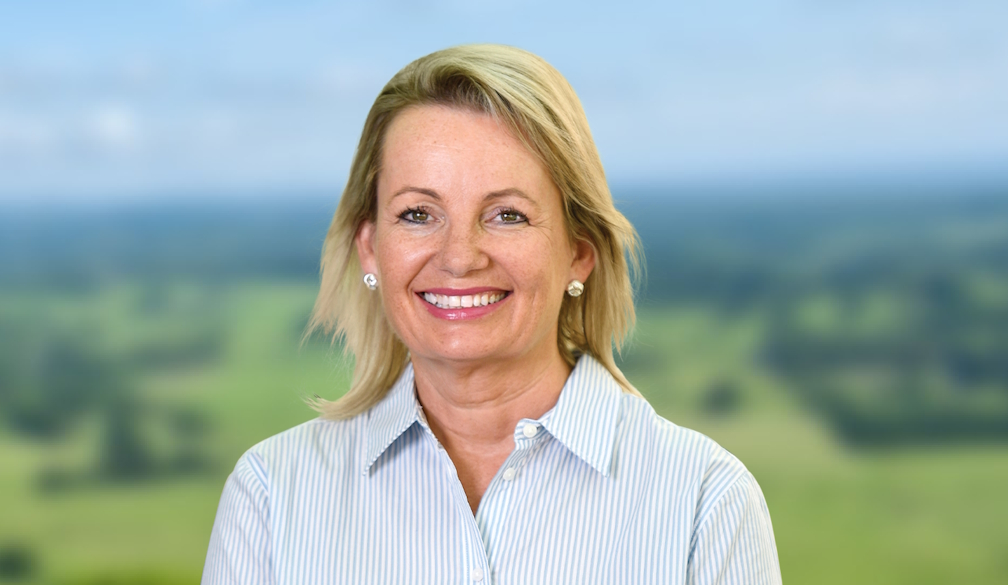
Sussan Ley always seemed set to be only an interim Liberal leader. If, as is likely, Angus Taylor wins the ballot on Friday morning, he could suffer the same fate.
Taylor as leader would be under intense heat in coming months. He would be stalked by the ambitious Andrew Hastie, who had wanted to be the one taking on Ley, before he was told by the conservative faction’s leadership to step back.
Ley has had much less than a year to try to prove herself. So how did the Liberals’ first female leader find herself on the canvas so quickly and dramatically?
Some of her problems have been self-imposed, reflecting her own limitations. Others have come from the circumstances in which she found herself.
In a nutshell, Ley has failed to project leadership authority. But she is also a victim of the Liberal Party’s deep internal ideological fracture, leaving what it stands for a void. The combination has prompted a huge slump in its support, with the related surge of One Nation.
Add to this the difficulties posed by the Nationals. Ley emerged from the two Coalition splits looking better than Nationals leader David Littleproud. But the crises, especially the most recent one centred on the Nationals defiance of shadow cabinet solidarity, took a toll on her.
From the beginning, Ley faced relentless undermining, from critics within the party, right-wing commentators, and the bad and worsening opinion polls.
In the divided party, the conservatives are dominant. They overwhelm the branches and have a clear edge among the parliamentarians.
Yet Ley, from the small centre-right faction, managed last May to win the leadership, with the backing of the moderates. Many of the conservatives never accepted this outcome.
Ley was quickly taken hostage. Once a supporter of net zero, she had to accept the party’s overthrow of the commitment. The policy change was probably inevitable. But Ley failed to get ahead of the issue, or state her own view before hearing everyone else’s. It left her looking weak.
She has been under constant criticism for not bringing forward policies. Partly this comes from the (accurate) perception that she does not personally have a strong policy framework. She’s a politician who shifts with the sands.
While the demand for policy is to an extent reasonable, it is not entirely so. The Dutton opposition was appallingly inadequate in formulating policy – late and lazy. But it also unrealistic to demand an opposition that’s been substantially wiped out at an election have an extensive policy slate within months.
The opinion polls have been a major weapon used in the assault on Ley. In modern times, polls have invariably been central in leadership choices. Nowadays they operate on steroids, and there are many more of them.
Key conservative James Paterson delivered a stark warning on Thursday:
Almost five million Australians voted for us. They put their trust in us. Over the last nine months, according to the most recent opinion polls, 2.1 million of those people have since deserted the Coalition. That’s more than 200,000 votes a month. It’s more than 50,000 votes a week. It’s more than 7,000 votes a day. This cannot go on. If it goes on, there’ll be nothing left of the Liberal Party by the next election.
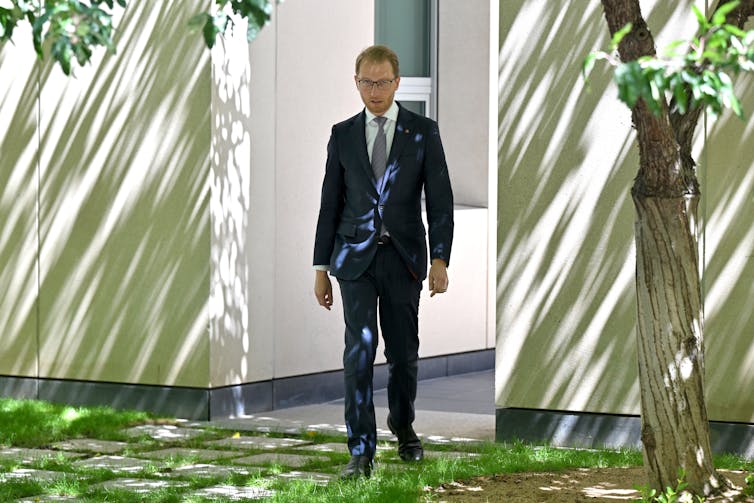
There used to be an old line that behind every successful man is a strong woman. In a leadership battle, behind every candidate you’ll find a factional heavyweight or two. The contemporary Liberal Party is as factionalised as Labor ever was, even in its heyday of players such as the late Graham Richardson.
Taylor’s leading factional “second” is Paterson, a senator from Victoria; Ley has Alex Hawke, who as part of the centre-right faction once was Scott Morrison’s “spear carrier” (Morrison’s description).
Paterson in opposition has stood out as a strong performer, inside the parliament (especially in Senate estimates) and in the media.
Recent weeks have highlighted his factional role, most publicly at that Melbourne meeting attended by Hastie, Taylor, fellow right-wing factional player Senator Jonno Duniam, and former MP Michael Sukkar. The meeting had been called to sort out who would challenge Ley. Paterson was central in demonstrating to Hastie that he did not have the necessary support.
Hawke, who once belonged to the hard right in New South Wales, has a chequered history and is deeply unpopular with a wide range of Liberals. He acted for Morrison in delaying some preselections in NSW before the 2022 election (which backfired on the then prime minister). As Ley’s numbers man he helped her win the leadership and has been a tactical adviser in the mounting crisis of recent weeks. One of the key staffers in her office is seen as a “Hawke man”.
People ask: has Ley been a victim of sexism? If we think back to the harsh treatment dealt out to various leaders, probably not in terms of substance. But it is hard to avoid the conclusion she has been treated with more disrespect than a man would have been. The plotting has been extraordinarily open. Those seeking to bring her down haven’t even felt the need to whisper behind their hands.
It’s notable that two high-profile Liberal women have been to the fore in the move on Ley’s leadership: Jane Hume, a moderate, and Sarah Henderson, a conservative. Both are Victorian senators. Each had senior jobs on Peter Dutton’s frontbench: Hume was finance spokeswomen (a role in which she formed a bond with Taylor). Henderson was shadow minister for education. Ley excluded both women when she formed her shadow ministry.
Who is rewarded and who is penalised when frontbench jobs are handed out often has political fallout.
One thing to watch for in a Taylor front bench would be who is not in, and whether they would be likely to cause trouble.
Also significant, in the event of Ley losing, will be whether she says she will stay in parliament for the rest of the term. A byelection in her regional NSW seat of Farrer, if there were a strong independent candidate, could be ugly for a new leader.