Why state and federal governments are fighting about funding
- Written by: Stephen Duckett, Honorary Enterprise Professor, School of Population and Global Health, and Department of General Practice and Primary Care, The University of Melbourne

The clock is ticking for the Commonwealth government to strike a new hospital funding deal with state and territory governments before its end-of-year deadline[1].
While states and territories are responsible for running Australia’s public hospitals, funding is split between the Commonwealth, and state and territory governments. The proportion of funding the Commonwealth contributes is at the centre of negotiations.
Negotiations so far have been predictably ugly. The states have hit out[2] at the Commonwealth, saying much of the extra pressure comes from[3] patients who are “stranded” in hospitals because they can’t get an aged care bed or appropriate disability accommodation, both of which Commonwealth responsibilities.
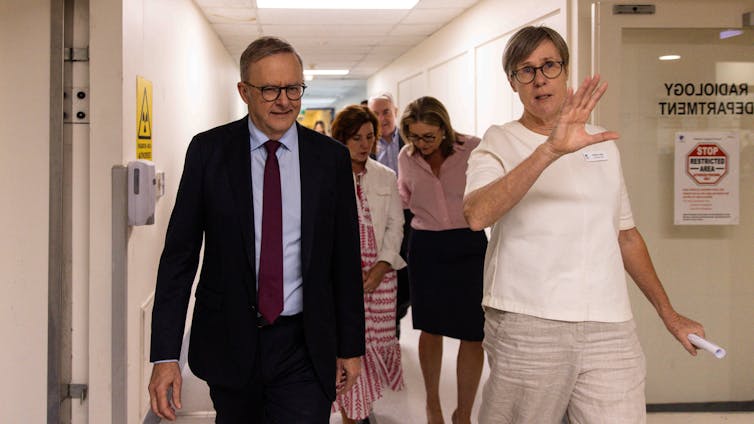
Prime Minister Anthony Albanese has warned[4] the states to rein in the growth of hospital funding if they want to strike a deal, which would be due to start[5] in mid 2026.
The states say that’s unreasonable, with Queensland Premier Tim Nicholas asking[6]:
Does he want us to go out there and close the front door to our emergency departments or stop taking ambulances delivering sick patients to our emergency wards?
As negotiations continue this week, so too will the “blame game”, where each side blames the other[7] for problems in public hospitals.
So how did we get here? And what might happen next?
Equal funding under Whitlam
Fifty years ago Commonwealth-state relations in health were transformed when the Whitlam government introduced Medibank. Under Medibank, the Commonwealth shared public hospital costs equally with the states. This has remained the Holy Grail, at least for the states, of how the funding split should work.
The ink was barely dry on those new funding arrangements when the Whitlam government lost office and the incoming Fraser government started to dismantle Medibank.
Fast forward to 1984. The Hawke government reinstated universal health insurance with a new name, Medicare. However, it didn’t reintroduce hospital cost-sharing. Instead, it made a new agreement to compensate the states. Commonwealth grants to the states started increasing in line with population growth and wage and general inflation.
This insulated the Commonwealth from covering all the costs of activity increases, as the population started needing more hospital care. It also insulated the Commonwealth from meeting the costs of hospital-specific inflation, which tends to be higher than general inflation.


However, in 2016[10] Prime Minister Malcolm Turnbull re-instituted the Commonwealth’s commitment to share the costs of the growth in public hospital services, though only at 45%. And even this was capped at maximum growth in funding of 6.5% per year.
So states were on the hook again if admissions grew faster than inflation, or health costs grew faster than general inflation, with the Commonwealth committing to only share growth up to the 6.5% cap.
Because the growth in costs has proven to be greater than the Commonwealth cap of 6.5%, the Commonwealth share has declined over time. By 2023-24, the latest year for which data are available[11], the Commonwealth share was only 38%, well short of the states’ aspiration of 50%.
So far from the Commonwealth share increasing over time, it has shrunk. States are picking up more and more of the growth in costs, squeezing state budgets and impacting patients’ access to care.
Didn’t Albanese ‘fix’ hospital funding?
The declining Commonwealth share led to pressure on the new Albanese government to put more money on the table for the next agreement, which it did. In December 2023, National Cabinet endorsed[12] a Commonwealth proposal to increase its:
contributions to 45% over a maximum of a ten-year glide path from 1 July 2025, with an achievement of 42.5% before 2030.
It also:
endorsed the current 6.5% funding cap being replaced by a more generous approach that applies a cumulative cap over the period 2025-2030 […].
Importantly, under the new arrangements, the Commonwealth share would no longer be based on the share of the growth in costs. Rather, the Commonwealth’s share would be based on total costs rather than just the growth in costs – and this rate would increase over time.
But then a spanner was thrown into the works. The Commonwealth offer was based on historic growth in costs of around 6% per year. The independently determined growth in the national efficient price for 2025-26[14] was about twice that, blowing the Commonwealth estimates of the cost of its offer out of the water.
This, coupled with the Commonwealth linking increased health funding to increased state funding for disability services, meant negotiations ground to a halt.
The Albanese government extended the 2020-2025[15] plan by one year in the lead up to the May 2025 federal election.
Read more: Hospitals will get $1.7 billion more federal funding. Will this reduce waiting times?[16]
What’s likely to happen next?
Commonwealth, state and territory government officials met yesterday for more negotiations but are yet to come to an agreement.
Eventually, there will be a compromise and a new agreement will be signed, perhaps with some commitments to improving public hospital efficiency[17].
The new deal will provide an overall increase in funding. But the states will continue to complain that is not enough.
The Commonwealth will quietly pat itself on the back that it has taken the hospital funding issue off the table for another few years.
References
- ^ deadline (www.smh.com.au)
- ^ hit out (www.abc.net.au)
- ^ comes from (www.smh.com.au)
- ^ has warned (www.abc.net.au)
- ^ due to start (www.health.gov.au)
- ^ asking (www.abc.net.au)
- ^ blames the other (www.aph.gov.au)
- ^ new basis for funding (federalfinancialrelations.gov.au)
- ^ Nikki Short/AAP (photos.aap.com.au)
- ^ in 2016 (www.malcolmturnbull.com.au)
- ^ latest year for which data are available (www.aihw.gov.au)
- ^ National Cabinet endorsed (www.pm.gov.au)
- ^ Diego Fedele/AAP (photos.aap.com.au)
- ^ national efficient price for 2025-26 (www.ihacpa.gov.au)
- ^ extended the 2020-2025 (www.health.gov.au)
- ^ Hospitals will get $1.7 billion more federal funding. Will this reduce waiting times? (theconversation.com)
- ^ improving public hospital efficiency (grattan.edu.au)