Is China’s reported ban on BHP a bluff, or a glimpse of the future?
- Written by: Marina Yue Zhang, Associate Professor, Technology and Innovation, University of Technology Sydney
Though they still haven’t been officially confirmed, reports[1] China’s state-owned buyer told steelmakers to stop purchasing iron ore from Australian mining giant BHP have rattled both markets and Canberra.
At first glance, this looks like a simple dispute over price. But step back, and a picture begins to emerge of something possibly far more deliberate.
If true, this ban represents a pressure test from China – one that goes beyond trade and speaks directly to the future of Australia’s economy and the shape of global resource politics.
A dispute over price
The flashpoint appears to be a breakdown in iron ore supply contract talks between BHP and the China Mineral Resources Group (CMRG[2]), a government-run company created in 2022 to consolidate purchases for China’s steel industry. The disagreement[3] centres on stalled negotiations over pricing.
According to reporting[4] by Bloomberg, China applied pressure earlier in September by instructing its mills to stop buying one specific BHP product[5]. Then, at the end of the month, China reportedly[6] expanded the order to suspend all shipments from BHP priced in US dollars.
Neither side has yet confirmed or denied the report, and one Chinese commodity analysis firm, Mysteel, disputed the claim of a ban[7]. But markets were quick to react anyway. BHP’s share price fell[8] on Wednesday.
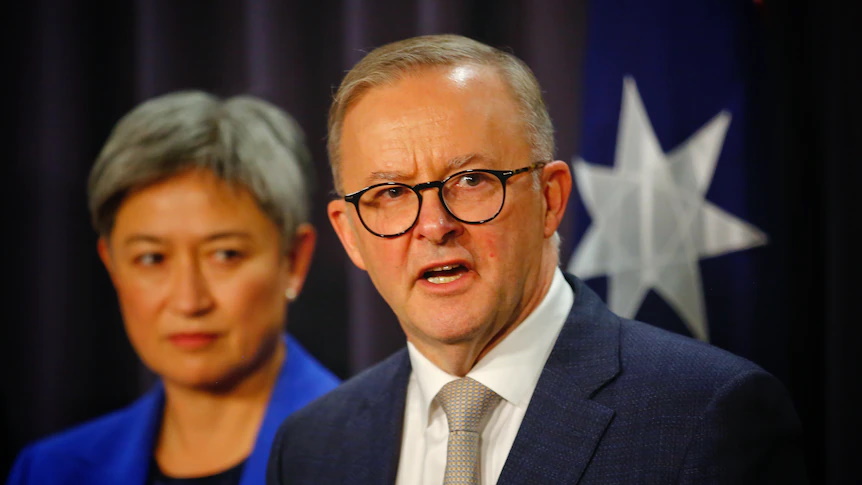
Prime Minister Anthony Albanese voiced concern[9] over the report, and Treasurer Jim Chalmers spoke with[10] BHP chief executive Mike Henry.
For Canberra, it may have carried an unsettling sense of déjà vu: harking back to the 2020–21 trade dispute[11], when Beijing targeted Australian exports including wine, barley, and coal.
The difference now is that iron ore matters more than any of those products combined. Nearly 60%[12] of Australia’s exports to China in the year to May 2024 were iron ore. Losing access to that trade would strike at the heart of Australia’s economy.
China’s long game
To understand where China sits in these negotiations, it is necessary to rewind two decades.
Despite being the world’s biggest buyer of iron ore, China has long had little influence over the price. Hundreds of steel mills cut deals separately with BHP, Rio Tinto, and Brazil’s Vale. The miners spoke with one voice. The mills did not.
The result was higher costs for China, captured in a phrase often used in its media: the “pain of pricing power[13]”. Whatever China bought, the price went up.
Attempts to push back failed. The China Iron and Steel Association urged boycotts of the miners[14], but mills broke ranks to secure supply.
In 2009, one Rio Tinto executive was jailed[15] in China for alleged commercial espionage during fraught negotiations.
Then came 2010. BHP’s then chief executive Marius Kloppers led a push to replace[16] annual price benchmarks with shorter-term market-based pricing.
This change supercharged profits for Western Australian producers, who could capitalise instantly as China’s demand surged. For China, it was a nightmare – less control, more volatility, bigger bills.
The creation[17] of the CMRG in 2022 was Beijing’s strategic response.
This is not old-fashioned central planning. It is state capitalism with sharper tools: centralised buying, stockpiling, and big data to support national goals. Its purpose is clear – to turn China from price-taker into price-maker.

The standoff: who holds the cards?
Australia and China rely on each other, but not in equal amounts.
Australia is critically dependent on China for revenue. China, in the short term, still depends heavily on Australian ore. BHP alone supplies around 13%[19] of China’s imports – impossible for either side to replace overnight.
BHP is seeking alternative markets, and Beijing is investing billions[20] in Guinea’s Simandou mine, but both things will take years or decades before reaching scale.
That creates a tense balance: fighting without breaking (斗而不破). Both sides can inflict pain, but neither can afford a full rupture.
If the reports are true, the “ban” is less a final break than a negotiation tactic. It is Beijing’s way of showing BHP – and by extension Rio Tinto and Vale – that the old rules no longer apply.
The future: from iron ore to green steel
Beneath this contest lies a bigger question: who will shape the future of steel?
Traditional steelmaking is one of the world’s dirtiest industries. It relies on coal, which pumps out carbon emissions. The next frontier[21] is “green steel”, made with renewable energy and green hydrogen instead of coal.
During his visit to Beijing earlier this year, Prime Minister Anthony Albanese pitched a vision for Australia to move beyond exporting raw ore and instead sell processed “green iron[22]” – an intermediate product on the path to green steel. With its vast renewable resources, Australia could climb the value chain rather than remain just “the world’s quarry[23]”.
This aligns with China’s own carbon-neutral goals. By flexing now, Beijing may be signalling that future cooperation on green steel will come with conditions. China will not simply be a buyer; it intends to set the rules.
References
- ^ reports (www.abc.net.au)
- ^ CMRG (globalroadtechnology.com)
- ^ disagreement (asiatimes.com)
- ^ reporting (www.bloomberg.com)
- ^ one specific BHP product (www.afr.com)
- ^ reportedly (www.abc.net.au)
- ^ disputed the claim of a ban (www.smh.com.au)
- ^ fell (www.abc.net.au)
- ^ voiced concern (www.theguardian.com)
- ^ spoke with (www.afr.com)
- ^ 2020–21 trade dispute (www.bbc.com)
- ^ 60% (www.exportfinance.gov.au)
- ^ pain of pricing power (paper.people.com.cn)
- ^ urged boycotts of the miners (www.smh.com.au)
- ^ jailed (www.abc.net.au)
- ^ replace (www.miningreview.com)
- ^ creation (gmk.center)
- ^ CHINATOPIX/AP (photos.aap.com.au)
- ^ 13% (www.exportfinance.gov.au)
- ^ investing billions (www.afr.com)
- ^ next frontier (ieefa.org)
- ^ green iron (www.afr.com)
- ^ the world’s quarry (www.ft.com)
Read more https://theconversation.com/is-chinas-reported-ban-on-bhp-a-bluff-or-a-glimpse-of-the-future-266480