Trump is systematically destroying press freedom
- Written by: Denis Muller, Senior Research Fellow, Centre for Advancing Journalism, The University of Melbourne
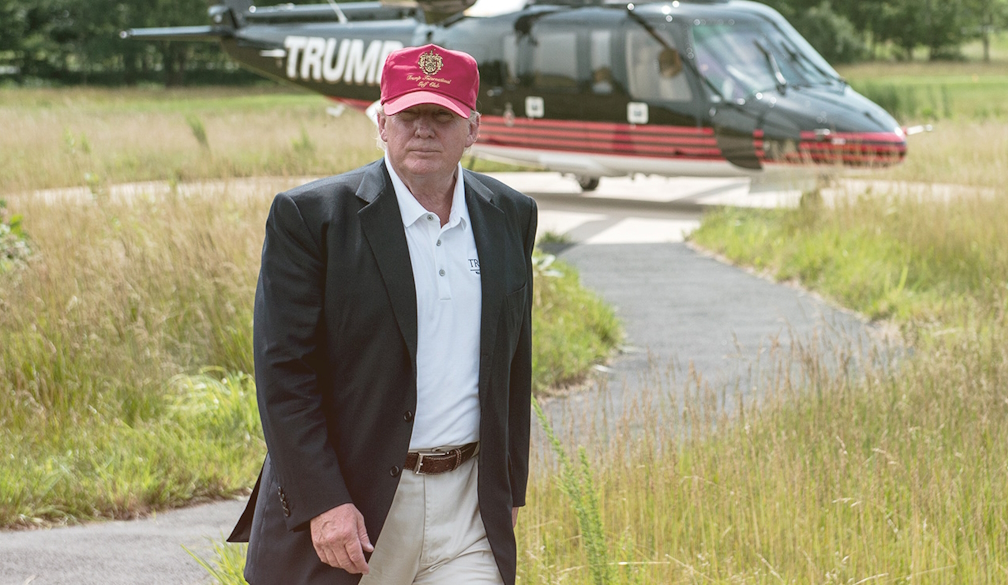
United States President Donald Trump is well advanced in his systematic campaign to undermine the American media and eviscerate its function of holding him and others in power to account.
Since the late 18th century this function has often been called the fourth estate. It’s the idea the media is a watchdog over the other three estates which, in modern democracies, are parliament, the executive government and the judiciary.
In the US, Trump has had considerable success in weakening the other three.
His Republican Party controls both Houses of Congress, and they have shown no sign[1] of wishing to restrain him.
He has stacked the executive government[2] with cronies and ideological fellow travellers, including Robert F. Kennedy Jr (and his anti-vaccination agenda[3]) as secretary of health, a brief stint by Elon Musk as head of the Department of Government Efficiency, and former Fox News host Pete Hegseth as defence secretary.
He has secured the support of the Republican Party to stack the Supreme Court[4] with politically aligned judges who have routinely struck down lower court decisions against Trump, most notably in the matter of deporting migrants[5] to countries other than their homelands.
Pulling funding, applying pressure
The fourth estate’s turn started in March, when Trump stripped federal funding[6] from Voice of America, a public broadcasting service with a global reach, because it was “anti-Trump” and “radical”.
These cuts also hit two other projections of American soft power, Radio Free Europe and Radio Free Asia.
In July, he cut funding to the Corporation for Public Broadcasting (CPB) in a move that ended all federal support[7] for National Public Radio, the Public Broadcasting service and their member stations.
Now he has turned to the private sector media. He does not have the power to cut their funding, so he is taking a different approach: financial shake-downs and threats to the foundations of their business.
In October 2024, even before he was elected, Trump sued the Paramount company[8] for US$10 billion (about A$15 billion). He alleged an interview with Kamala Harris during the 2024 election campaign had been “deceptively edited” by the CBS television network, a Paramount subsidiary.
In February 2025, after he had been sworn in as president, Trump upped the ante[9] to US$20 billion (A$30 billion).
The case was considered by lawyers to have no legal merit[10], but at that time, Paramount was anxious to merge with Skydance Media, and this was subject to regulatory approval from the Trump administration.
So Paramount was vulnerable to, how shall we say? Blackmail? Extortion? Subornation?
A busy, dangerous July
On July 2, Paramount settled[11] with Trump for US$16 million (A$24 million), which ostensibly is to go towards funding his presidential library.
On July 17 Paramount’s CBS network announced[12] its longtime Late Show would be cancelled from May 2026 after its presenter Stephen Colbert, an outspoken critic of Trump, condemned the corporate cave-in. The Trump administration approved the merger[13] shortly after.
Subsequently the House of Representatives Judiciary and Energy and Commerce committees announced an investigation[14] into whether the $16 million settlement constituted a bribe.
Also in July, Trump sued[15] Rupert Murdoch’s Wall Street Journal for defamation arising from an article linking Trump to the sex trafficker Jeffrey Epstein. He claimed the now-familiar amount of US$10 billion (A$15 billion) in damages.
Legal experts in the US say Trump has next to no chance[16] of winning. In the US, public figures who sue for defamation have to prove that the publisher was motivated by malice, which means they published either knowing the material to be untrue, or not caring whether it was true or not.
This case is never likely to end up in court, nor is it likely that Trump will see a red cent of Murdoch’s money. The two men need each other too much. To borrow a phrase from the Cold War, they are in a MAD relationship[17]: Mutually Assured Destruction.
Coming to heel, one by one
Rupert Murdoch was a guest at Windsor Castle at the recent banquet[18] given for Trump by King Charles.
Considering Murdoch’s bitter history with the Royal Family, it is difficult to imagine Buckingham Palace inviting him without Trump’s urging. It may have been a sign of rapprochement between the two men.
Meanwhile Trump has set his sights on The New York Times, suing it[19] for defamation and claiming US$15 billion (A$27 billion).
Referring to the Times’ endorsement of Kamala Harris in the 2024 presidential election, he said it had become a “mouthpiece for the Radical Left Democrat Party”.

This case faces the same difficulties as his suit against the Wall Street Journal. The question is whether the Times will stand its ground or whether, like Paramount, it caves.
Among the big three US newspapers, the Times is the only one so far not to have been intimidated by Trump. The other two, The Washington Post and the Los Angeles Times, refused to endorse a candidate[21] at the election on instructions from their owners, Jeff Bezos and Patrick Soon-Shiong respectively, both of whose wider business interests are vulnerable to Trumpian retribution.
Read more: Two of the US's biggest newspapers have refused to endorse a presidential candidate. This is how democracy dies[22]
The Post’s decision was condemned[23] as “spineless” by its celebrated former editor Marty Baron.
Now Disney is in the firing line. It owns another of the big four US television networks, ABC. On September 17, it pulled[24] its late-night talk show Jimmy Kimmel Live.
Kimmel had responded to White House accusations that leftists were responsible for the assassination of Charlie Kirk, saying[25]:
we hit some new lows over the weekend with the MAGA gang desperately trying to characterize this kid who murdered Charlie Kirk as anything other than one of them.
In what had all the hallmarks of a preemptive buckle, ABC and two of its affiliate networks took Kimmel off air indefinitely after Brendan Carr, the Trump-appointed chair of the Federal Communications Commission, said his agency might “take action” against the network because of Kimmel’s comments.
Kimmel is returning to TV[26], but the damage is already done.
Read more: Jimmy Kimmel's cancellation is the latest sign we're witnessing the end of US democracy[27]
Over at cable network MSNBC, its senior political analyst Matthew Dowd was fired[28] after he had uttered on air the blindingly obvious statement that Kirk’s own radical rhetoric may have contributed to the shooting that killed him.
This cable network is no longer part of the main NBC network, so it can’t be said that NBC itself has yet come to heel.
Within 24 hours of Brendan Carr’s veiled threat, Trump stripped the veil away and made the threat explicit[29]. Trump said of the national networks:
All they do is hit Trump. They’re licensed, they’re not allowed to do that. They’re an arm of the Democrat party. I would think maybe their licence should be taken away.
Whether cancelling a licence would breach the First Amendment to the US Constitution, which protects freedom of speech, is a question that might ultimately come before the Supreme Court. Given the present ideological proclivities[30] of that court, the outcome would be by no means certain.
So Trump now has two out of three national newspapers, and two out of the big four national television networks, on the run.
Only one national newspaper and two national networks to go, and one of those is Murdoch’s Fox News, Trump’s most reliable cheerleader.
References
- ^ shown no sign (about.bgov.com)
- ^ stacked the executive government (www.bbc.com)
- ^ anti-vaccination agenda (theconversation.com)
- ^ stack the Supreme Court (www.newyorker.com)
- ^ deporting migrants (www.bbc.com)
- ^ stripped federal funding (www.bbc.com)
- ^ ended all federal support (www.npr.org)
- ^ sued the Paramount company (theconversation.com)
- ^ upped the ante (www.latimes.com)
- ^ no legal merit (firstamendment.mtsu.edu)
- ^ Paramount settled (www.cbsnews.com)
- ^ announced (www.cbsnews.com)
- ^ approved the merger (www.theguardian.com)
- ^ an investigation (www.independent.co.uk)
- ^ sued (theconversation.com)
- ^ next to no chance (www.abc.net.au)
- ^ MAD relationship (theconversation.com)
- ^ recent banquet (www.smh.com.au)
- ^ suing it (www.abc.net.au)
- ^ Mary Altaffer/AP (photos.aap.com.au)
- ^ refused to endorse a candidate (theconversation.com)
- ^ Two of the US's biggest newspapers have refused to endorse a presidential candidate. This is how democracy dies (theconversation.com)
- ^ was condemned (www.newyorker.com)
- ^ it pulled (theconversation.com)
- ^ saying (www.cleveland.com)
- ^ returning to TV (www.theguardian.com)
- ^ Jimmy Kimmel's cancellation is the latest sign we're witnessing the end of US democracy (theconversation.com)
- ^ was fired (www.theguardian.com)
- ^ made the threat explicit (www.afr.com)
- ^ ideological proclivities (abcnews.go.com)