Albanese supports US bombing, reluctantly
- Written by: Michelle Grattan, Professorial Fellow, University of Canberra
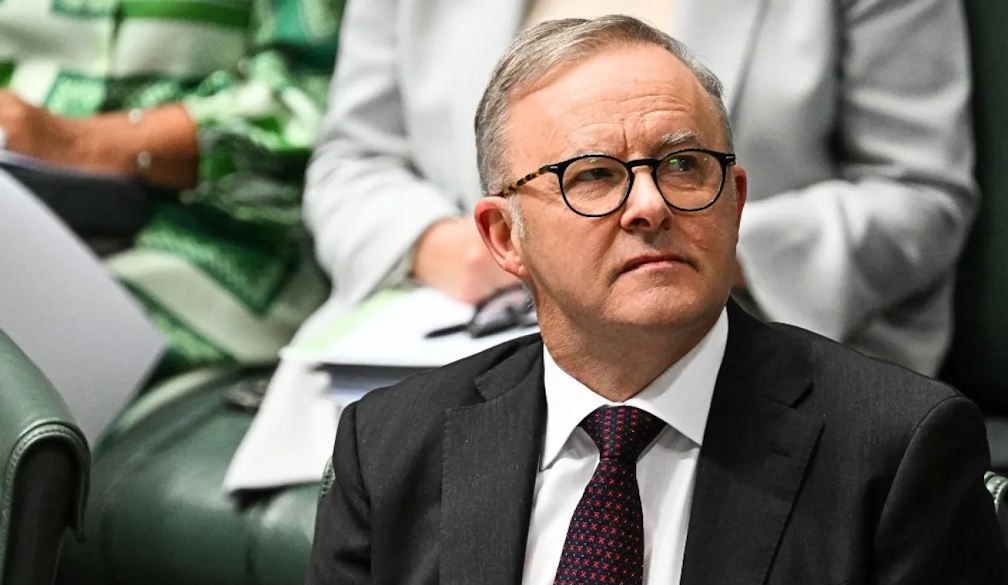
When Prime Minister Anthony Albanese and Foreign Minister Penny Wong went out on Monday to back the United States attack on Iran, it was obvious their support was through gritted teeth.
Albanese told their joint news conference: “The world has long agreed that Iran cannot be allowed to get a nuclear weapon. And we support action to prevent that. That is what this is.
"The US action was directed at specific sites central to Iran’s nuclear program. We don’t want escalation and a full-scale war. We continue to call for dialogue and for diplomacy. As I’ve said for many days now, we are deeply concerned about any escalation in the region and we want to see diplomacy, dialogue and de-escalation.”
At the news conference and in Wong’s media round beforehand, one big question was, why did they take so long to appear?
The attack is a seismic event in the Middle East conflict. Yet on Sunday the government only put out a tepid statement attributed to a “spokesperson”, which did not endorse the American action.
This suggests the prime minister and foreign minister are, at the very least, uncomfortable with the action.
It is further evidence of the current distance between the Australian government and the Trump administration. Whether it affects Albanese’s attempt to get the now much-sought after bilateral remains to be seen.
At every stage of the Middle East conflict, as the situation has progressively escalated, the Australian government has been urging restraint and/ or de-escalation.
Albanese is caught between not wanting to repudiate the Americans, the conflicting pressures of domestic lobbies, and his Labor constituency.
Over the years, Albanese has moved to the political centre. But he hasn’t taken down from his website a strong speech[1] he made in 2003 opposing the Iraq war.
“In the short term, the conflict that is now clearly about to start can only make things worse, perhaps much worse,” Albanese told parliament then. “Iraq does not represent a threat to Australia. We are, with this [Howard government] decision, supporting a pre-emptive strike, which changes forever the way that international politics works.”
In that war and this war, some of the same issues are at play. Iraq was thought to have weapons of mass destruction – later it was found it did not. Iran has long been on the path to developing nuclear weapons, but there are varying intelligence assessments of how much progress it has made.
One can’t help thinking Albanese probably has the same sort of reservations about the Iran strike that he did about the Iraq war.
For Australia’s there is one big difference: there is no thought of involving Australian defence forces, as happened in Iraq.
Former Labor senator Doug Cameron, in parliament from 2008 to 2019 and a firebrand of the left, on Monday recalled how then opposition leader Simon Crean opposed Australia’s support for and participation in the Iraq war. (Crean said, “Never allow our foreign policy to be determined by another nation. Never commit to unnecessary war when peace is possible.”)
Cameron, now a national patron of Labor Against War, issued several tweets condemning the government’s stand, and saying “time for Labor backbenchers to speak up”.
But the Labor backbench is far from what it once was. Hardly anyone speaks up to challenge anything. As for the left, it is a shadow of its old feisty self.
“What has happened to the left?” Cameron asks. “To be honest I don’t understand it,” he admits to The Conversation.
Cameron recalls how the left – and indeed the wider caucus – was up in arms when Bob Hawke in the mid-1980s wanted Australia to facilitate the Americans’ testing of MX missiles that would splash down in the Tasman Sea. Hawke had to back down.
He wonders if it’s a matter of not wanting to contradict a “left prime minister, and a left foreign minister”. “Personal support and party solidarity have come before common sense.”
There are many causes of the demise of the ALP left, as Cameron knew it. They include the loss of what power Labor’s rank-and-file once had, the splintering of the left more broadly to minor parties notably the Greens, and the decline of ideology within Labor (and generally). There is no current “Doug Cameron”-equivalent in the caucus. The factions no longer fight over ideas – they preside over spoils.
Those who contest the thesis of the decline of the left argue the contemporary Labor left has been shaping the Albanese government’s agenda on key issues from within, for example on industrial relations, industry policy, climate policy, and gender issues.
If the Albanese of 2003 could have foreseen what the caucus left of 2025 would be like, he’d have been surprised, and possibly shocked. As it is, he’s pretty pleased the left is so quietly behaved.
References
- ^ his website a strong speech (anthonyalbanese.com.au)
Read more https://theconversation.com/view-from-the-hill-albanese-supports-us-bombing-reluctantly-258967