How can I improve my running? 5 top tips for every runner, from a biomechanics expert
- Written by: Anthony Blazevich, Professor of Biomechanics, Edith Cowan University
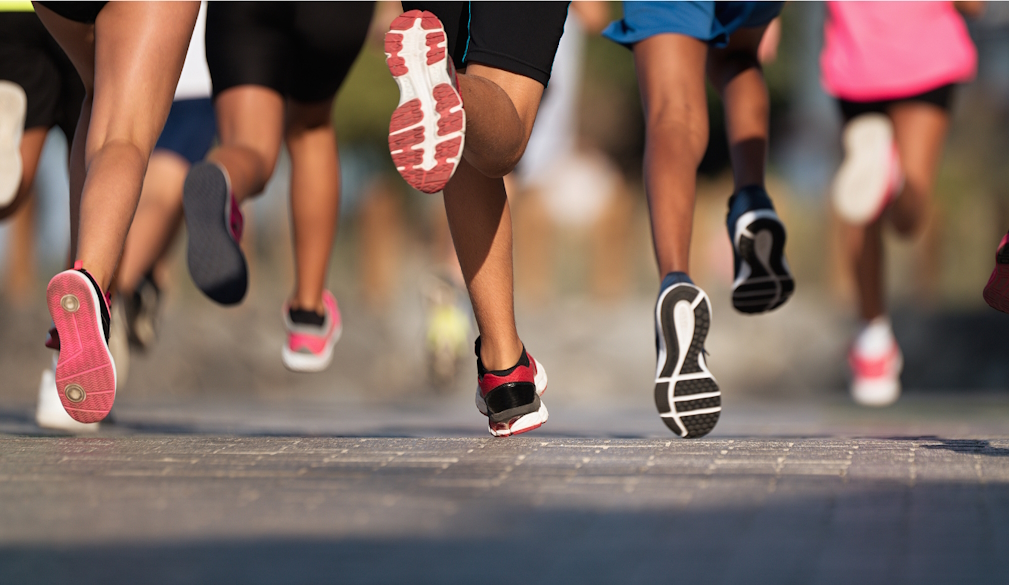
Humans and our ancestors have been running for millions of years[1]. Back then, it helped us capture – or avoid becoming – prey. Now, we do it to keep fit, boost mental health, unwind in nature, or play our favourite sport.
But while many of us were taught how to ride a bike, throw and catch a ball, or kick a footy, it seems very few people are ever taught how to run. You might’ve wondered: am I running wrong?
Well, the truth is there’s no one right way to run. Your ideal technique depends on factors such as leg and foot length, muscle mass, and even how springy your tendons are.
It also depends on whether you’re out for your Sunday run or running full pelt in a sprint.
That said, thinking a little more about how to run can make it feel easier and faster, and reduce injury risk.
Here are five basics to keep in mind.

1. Feet: how you land matters
Some of us land on our heels, others on the balls of our feet. If you grew up running barefoot, you’ll more often land towards the forefoot[3].
Debate rages on which is best. The truth is heel-first striking stresses the knees a bit more while forefoot landing places more impact on the calves and Achilles tendon[4].
So, if you’re injury prone in one of those areas, it might be worth adjusting your style.
But for healthy runners, there’s no strong evidence[5] one technique is better for injury.
If you’re considering a change, do it slowly[6] over several months, ideally with expert help.
As you run faster, you’ll bounce more in each step. You’ll naturally land more on your forefoot, especially when sprinting.
2. Legs: softer landings and smoother strides
Three things are worth focusing on:
- minimise the twisting of the legs under your body as you land, to reduce strain on knees and ankles
- keep your pelvis level[7] during landings (dropping or rotating it increases injury risk)
- don’t bounce too high; a smooth, low trajectory[8] uses less energy and keeps impacts manageable.
These principles are perfectly demonstrated by Ethiopian former long-distance runner Haile Gebrselassie:
Just keep relaxed, and allow the knees and ankles to flex normally.
If you find your landing style causes stress or pain, consider running with slightly shorter strides[9].
Then there’s the “leg recovery phase” – when your leg swings forward after push-off. During jogging, we pull the leg forward briefly with our hip muscles, but otherwise it’s a pretty passive task.
In sprinting, however, the faster leg recovery powered by your hip can contribute about 25% of your forward propulsion[10] in each step. So make sure you flex at the hip while you push back into the ground, so your legs act like scissors as they swing.
Also, the faster you run, the more your knee should flex, and the more the foot should rise under you. This helps the leg swing forwards faster.
In other words: pick your feet up more as you pick up the pace.
3. Arms: built-in shock absorbers
During jogging, your arms help with balance, absorbing bumps or stumbles, especially on uneven ground, as seen here:
They swing mostly passively and act as shock absorbers during jogging; they can’t do their job when they’re stiff[11]. Relaxation is key.
To keep energy cost low, try bending your elbows to keep their mass closer to your shoulder and keep your shoulders relaxed.
When sprinting, your arms become more active. They help stabilise your whole body in the short time your feet are on the ground.
Top sprint coaches often insist the “drive arm” (the arm swinging backwards) contributes to forward propulsion, thanks to physics.
But the limited studies[12] to date suggest the effect on propulsion is moderate; future studies might shed more light.
That said, the fastest sprinters, like Usain Bolt, are renowned for their aggressive backwards arm drive:
See how his drive arm whips backwards with rapid extension of the shoulder and elbow? Meanwhile, the recovery arm – swinging forwards – is more flexed and moves much slower.
4. Torso: lean just a little
When we run, the torso naturally rotates left and right. That’s fine, although when we run faster there should be less rotation. A more aggressive arm swing helps balance out these rotations.
Our pelvis then rotates in the opposite direction to the torso. The twisting helps us balance, but also contributes a little to forward force.
But as we run faster, these rotations should become smaller as we use our arms to balance better. As your speed increases, swing your arms a bit harder and your body, legs and other arm will follow.
Finally, it’s generally accepted that we keep our torso upright when we run relaxed, with only a very slight forward lean.
But if we want to speed up, leaning forward[13] is a great way to accelerate quickly without doing too much tiring muscle work.
And for those with knee troubles, leaning forward a bit might help reduce impact on the knees[14].

5. Head: a balancing act
You might be tempted to tilt your head down when you run, to watch your feet or in an effort to accelerate forwards.
But during upright (non-sprinting) running, try to keep it in normal position. Rest your head quietly on the top of your shoulders, just as as evolution intended[16].
During sprinting, try looking about 20 metres in front of you (a slight chin tuck is fine). When jogging, try looking ahead toward the horizon.
Not sure what your own technique looks like? Try asking a friend to take a quick video of you running. Compare it to an experienced runner running at the same speed.
You might be surprised what you notice.
References
- ^ running for millions of years (pubmed.ncbi.nlm.nih.gov)
- ^ Rocksweeper/Shutterstock (www.shutterstock.com)
- ^ towards the forefoot (pubmed.ncbi.nlm.nih.gov)
- ^ calves and Achilles tendon (pubmed.ncbi.nlm.nih.gov)
- ^ no strong evidence (pubmed.ncbi.nlm.nih.gov)
- ^ do it slowly (pubmed.ncbi.nlm.nih.gov)
- ^ pelvis level (pubmed.ncbi.nlm.nih.gov)
- ^ smooth, low trajectory (pubmed.ncbi.nlm.nih.gov)
- ^ slightly shorter strides (pubmed.ncbi.nlm.nih.gov)
- ^ 25% of your forward propulsion (pubmed.ncbi.nlm.nih.gov)
- ^ stiff (pubmed.ncbi.nlm.nih.gov)
- ^ limited studies (pubmed.ncbi.nlm.nih.gov)
- ^ leaning forward (pubmed.ncbi.nlm.nih.gov)
- ^ reduce impact on the knees (pubmed.ncbi.nlm.nih.gov)
- ^ Demkat/Shutterstock (www.shutterstock.com)
- ^ just as as evolution intended (pubmed.ncbi.nlm.nih.gov)