Is there a right way to talk to your baby? A baby brain expert explains ‘parentese’
- Written by: Jane Herbert, Associate Professor in Developmental Psychology, University of Wollongong
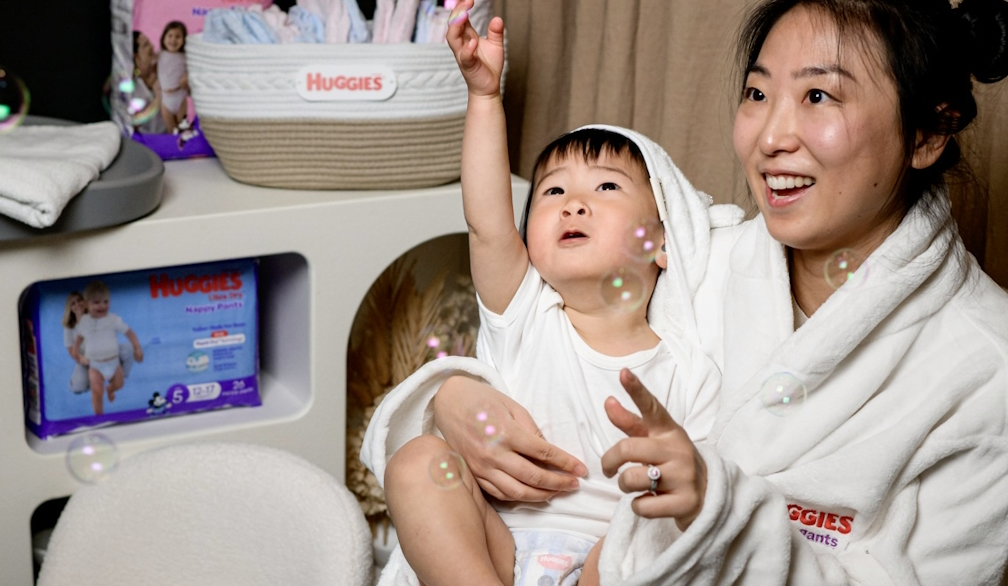
You might have seen those heartwarming and often funny viral videos where parents or carers engage in long “talks” with young babies about this and that – usually just fun chit chat of no great consequence.
They’re often very sweet, and it’s lovely to see the babies’ faces lighting up at the sound of their mother or carer’s voice, or seeming to talk back. In one, the baby appears to reply in an accent strikingly similar to their carer’s:
So, what’s going on when we chat like this to babies? And is it better to chat to them in the tone and pace we’d use when talking to other adults, or is it OK to talk in a slower, higher pitched, sing-song voice?
Here’s what the research shows so far.
Talking to your baby matters
When you speak with your baby, they are exposed to a rich tapestry of sounds and movements. Can babies make sense of all this input?
Well, by the time they’re born babies are already highly experienced with their mother’s voice as well as other language sounds they’ve heard while in utero.
In fact, research shows newborns prefer listening to the language they heard in utero rather than an unfamiliar language[1].
They also prefer to hear the story their mother read aloud regularly in the final weeks of pregnancy[2], compared to a different story – regardless of who is reading it.
So, although newborns are yet to understand the meaning of these words, they are already tuned in to the importance of language.
Given the vast exposure that most young babies have with their parent’s voice, passively listening to mum or dad talking is likely to be comforting.
Time spent together in close physical contact with a highly familiar person producing familiar sounds creates a safe, secure space rich in learning opportunities.
Babies can learn a lot about conversational style from just listening to and watching the way their parent communicates.
In fact, babies mimic their parents’ gestures[3], which can help build their vocabulary over time. The social context influences language skills.

What if I run out of things to say?
If you’re not a fan of monologuing to your baby, don’t worry. They’re not missing out.
In fact, constant exposure to long monologues by a parent is unlikely to provide the baby with a particularly supportive language environment for developing their understanding or production of words.
Adult language is extremely complex. It takes a lot of experience with language before a string of sounds like “Yourdadlikeschocolatemoltenlavacake[5]” can be interpreted as individual words linked to people, objects, or concepts.
One of the most effective ways to support early word recognition[6] and promote attention to the structure of language[7] is for the adult to use a simplified way of speaking to the baby.
“Parentese” is characterised by the use of higher pitch sounds, elongated vowels, and a slower pace of speaking. Real words are presented in a sing-song, happy voice.
Parentese draws the baby’s attention to words, and highlights how information in speech chunks together[8]. Babies have been found to prefer to listen to this style of speaking[9] compared to standard speech.

Speaking ‘parentese’
Parentese is not the same thing as “baby talk”. Baby talk involves the use of nonsense words, and the modelling of incorrect speech sounds and grammar. A baby is not being supported to learn the word “water” if they are repeatedly presented with a nonsense label like “waa waa” for their drink.
One US study found that when parents were trained to use parentese with their infants at six and ten months, the infants showed an increase in babbling and said more words at 14 months[11], compared to infants of parents who did not receive this training.
Other research has shown consistent use of parentese in the early years can help build the complexity of children’s language skills at five years of age[12].
Learning to talk is not simply the product of hearing lots of words. In the first weeks of life, infants are already beginning to produce coos and murmurs that both parents and outside observers judge to be intentional vocalisations[13].
Try responding to these sounds by imitating them and then interpreting what your baby might be trying to say. This enables them to take a turn as a social partner in the conservation.
When even very young babies take turns in conversations with an adult, the quality of their vocalisations increases[14].
At the youngest ages, time spent talking together in face-to-face interactions best supports language development.
With age, babies become increasingly interested in the objects in their environment.
 Try responding to your baby’s sounds by imitating them and interpreting what they might be trying to say. Halfpoint/Shutterstock[15]
So, what should I do?
An effective way to boost language learning from about nine months of age is to notice what’s captured your baby’s attention and talk about that.
Try labelling and describing what your baby is looking at, playing with, pointing at, or babbling towards.
Research[16] by colleagues and I found encouraging parents to engage in 15 minutes of this kind of talk a day with their 11-month-olds for a month was effective in promoting vocabulary growth at 15 and 18 months.
Overall, a rich language environment[17] is created by engaging with your baby in a wide range of activities – via games, songs, and reading aloud – not just having focused conversations.
References
- ^ heard in utero rather than an unfamiliar language (infantstudies-psych.sites.olt.ubc.ca)
- ^ final weeks of pregnancy (www.sciencedirect.com)
- ^ mimic their parents’ gestures (doi.org)
- ^ Photo by Josh Willink/Pexels (www.pexels.com)
- ^ Yourdadlikeschocolatemoltenlavacake (www.tiktok.com)
- ^ support early word recognition (onlinelibrary.wiley.com)
- ^ promote attention to the structure of language (www.cambridge.org)
- ^ how information in speech chunks together (journals.sagepub.com)
- ^ Babies have been found to prefer to listen to this style of speaking (doi.org)
- ^ Tomsickova Tatyana/Shutterstock (www.shutterstock.com)
- ^ an increase in babbling and said more words at 14 months (onlinelibrary.wiley.com)
- ^ five years of age (www.cambridge.org)
- ^ judge to be intentional vocalisations (www.taylorfrancis.com)
- ^ the quality of their vocalisations increases (www.cambridge.org)
- ^ Halfpoint/Shutterstock (www.shutterstock.com)
- ^ Research (acamh.onlinelibrary.wiley.com)
- ^ rich language environment (journals.lww.com)