We have the proof that logging makes Tasmania’s forests more flammable
- Written by: David Bowman, Professor of Pyrogeography and Fire Science, University of Tasmania
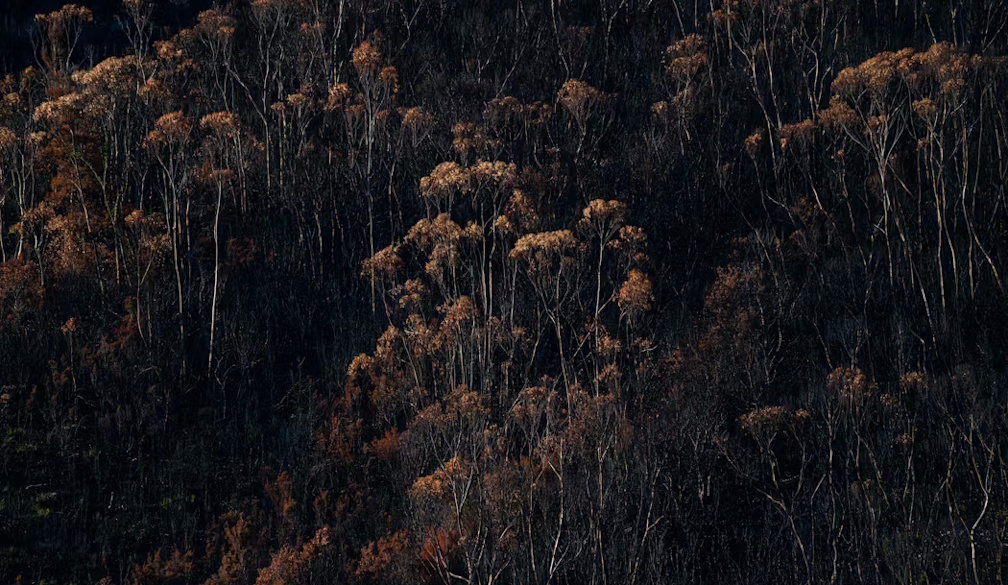
In 1967, catastrophic bushfires[1] in Tasmania killed dozens of people – and very nearly destroyed Hobart.
A year later, W.D. Jackson, Professor of Botany at the University of Tasmania, published[2] a short but very influential article on why the fires were so bad. He suggested that after Tasmania’s wet eucalypt forests were burned by severe bushfires, there would be a high-risk period during their regrowth when they are at risk of severely burning again.
This, Jackson theorised, was because regrowing saplings form a very dense canopy, with little distance between living leaves and the leaf litter and understorey plants able to ignite canopy fires. If a second fire sweeps through, he predicted the forests could be replaced with more fire-tolerant scrub.
Was Jackson correct? Is regrowth truly more flammable? It’s very difficult to prove regrowth burns more intensely and accelerates bushfire spread, as it’s not practical to undertake neat, perfectly controlled experiments involving severe bushfires.
But sometimes, scientists get lucky. We took advantage of a natural experiment in 2019, when a severe bushfire burned through a research site spanning old growth wet Tasmanian forests and logged areas of regrowth, giving us access to data before and after the fires.
In our new research[3], we show Jackson was right. Regrowth does indeed burn more intensely than mature forests.
Why does this matter?
Jackson’s theory has resonated with generations of fire ecologists and fire managers in Australia and internationally[5], due to how it focuses on the interplay between the age of forests and the risk of bushfires.
Worldwide, vast areas of regrowth forest are recovering from clear-fell forestry and wildfires. In Tasmania alone, remote sensing data suggests[6] a fifth of all tall wet forests are in a regrowth stage younger than 40 years old.
After an old forest is clear-felled, it is regenerated using fire to remove logging debris and then sown with seeds native to the area. This puts it in Jackson’s 30-year danger zone, which begins about 20 years after a fire, when eucalypts begin bearing gumnuts. It ends about 50 years after the fire, when trees are tall enough and moist dense understoreys have developed to lower the risk of devastating fires able to kill mature trees.
If regrowing forests make it through centuries without more fires, they could potentially become temperate rainforests, whose deeply shaded, moist understoreys put them at very low risk of fire.
If another severe fire starts before forests reach this safer period, experts have suggested[7] the flammable regrowth could threaten entire landscapes by making fires more intense.
Some experts suggested[8] forests regrowing from logging were a key factor in the huge area burned during the notorious 2019–20 fire season, though others have disputed this[9].
This is why Jackson’s theory still matters, almost 60 years after he proposed it.
Hard to test
Testing this theory has long proved difficult.
Forest ecologists have instead typically relied on indirect approaches, such as analysing how severe the fire was using satellite data[10], or estimating likely fire behaviour based on[11] field measurements of the amount of fuel and how much moisture was present.
These inferential approaches can be scientifically fraught, as they are vulnerable to many assumptions that are hard to test or control for.
A previous attempt to resolve this question by experts, including the renowned Tasmanian ecologist J.B. Kirkpatrick had to be withdrawn[12] due to technical issues. In retracting the paper, the authors noted their results had proven “highly sensitive” to variation in a small number of sites.
A natural experiment
In 2019, a lightning strike ignited a fire in Tasmania’s southwest forests. Known as the Riveaux Road fire[13], it burned through an area of regrowing forest used for research.
This offered a rare chance of a natural experiment. We had pre-fire data on fuel loads, canopy structure and microclimates (areas where local conditions make climate different from surrounding areas) in both mature forests and adjacent areas logged around 40 years earlier.
After the fire passed, we collected more data so we could compare the fire damage (measured by damage to tree canopy) and the effects on the microclimates in both regrowth and mature, unlogged forests.
This natural experiment was conclusive. The areas of post-logging regrowth burned more severely, due to their hotter, drier microclimates and the fact their canopies were closer to the ground.
Interestingly, we found fires in the regrowth didn’t cause the fires to spread further. This was because the damp understorey of the surrounding mature forests could contain the fires.
That’s not to say this would always be the case. The 2019 fire took place in moderate fire weather conditions, meaning it wasn’t especially hot, dry or windy. If severe fire weather was present, this dampening effect would likely have been overwhelmed[14].
In 2019, the Riveaux Road fire swept across parts of southeastern Tasmania – including a research site. Lauren Dauphin/NASA Earth Observatory[15]Lots of regrowth, lots more fire
Proving Jackson’s theory isn’t good news for forests.
Climate change means fire weather will arrive more often and be more extreme. Combined with the large areas of forest regrowth, this means we will have to be ready for more fires.
In North American conifer forests, thinning out regrowth and burning off leaf litter and other fuel have proven effective[16] in reducing the risks of fire-prone regrowth. Eucalypts have fundamentally different fire ecologies, so we can’t directly apply that research to Australia. Local research is limited, meaning we don’t know yet if this will work here.
Recent research has shown[17] commercial thinning of regrowth in Tasmania doesn’t reduce the risk of fire, because bark, limbs and smashed trunks left after logging act as fuel.
This means we urgently need to find an effective way to reduce the risk of fires in regrowth in wet eucalypt forests in Tasmania and elsewhere in Australia.
Since the lethal fires of 1967, many Tasmanian communities – including large areas of Hobart – are now surrounded by forests still in the dangerous period of regrowth after logging or fires.
Read more: In 1939, a Royal Commission found burning forests leads to more bushfires. But this cycle of destruction can be stopped[18]
References
- ^ catastrophic bushfires (knowledge.aidr.org.au)
- ^ published (doi.org)
- ^ new research (doi.org)
- ^ Rob Blakers/AAP (photos.aap.com.au)
- ^ internationally (doi.org)
- ^ suggests (doi.org)
- ^ have suggested (doi.org)
- ^ suggested (doi.org)
- ^ disputed this (doi.org)
- ^ using satellite data (doi.org)
- ^ based on (doi.org)
- ^ withdrawn (doi.org)
- ^ Riveaux Road fire (www.theguardian.com)
- ^ been overwhelmed (doi.org)
- ^ Lauren Dauphin/NASA Earth Observatory (photos.aap.com.au)
- ^ proven effective (doi.org)
- ^ has shown (doi.org)
- ^ In 1939, a Royal Commission found burning forests leads to more bushfires. But this cycle of destruction can be stopped (theconversation.com)