An ‘arms race’ of promises as prime minister set to call election
- Written by: Michelle Grattan, Professorial Fellow, University of Canberra
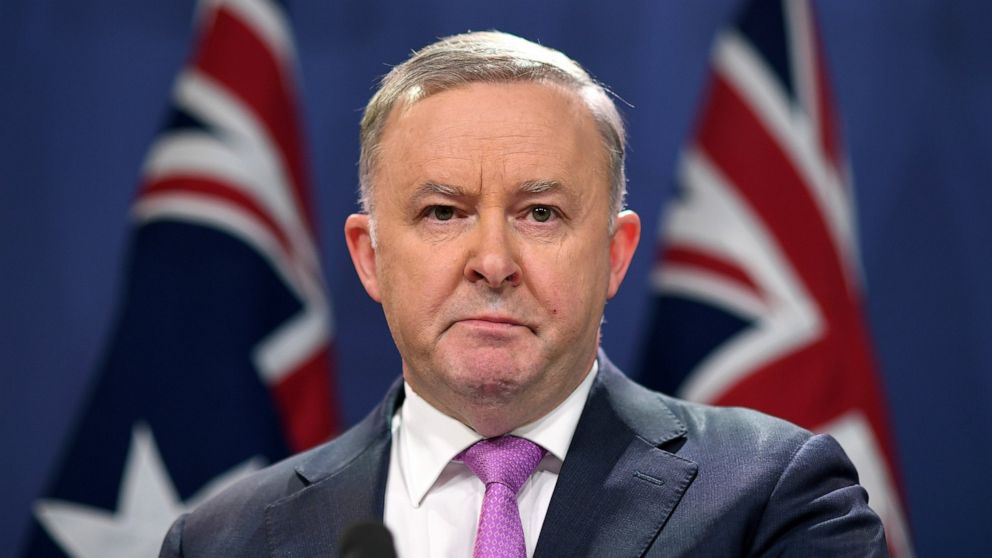
Oops. Anthony Albanese’s own department pre-empted its boss on Thursday. Some unfortunate official, pressing the wrong button, posted on X that the government was in “caretaker” mode, although the prime minister had not yet called the election.
There was a grovelling apology from the department, saying it was trying to find out why the error occurred.
No matter. The department was only a day early. Albanese goes to government house on Friday for an election on May 3.
Indeed, most players and observers had expected, before Cyclone Alfred, that the campaign, with its “caretaker” period, would be well under way by now.
Instead, we’ve had this budget week that’s seen an auction of handouts.
First, the budget announced the tax cuts, which are more than a year away, and will be delivered in two stages, They are, to use Treasurer Jim Chalmers’ description, “modest”.
Then came Peter Dutton’s counter hit – a halving of the excise on petrol and diesel, briefed out ahead of his budget reply. The benefit would come more quickly – but would only last a year. This is a recycled, extended version of the Morrison government’s 2022 excise cut. Labor supported the 2022 move, but rejects Dutton’s proposal.
The budget we nearly didn’t have gave Chalmers the stage to strut his stuff. Budget weeks traditionally belong to treasurers who, among other things, do a walkabout through the ranks of the journalists who are “locked up” and ploughing through the embargoed budget documents. So some old hands were surprised when the PM appeared with a senior staffer to do his own walkabout. Precedents didn’t come to mind.
Labor sought to wedge the Coalition by pushing through legislation to enshrine the tax cuts. The Coalition voted against them in parliament, then declared if elected, it would repeal them. Dutton has confirmed he won’t be announcing any policy for tax cuts closer to the election.
For the Liberals, to be seen opposing an income tax cut is unusual and risky. It’s made for campaign slogans. “The only thing they don’t want to cut is people’s taxes,” Albanese declared. “Labor is the party of lower taxes.” Both sides will be watching their polling carefully in coming days to see whether this stand rebounds against the Liberals.
The opposition believes its excise reduction will hit the mark, especially in the seats it is most targeting – those in the outer suburbs where people drive a lot.
But Kos Samaras, from the Redbridge political consultancy, predicts people will see this “arms race” of handouts as providing just band-aids, with the measures likely to cancel each other out.
Apart from the excise measure, the other big initiative in Dutton’s reply was his plan for a gas reservation scheme.
This is designed to fill what has been an apparent big hole in the opposition’s energy policy. It has its ambitious (many would say unrealistic) nuclear plan for the long term. But if it is arguing it would be able to bring down energy bills any time soon, it needs a here-and-now policy to do so.
Its answer is to turn to gas. That requires ensuring a reliable and adequate supply for the local market, to drive down the price.
“Gas sold on the domestic market will be de-coupled from overseas markets to protect Australia from international price shocks,” Dutton said in his Thursday speech. “And this will drive down new wholesale domestic gas prices from over $14 per gigajoule to under $10 per gigajoule.”
Dutton told the ABC after his address that the price fall could be achieved by the end of this calendar year.
That estimate sounds like a hostage to fortune. Precision can be dangerous when it comes to energy promises. Who can forget that number Labor put out so confidently before the last election – a $275 fall in household power bills?
Critics will find all sorts of issues with Dutton’s east coast reservation scheme, including that it would be heavily interventionist and there’s no guarantee it would work. Labor says Dutton is reheating one of its old plans, and that the government has the gas situation under control anyway.
The opposition says its plan is in line with warnings on gas supply released by the Australian Competition and Consumer Commission on Thursday.
The potential effectiveness of Dutton’s gas plan will be highly contested. What is not in dispute is that the partisan divide over the energy transition will be one of the central issues of the campaign.
This week the prime minister has had a spring in his step. The polls have improved somewhat, and the “vibe” seems to be with him. Responding to a challenge from a couple of podcasters, he playfully put the phrase “delulu with no solulu” into a speech to describe his opponents. Never mind that middle-aged politicians sound slightly absurd when they try to be hip. Albanese is a confidence player and at the moment his confidence is up.
The tactical games aren’t just around the tax cuts. Calling the election first thing Friday carpet bombs Dutton’s budget reply.
And once the election is called, parliament will be prorogued and that will scrap the Friday sitting of estimates committees, denying the opposition an opportunity to quiz officials about the budget and other matters. (On Thursday, the “caretaker” fiasco became public during an estimates hearing, surprising officials from the PM’s department who happened to be appearing at the time.)
For his part, Dutton understands the odds against him.
Political scientist Rodney Tiffen, in an analysis of federal campaigns from 1972 to 2022, found no example where an opposition had started the campaign roughly equal in the polls and won, and three where it had lost (1980, 1987, and 2004). “All winning oppositions started the campaign already ahead,” Tiffen writes in a chapter in The Art of Opposition[1].
In his budget reply, Dutton delivered one revealing line: “This election is as much about leadership as it’s about policy”.
Dutton casts himself as the leader who would make the tough decisions. “I will lead with conviction – not walk both sides of the street,” he said.
“I will be a strong leader and a steady hand – just as John Howard was.”
Dutton might see Howard as his role model, but it will be a big leap of faith for many voters to see the opposition as a contemporary Howard.
References
- ^ The Art of Opposition (www.connorcourtpublishing.com.au)