1 in 5 Australian workers are either underemployed or out of work: white paper
- Written by: John Hawkins, Senior Lecturer, Canberra School of Politics, Economics and Society, University of Canberra
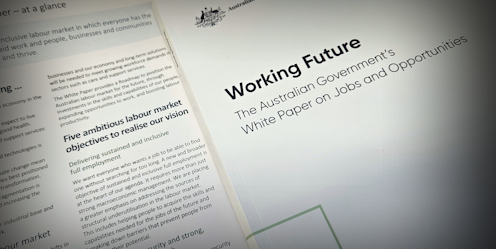
Today’s employment white paper[1] has adopted the broadest-ever definition of what “full employment” means for Australia.
The new paper says closer to 2.8 million Australians are either underemployed or out of work – equivalent to one-fifth of the current workforce. That new estimate is much higher than the official unemployment total of 539,700.
Going further than any of the previous employment white papers over the past 80 years, the new report defines full employment as meaning
everyone who wants a job should be able to find one without searching for too long
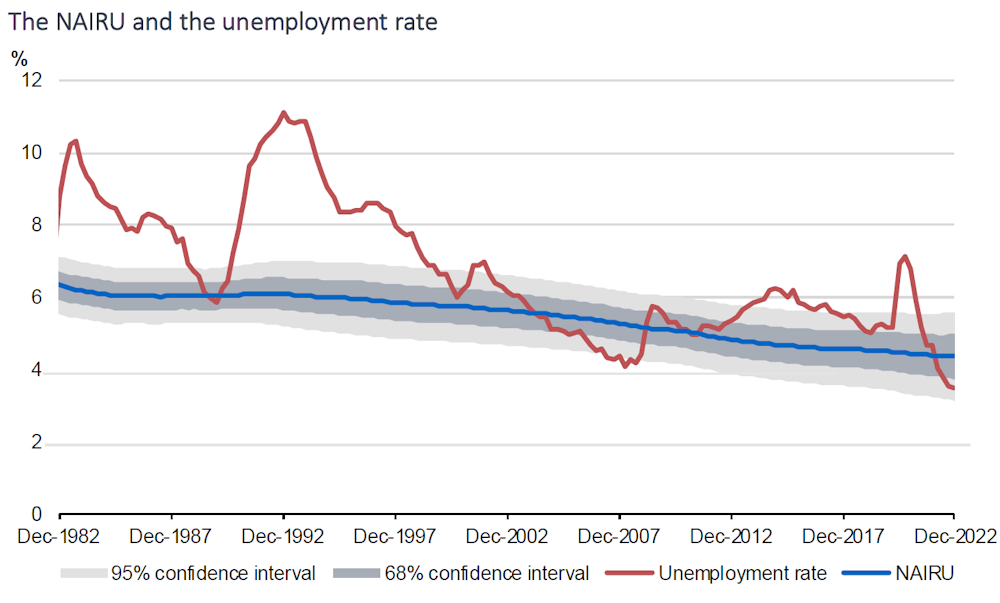
While it commits the government to keeping employment as close as possible to the current maximum sustainable level “consistent with low and stable inflation”, it goes further, noting that this measure – the so-called non-accelerating inflation rate of unemployment (NAIRU) – has been falling and is hard to estimate.
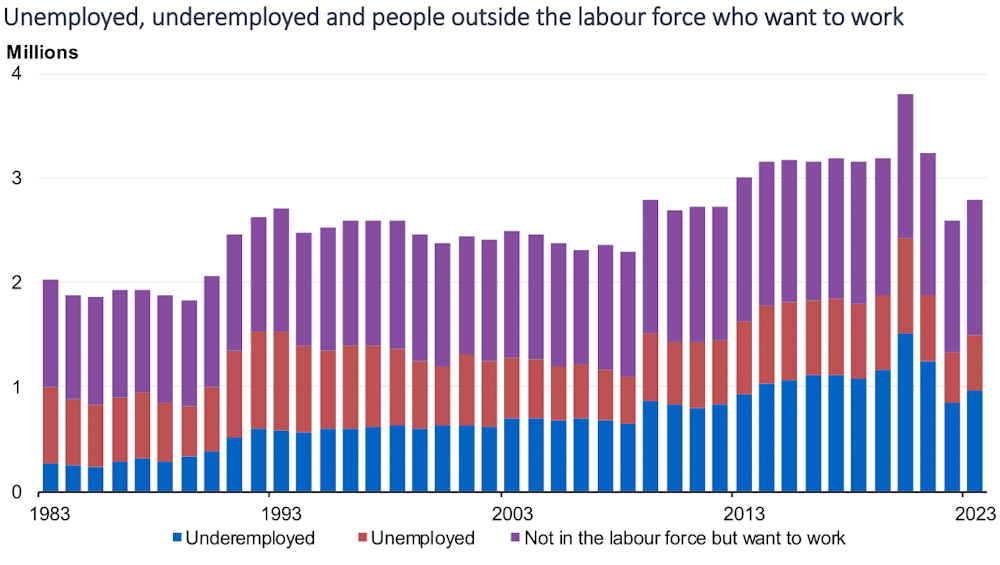 Unemployed and underemployed series report the August monthly outcome for respective years, whereas the ‘Not in the labour force but want to work’ series reflects different months of the year based on the different timing of the survey across years. This group also includes workers who have said they had a job to return to, but were considered outside the labour force at the time of the survey. These data are not seasonally adjusted.
Commonwealth Treasury, 2023 employment white paper[3]
The white paper also talks of “inclusive full employment”, by which it means “broadening labour market opportunities” to encourage more people to seek jobs.
Economists refer to this as further increasing the participation rate[4], which is already near a record high.
Enhanced support for childcare (already announced[5] in Labor’s first budget) is one of the sorts of measures that would help, reducing barriers to work for parents.
Another, announced in this white paper, is a permanent extension of the A$11,800 work bonus for pensioners over age pension age and eligible veterans, which was temporarily lifted from $7,800 to $11,800 in the October 2022 budget.
Read more:
Employment white paper to deliver more highly qualified workers in net zero, care and digitisation[6]
Employment white papers date back to WWII
This isn’t the first Australian government employment white paper.
The very first was released by the wartime Curtin government in 1945, entitled Full Employment in Australia[7].
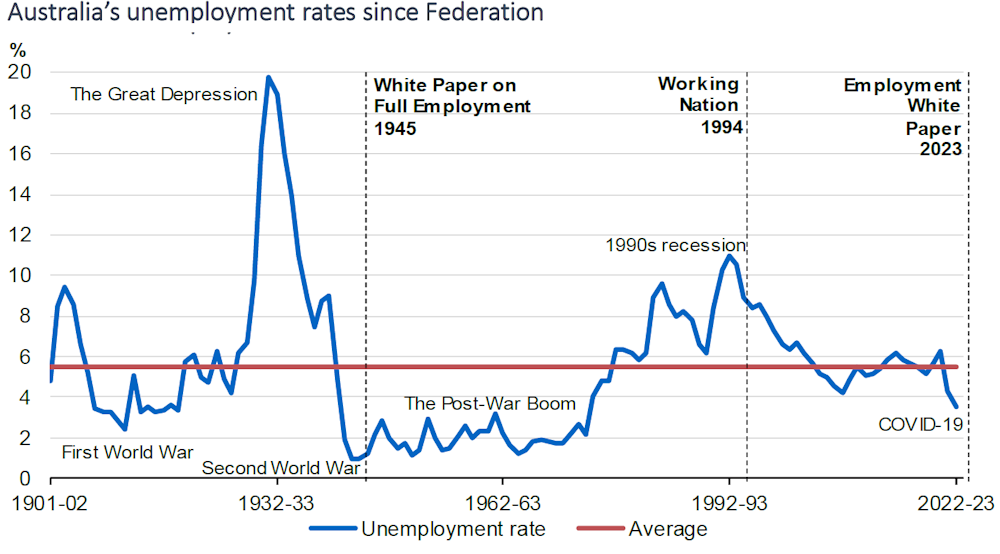
Curtin wanted to ensure that post-war unemployment would not return to the extraordinarily high levels experienced in the 1930s.
Unemployed and underemployed series report the August monthly outcome for respective years, whereas the ‘Not in the labour force but want to work’ series reflects different months of the year based on the different timing of the survey across years. This group also includes workers who have said they had a job to return to, but were considered outside the labour force at the time of the survey. These data are not seasonally adjusted.
Commonwealth Treasury, 2023 employment white paper[3]
The white paper also talks of “inclusive full employment”, by which it means “broadening labour market opportunities” to encourage more people to seek jobs.
Economists refer to this as further increasing the participation rate[4], which is already near a record high.
Enhanced support for childcare (already announced[5] in Labor’s first budget) is one of the sorts of measures that would help, reducing barriers to work for parents.
Another, announced in this white paper, is a permanent extension of the A$11,800 work bonus for pensioners over age pension age and eligible veterans, which was temporarily lifted from $7,800 to $11,800 in the October 2022 budget.
Read more:
Employment white paper to deliver more highly qualified workers in net zero, care and digitisation[6]
Employment white papers date back to WWII
This isn’t the first Australian government employment white paper.
The very first was released by the wartime Curtin government in 1945, entitled Full Employment in Australia[7].
Curtin wanted to ensure that post-war unemployment would not return to the extraordinarily high levels experienced in the 1930s.
 Commonwealth Treasury, 2023 employment white paper[8]
That 1945 white paper was inspired by the British white paper[9] released in 1944, which set out an ambitious plan to carry forward the high employment achieved during wartime into peacetime.
A large team of economists and other experts, led by HC “Nugget” Coombs[10], spent almost a year preparing the white paper, producing eight drafts[11].
No specific target for our unemployment rate
As with today’s white paper, the 1945 full employment white paper didn’t put a number on the unemployment rate which corresponds to “full employment” – although early drafts of the 1945 paper included numbers ranging from 2% to 5%.
The 1965 Vernon Report[12] on the economy was more optimistic, defining full employment as an unemployment rate of 1 to 1.5%.
The Keating government’s Working Nation[13] paper – released in 1994 when unemployment was almost 10% – adopted a target of 5% by 2000. That wasn’t quite met – unemployment remained above 6% in 2000, but fell to 5% by 2004.
By 2010, many economists regarded 5%[14] as effectively “full employment”.
In June this year, the present Reserve Bank governor, Michele Bullock, defined[15] full employment as
the point at which there is a balance between demand and supply in the labour market (and in the markets for goods and services) with inflation at the inflation target
She nominated an unemployment rate of around 4.5%[16].
Australian economists surveyed by The Conversation and the Economic Society of Australia last month nominated 4%[17]. Curiously, that’s the same rate nominated by the Department of Postwar Reconstruction’s Chief Economist, Trevor Swan, in work for the full employment white paper in 1945.
The words, but not the numbers, in today’s employment white paper are consistent with an unemployment rate of 4% or lower.
Read more:
We can and should keep unemployment below 4%, say top economists[18]
Few ideas for lifting productivity
The white paper identifies labour productivity (output per hour worked) as crucial to increasing the purchasing power of wages, yet details few ideas for increasing it.
Labour productivity has slowed over recent decades, and in recent years has actually fallen. The causes are not obvious. Some of it may be a temporary reflection of the very desirable reductions in unemployment.
Workers who have been out of work for a while are, at first, likely to produce less than workers already in work.
Declining labour productivity is also likely to reflect the gradual shift from manufacturing to services.
The white paper says the services sector now accounts for more than 80% of employment, compared to around 50% at the turn of the 20th century.
Productivity in many services is hard to increase. A haircut or a live performance of Vivaldi’s Four Seasons by a string quartet takes about as many hours of labour now as it did a century ago.
Read more:
Government's employment white paper commits to jobs for all who want them – and help to get them[19]
But weak productivity probably also reflects other things. The white paper refers to evidence that dynamism and innovation have declined in Australia. This is not easy to address. The government’s two-year competition review[20] will help.
And low investment is another problem. Companies might not be moving fast enough to equip workers with the tools they need to help them produce more.
A more robust economy might encourage them to invest, as could tax changes – but they were beyond the scope of this white paper.
References^ employment white paper (treasury.gov.au)^ Commonwealth Treasury, 2023 employment white paper (treasury.gov.au)^ Commonwealth Treasury, 2023 employment white paper (treasury.gov.au)^ participation rate (www.investopedia.com)^ already announced (www.theguardian.com)^ Employment white paper to deliver more highly qualified workers in net zero, care and digitisation (theconversation.com)^ Full Employment in Australia (www.billmitchell.org)^ Commonwealth Treasury, 2023 employment white paper (treasury.gov.au)^ British white paper (c59574e9047e61130f13-3f71d0fe2b653c4f00f32175760e96e7.ssl.cf1.rackcdn.com)^ HC “Nugget” Coombs (www.rba.gov.au)^ eight drafts (catalogue.nla.gov.au)^ Vernon Report (www.smh.com.au)^ Working Nation (theconversation.com)^ 5% (www.smh.com.au)^ defined (www.rba.gov.au)^ 4.5% (www.rba.gov.au)^ 4% (theconversation.com)^ We can and should keep unemployment below 4%, say top economists (theconversation.com)^ Government's employment white paper commits to jobs for all who want them – and help to get them (theconversation.com)^ competition review (treasury.gov.au)Authors: John Hawkins, Senior Lecturer, Canberra School of Politics, Economics and Society, University of Canberra
Commonwealth Treasury, 2023 employment white paper[8]
That 1945 white paper was inspired by the British white paper[9] released in 1944, which set out an ambitious plan to carry forward the high employment achieved during wartime into peacetime.
A large team of economists and other experts, led by HC “Nugget” Coombs[10], spent almost a year preparing the white paper, producing eight drafts[11].
No specific target for our unemployment rate
As with today’s white paper, the 1945 full employment white paper didn’t put a number on the unemployment rate which corresponds to “full employment” – although early drafts of the 1945 paper included numbers ranging from 2% to 5%.
The 1965 Vernon Report[12] on the economy was more optimistic, defining full employment as an unemployment rate of 1 to 1.5%.
The Keating government’s Working Nation[13] paper – released in 1994 when unemployment was almost 10% – adopted a target of 5% by 2000. That wasn’t quite met – unemployment remained above 6% in 2000, but fell to 5% by 2004.
By 2010, many economists regarded 5%[14] as effectively “full employment”.
In June this year, the present Reserve Bank governor, Michele Bullock, defined[15] full employment as
the point at which there is a balance between demand and supply in the labour market (and in the markets for goods and services) with inflation at the inflation target
She nominated an unemployment rate of around 4.5%[16].
Australian economists surveyed by The Conversation and the Economic Society of Australia last month nominated 4%[17]. Curiously, that’s the same rate nominated by the Department of Postwar Reconstruction’s Chief Economist, Trevor Swan, in work for the full employment white paper in 1945.
The words, but not the numbers, in today’s employment white paper are consistent with an unemployment rate of 4% or lower.
Read more:
We can and should keep unemployment below 4%, say top economists[18]
Few ideas for lifting productivity
The white paper identifies labour productivity (output per hour worked) as crucial to increasing the purchasing power of wages, yet details few ideas for increasing it.
Labour productivity has slowed over recent decades, and in recent years has actually fallen. The causes are not obvious. Some of it may be a temporary reflection of the very desirable reductions in unemployment.
Workers who have been out of work for a while are, at first, likely to produce less than workers already in work.
Declining labour productivity is also likely to reflect the gradual shift from manufacturing to services.
The white paper says the services sector now accounts for more than 80% of employment, compared to around 50% at the turn of the 20th century.
Productivity in many services is hard to increase. A haircut or a live performance of Vivaldi’s Four Seasons by a string quartet takes about as many hours of labour now as it did a century ago.
Read more:
Government's employment white paper commits to jobs for all who want them – and help to get them[19]
But weak productivity probably also reflects other things. The white paper refers to evidence that dynamism and innovation have declined in Australia. This is not easy to address. The government’s two-year competition review[20] will help.
And low investment is another problem. Companies might not be moving fast enough to equip workers with the tools they need to help them produce more.
A more robust economy might encourage them to invest, as could tax changes – but they were beyond the scope of this white paper.
References^ employment white paper (treasury.gov.au)^ Commonwealth Treasury, 2023 employment white paper (treasury.gov.au)^ Commonwealth Treasury, 2023 employment white paper (treasury.gov.au)^ participation rate (www.investopedia.com)^ already announced (www.theguardian.com)^ Employment white paper to deliver more highly qualified workers in net zero, care and digitisation (theconversation.com)^ Full Employment in Australia (www.billmitchell.org)^ Commonwealth Treasury, 2023 employment white paper (treasury.gov.au)^ British white paper (c59574e9047e61130f13-3f71d0fe2b653c4f00f32175760e96e7.ssl.cf1.rackcdn.com)^ HC “Nugget” Coombs (www.rba.gov.au)^ eight drafts (catalogue.nla.gov.au)^ Vernon Report (www.smh.com.au)^ Working Nation (theconversation.com)^ 5% (www.smh.com.au)^ defined (www.rba.gov.au)^ 4.5% (www.rba.gov.au)^ 4% (theconversation.com)^ We can and should keep unemployment below 4%, say top economists (theconversation.com)^ Government's employment white paper commits to jobs for all who want them – and help to get them (theconversation.com)^ competition review (treasury.gov.au)Authors: John Hawkins, Senior Lecturer, Canberra School of Politics, Economics and Society, University of Canberra