Google AI
The Times Australia

Times Media

Optus said it didn't have the 'soundbite' to explain the crisis. We should expect better

  • Written by: Peter Roberts, Lecturer, School of the Arts and Media, UNSW Sydney

Optus said it didn't have the 'soundbite' to explain the crisis. We should expect better

Asked on Wednesday to explain why Optus broadband and mobile services had been simultaneously knocked out for five hours, its chief executive Kelly Bayer Rosmarin blamed a “technical network fault[1]”, and then added:

There is no soundbite that is going to do it justice, so we want to really bottom-out the root cause, and when we have that very clear and in a digestible form, we will be forthcoming.

There are a couple of ways to interpret this statement. Either she didn’t want to indicate what her engineers really thought had happened, or she believed Optus users wouldn’t be able to understand the truth.

Or she might not have been thinking about Optus users.

Her reference to a “soundbite[2]” seems to suggest Optus regards its key audience as the media rather than its customers.

Optus is baked into too much of what we do

With more than 10 million[3] mobile customers alone, accounting for more than one-third of Australia’s population, the Singapore-owned[4] Optus has become integrated into almost everything[5] Australia does, from the operation of railways to automatic teller machines, to hospitals to emergency services.

Its customers, both corporate and personal, have become increasingly familiar with technical terms and technical explanations.

Those customers not only know more than they did – understanding many of the terms that apply to both software and hardware – but they expect more from technology, knowing that even some of their own jobs can potentially be replaced by artificially intelligent algorithms.

Many of those customers would be not only be asking “how did this happen”, but also “how could this be allowed to happen, given what technology is capable of”.
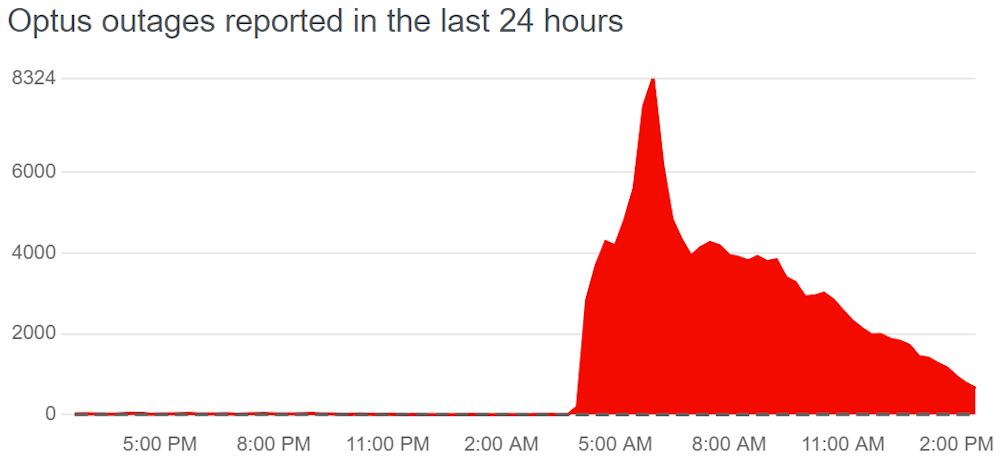
DownDetector, November 8 2023[6] The golden hour Crisis communicators have long spoken of the need to respond within the so-called “golden hour[7]”, a concept taken from the emergency services where it is important to get to the injured party promptly. In an increasingly automated world, that’s what Optus ought to have been able to do. Its core business is using technology for communications. If it couldn’t use its mobile network, it ought to have been ready to use something else, even email. Technology firms have built-in intensifiers Crisis communications expert Timothy Coombs argues that the damage done to reputations during a crisis can be worsened by “intensifiers[8]”, such as the organisation’s past history of crises, its track record, and sometimes the severity of damage caused. Significantly, he finds no “halo effect” from having handled things well in the past, only a “Velcro effect” from having handled things badly. Read more: In a crisis, Optus appears to be ignoring Communications 101[9] To that I would add that a further intensifier is the extent to which an organisation suffering from a technology failure is itself a technology organisation. It’s hard to argue you are a victim of something you have put yourself forward as a master of. Sharing what it knows, on the assumption that at least some of its users will understand it, would be one way of indicating that Optus trusts its customers and is worthy of their trust. References^ technical network fault (www.afr.com)^ soundbite (dictionary.cambridge.org)^ 10 million (treasury.gov.au)^ Singapore-owned (www.singtel.com)^ almost everything (www.9news.com.au)^ DownDetector, November 8 2023 (downdetector.com.au)^ golden hour (www.linkedin.com)^ intensifiers (journals.sagepub.com)^ In a crisis, Optus appears to be ignoring Communications 101 (theconversation.com)Authors: Peter Roberts, Lecturer, School of the Arts and Media, UNSW Sydney

Read more https://theconversation.com/optus-said-it-didnt-have-the-soundbite-to-explain-the-crisis-we-should-expect-better-217302

Business Times

Top doctors tip in another $3.5M into AI medtech capital raise

Medow Health AI ip in another $3.5M into AI medtech capital raise Medow Health AI, the Australian health-tech company buildin...

Australians are still spending — so why are shops closing?

Walk through many Australian shopping strips and there is a contradiction in plain sight. Australians are spending more mo...

Australian Investors Urged to Look Past the Headlines as Reportin…

Australia's reporting season delivered uneven results, sharp share price reactions and a more cautious outlook from many li...

Technology

The $4,699 iPhone: why people still…

The iPhone 18 Pro Max can cost more than many people would spend on a computer. Its appeal says as...

Local News

Fitstop Global Games to Bring 1,000…

The Australian-born fitness brand is bringing its global competition home, with athletes from across...

Culture

Caffeine: We Can Live Without It — Happily

Coffee starts the morning. Tea gets us through the afternoon. An energy drink promises another few...

Travel

School holiday pricing: fair market economics…

Every Australian family with school-aged children knows the pattern. Look at an airfare, hotel ro...

The Times Features

Caffeine: We Can Live Without It — Happily

Coffee starts the morning. Tea gets us through the afternoon. An energy drink promises another few...

Australians Put Major Renovations on Hold and Turn to S…

Nearly half of Australian homeowners have delayed a major renovation in the past two years, accord...

Healthy Spring Habits: Why Hydration Deserves a Spot on…

Spring is here, and it's arrived warm. Sydney recorded temperatures more typical of midsummer in t...