When it comes to power, solar is about to leave nuclear and everything else in the shade
- Written by: Peter Martin, Visiting Fellow, Crawford School of Public Policy, Australian National University
Opposition leader Peter Dutton might have been hoping for an endorsement from economists for his plan to take Australian nuclear[1].
He shouldn’t expect one from The Economist[2].
The Economist is a British weekly news magazine that has reported on economic thinking and served as a place for economists to exchange views since 1843.
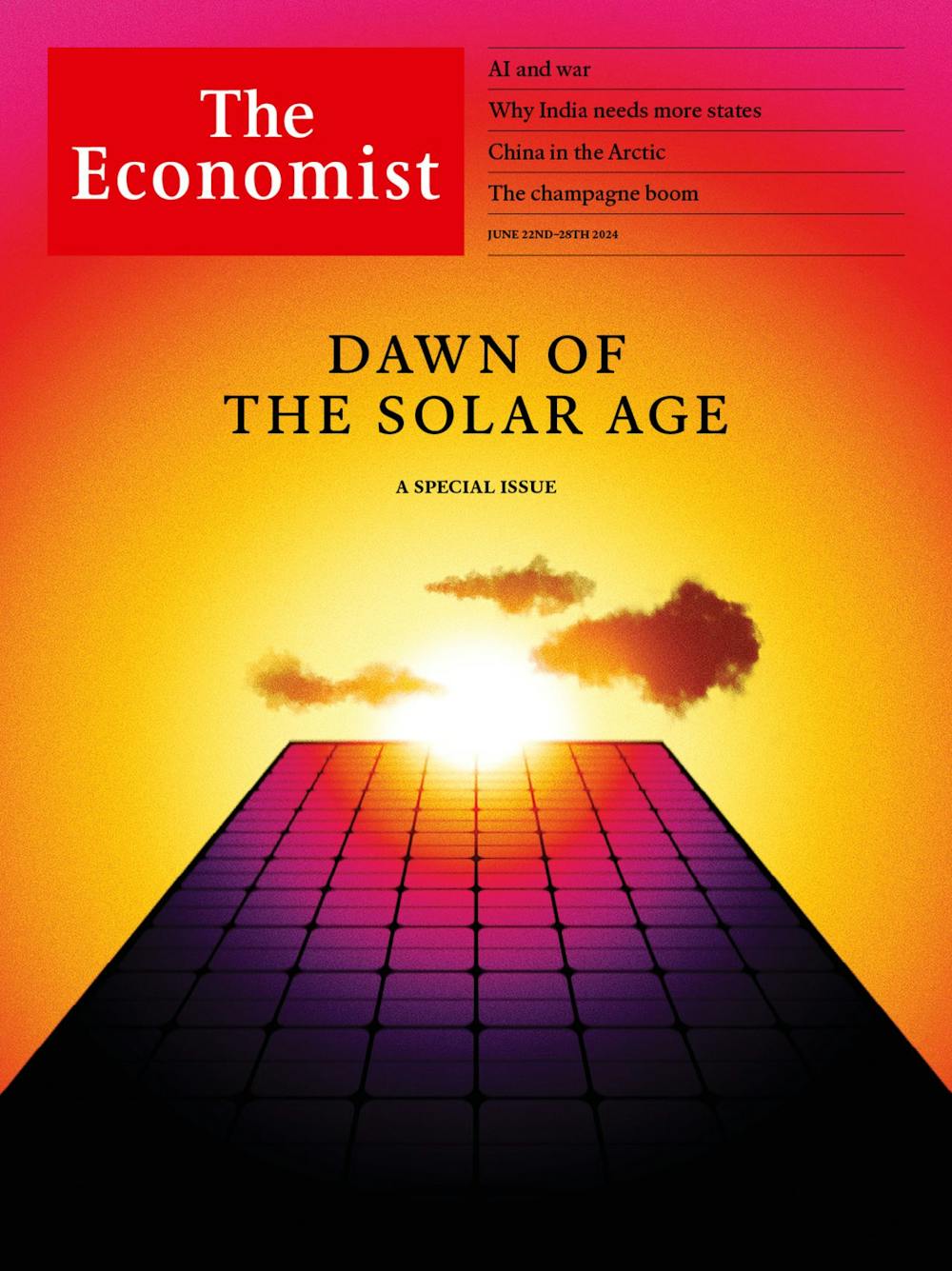
By chance, just three days after Dutton announced plans for seven nuclear reactors he said would usher in a new era of economic prosperity[3] for Australia, The Economist produced a special issue, titled Dawn of the Solar Age[4].
 Installations for 2024 are an estimate.
The Economist, IEA, Energy Institute, BloombergNEF[7]
And the cost of solar cells has been plunging in the way that costs usually do when emerging technologies become mainstream.
The Economist describes the process this way:
As the cumulative production of a manufactured good increases, costs go down. As costs go down, demand goes up. As demand goes up, production increases – and costs go down further.
Normally, this can’t continue. In earlier energy transitions – from wood to coal, coal to oil, and oil to gas – it became increasingly expensive to find fuel.
But the main ingredient in solar cells (apart from energy) is sand, for the silicon and the glass. This is not only the case in China, which makes the bulk of the world’s solar cells, but also in India, which is short of power, blessed by sun and sand, and which is manufacturing and installing solar cells at a prodigious rate[8].
Solar easy, batteries more difficult
Batteries are more difficult. They are needed to make solar useful after dark and they require so-called critical minerals[9] such as lithium, nickel and cobalt (which Australia has in abundance).
But the efficiency of batteries is soaring and the price is plummeting, meaning that on one estimate the cost of a kilowatt-hour of battery storage has fallen by 99%[10] over the past 30 years.
In the United States, plans are being drawn up to use batteries to transport solar energy as well as store it. Why build high-voltage transmission cables when you can use train carriages full of batteries[11] to move power from the remote sunny places that collect it to the cities that need it?
Solar’s step change
The International Energy Agency is suddenly optimistic. Its latest assessment released in January says last year saw a “step change[12]” in renewable power, driven by China’s adoption of solar. In 2023, China installed as much solar capacity as the entire world did in 2022.
The world is on track to install more renewable capacity over the next five years than has ever been installed over the past 100 years, something the agency says still won’t be enough to get to net-zero emissions by 2050.
That would need renewables capacity to triple over the next five years, instead of more than doubling[13].
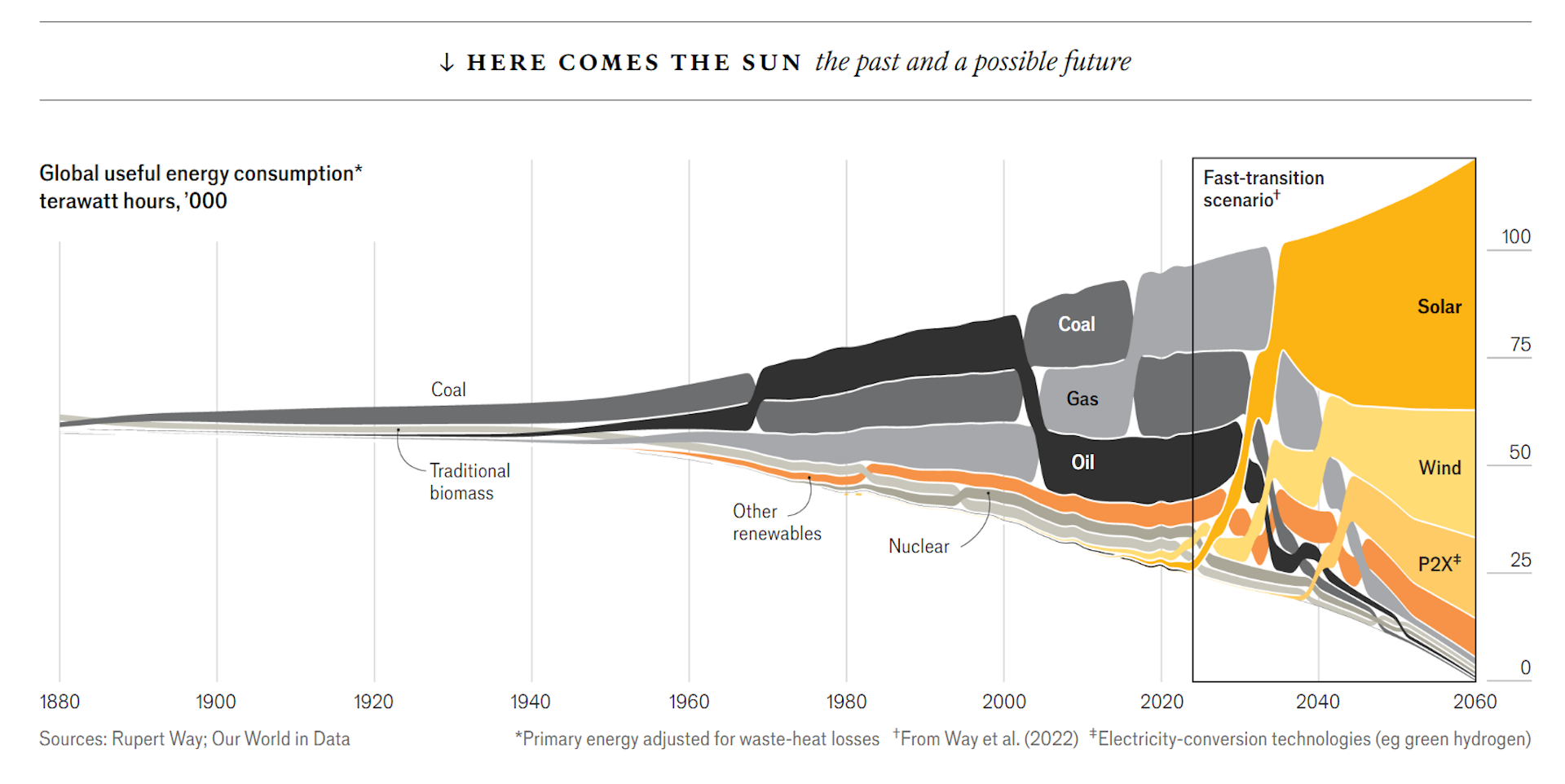
Oxford University energy specialist Rupert Way has modelled a “fast transition[14]” scenario, in which the costs of solar and other new technologies keep falling as they have been rather than as the International Energy Agency expects.
He finds that by 2060, solar will be by far the world’s biggest source of energy, exceeding wind and green hydrogen and leaving nuclear with an infinitesimally tiny role[15].
In Australia, solar is pushing down prices
Australia’s energy market operator says record generation from grid-scale renewables and rooftop solar is pushing down[16] wholesale electricity prices.
South Australia and Tasmania are the states that rely on renewables the most[17]. They are the two states with the lowest wholesale electricity prices[18] outside Victoria, whose prices are very low because of its reliance on brown coal.
It is price – rather than the environment – that most interests The Economist. It says when the price of something gets low people use much, much more of it[19].
As energy gets really copious and all but free, it will be used for things we can’t even imagine today. The Economist said to bet against that is to bet against capitalism.
References^ take Australian nuclear (www.peterdutton.com.au)^ The Economist (www.economist.com)^ new era of economic prosperity (www.peterdutton.com.au)^ Dawn of the Solar Age (www.economist.com)^ The June 22 2024 solar special issue. (www.economist.com)^ shrinking (ourworldindata.org)^ The Economist, IEA, Energy Institute, BloombergNEF (www.economist.com)^ prodigious rate (www.economist.com)^ critical minerals (www.industry.gov.au)^ 99% (www.economist.com)^ train carriages full of batteries (www.suntrain.co)^ step change (prod.iea.org)^ more than doubling (prod.iea.org)^ fast transition (www.cell.com)^ tiny role (images.theconversation.com)^ pushing down (aemo.com.au)^ rely on renewables the most (www.statista.com)^ lowest wholesale electricity prices (www.aer.gov.au)^ much, much more of it (www.sciencedirect.com)Authors: Peter Martin, Visiting Fellow, Crawford School of Public Policy, Australian National University
Installations for 2024 are an estimate.
The Economist, IEA, Energy Institute, BloombergNEF[7]
And the cost of solar cells has been plunging in the way that costs usually do when emerging technologies become mainstream.
The Economist describes the process this way:
As the cumulative production of a manufactured good increases, costs go down. As costs go down, demand goes up. As demand goes up, production increases – and costs go down further.
Normally, this can’t continue. In earlier energy transitions – from wood to coal, coal to oil, and oil to gas – it became increasingly expensive to find fuel.
But the main ingredient in solar cells (apart from energy) is sand, for the silicon and the glass. This is not only the case in China, which makes the bulk of the world’s solar cells, but also in India, which is short of power, blessed by sun and sand, and which is manufacturing and installing solar cells at a prodigious rate[8].
Solar easy, batteries more difficult
Batteries are more difficult. They are needed to make solar useful after dark and they require so-called critical minerals[9] such as lithium, nickel and cobalt (which Australia has in abundance).
But the efficiency of batteries is soaring and the price is plummeting, meaning that on one estimate the cost of a kilowatt-hour of battery storage has fallen by 99%[10] over the past 30 years.
In the United States, plans are being drawn up to use batteries to transport solar energy as well as store it. Why build high-voltage transmission cables when you can use train carriages full of batteries[11] to move power from the remote sunny places that collect it to the cities that need it?
Solar’s step change
The International Energy Agency is suddenly optimistic. Its latest assessment released in January says last year saw a “step change[12]” in renewable power, driven by China’s adoption of solar. In 2023, China installed as much solar capacity as the entire world did in 2022.
The world is on track to install more renewable capacity over the next five years than has ever been installed over the past 100 years, something the agency says still won’t be enough to get to net-zero emissions by 2050.
That would need renewables capacity to triple over the next five years, instead of more than doubling[13].
Oxford University energy specialist Rupert Way has modelled a “fast transition[14]” scenario, in which the costs of solar and other new technologies keep falling as they have been rather than as the International Energy Agency expects.
He finds that by 2060, solar will be by far the world’s biggest source of energy, exceeding wind and green hydrogen and leaving nuclear with an infinitesimally tiny role[15].
In Australia, solar is pushing down prices
Australia’s energy market operator says record generation from grid-scale renewables and rooftop solar is pushing down[16] wholesale electricity prices.
South Australia and Tasmania are the states that rely on renewables the most[17]. They are the two states with the lowest wholesale electricity prices[18] outside Victoria, whose prices are very low because of its reliance on brown coal.
It is price – rather than the environment – that most interests The Economist. It says when the price of something gets low people use much, much more of it[19].
As energy gets really copious and all but free, it will be used for things we can’t even imagine today. The Economist said to bet against that is to bet against capitalism.
References^ take Australian nuclear (www.peterdutton.com.au)^ The Economist (www.economist.com)^ new era of economic prosperity (www.peterdutton.com.au)^ Dawn of the Solar Age (www.economist.com)^ The June 22 2024 solar special issue. (www.economist.com)^ shrinking (ourworldindata.org)^ The Economist, IEA, Energy Institute, BloombergNEF (www.economist.com)^ prodigious rate (www.economist.com)^ critical minerals (www.industry.gov.au)^ 99% (www.economist.com)^ train carriages full of batteries (www.suntrain.co)^ step change (prod.iea.org)^ more than doubling (prod.iea.org)^ fast transition (www.cell.com)^ tiny role (images.theconversation.com)^ pushing down (aemo.com.au)^ rely on renewables the most (www.statista.com)^ lowest wholesale electricity prices (www.aer.gov.au)^ much, much more of it (www.sciencedirect.com)Authors: Peter Martin, Visiting Fellow, Crawford School of Public Policy, Australian National University