it's about flexibility and boundaries
- Written by: Ruchi Sinha, Senior Lecturer, Organisational Behaviour & Management, University of South Australia
It’s hard enough juggling a job with parenthood when you’ve got young kids. But what do you do when social-distancing policies mean you’ve all been sent home?
This is the reality many families now face. Schools have been shut in Britain[1], France[2], Germany[3], South Korea[4] and all but five US states[5]. In Australia, Victoria and the Australian Capital Territory are closing schools this week, with more states likely to follow.
Read more: COVID-19: what closing schools and childcare centres would mean for parents and casual staff[6]
To entertain and home school your children while working from home is going to take self-awareness, planning, communication and technology to stop the boundaries between the work and family from fraying and ripping.
Here are six strategies to survive.
1. Be flexible
Working parents often develop routines around work (8am-4pm) and family time (4pm-8pm). Even if you prefer to stick to your routine and keep work to regular work hours, you may need to re-evaluate. The new normal is likely to involve combining greater flexibility with plans and schedules for non-standard working and family time.
To plan successfully, it is critical your know your own style and work preferences. Research shows[7] some people are “integrators”, who cope well with multitasking and switching between work and personal tasks, while “segmenters” prefer to keep things separate and have strong boundaries.
Read more: Women aren't better multitaskers than men – they're just doing more work[8]
2. Make a plan
Make a daily work and childcare schedule that you, your partner and (to a large extent) your kids agree on.
It is crucial to schedule things as it gives you a realistic understanding of what is possible and what you may have to give up versus what you need to claim as essential.
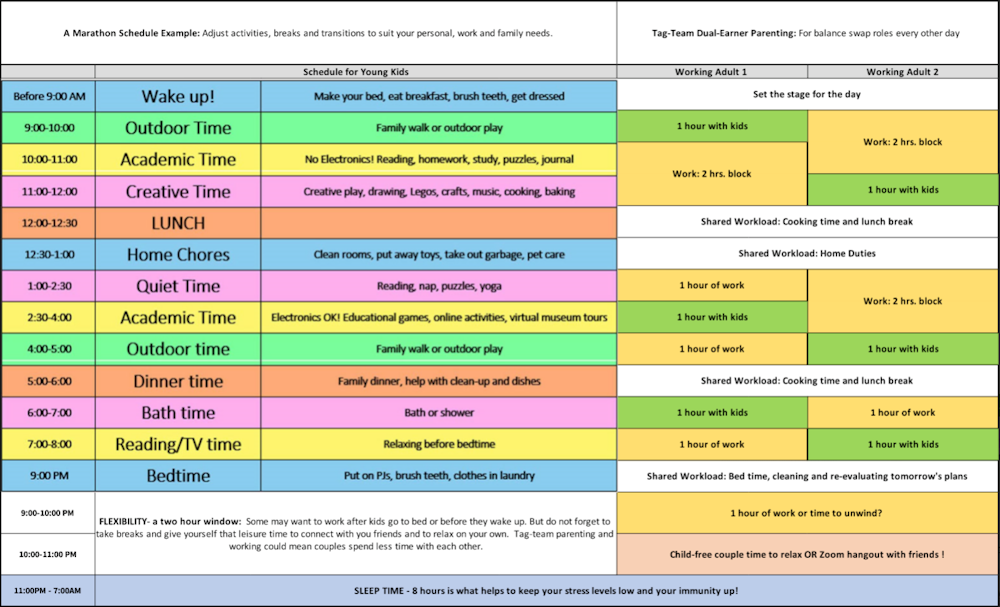
Here is my personal schedule for my partner and I working from home with our six-year-old daughter.
 Ruchi Sinha, Author provided
It’s a manic schedule and we are trying to adapt it each day to make it work. But to have it in the first place made us realise how to share home duties and educational responsibilities while carving out work and personal time.
Have a family meeting and lay down what you think is critical for the health of your family and for your productivity at work. Use that understanding to identify workload-sharing plans.
Try different scheduling for a week and meet as a family to discuss what does not work and what could work. For example, try a two-hour work block for two days and see how your partner and kids react to it. Or swap activity times or roles twice a week or every other day.
Once you have a plan, it is critical to communicate the same with colleagues in a way that ensures they are supportive and can work with your constraints and capabilities. Be genuine about your struggles and ask others at work about how they manage their schedules. They will be able to empathise and appreciate you being upfront.
Ruchi Sinha, Author provided
It’s a manic schedule and we are trying to adapt it each day to make it work. But to have it in the first place made us realise how to share home duties and educational responsibilities while carving out work and personal time.
Have a family meeting and lay down what you think is critical for the health of your family and for your productivity at work. Use that understanding to identify workload-sharing plans.
Try different scheduling for a week and meet as a family to discuss what does not work and what could work. For example, try a two-hour work block for two days and see how your partner and kids react to it. Or swap activity times or roles twice a week or every other day.
Once you have a plan, it is critical to communicate the same with colleagues in a way that ensures they are supportive and can work with your constraints and capabilities. Be genuine about your struggles and ask others at work about how they manage their schedules. They will be able to empathise and appreciate you being upfront.
 A separate work space can help you mentally separate roles and boundaries even if the kids are still close.
Shutterstock
4. Create a work space
Research shows[9] working from home is less stressful when you have a dedicated work area. This helps you mentally and physically separate roles and boundaries.
With younger kids, you may want to have a symbolic boundary, such as a bookshelf or a room divider, so you can still see and hear them.
Invest in a good noise-cancelling headset and an ergonomically designed desk and table.
Read more:
Working at home to avoid coronavirus? This tech lets you (almost) replicate the office[10]
Make small traffic-light signs to indicate to young ones when they can and cannot interrupt. Use alarms to give you 10-minute reminders before you need to change gear from work to parenting.
When you are about to transition, write a note on what you want to do when you come back. This will help reduce the spillover of those incomplete tasks into your next activity.
5. Build a community
Gather every human and virtual resource you can find to aid mental well-being and efficiency. You, your partner and your kids will need social stimulation beyond each other.
Organise virtual play dates through video chat. Reach out to the parents of your child’s classmates to help share the load. Another parent doing a video music class or a virtual art class might free up precious time for you to do something else.
Read more:
Kids at home because of coronavirus? Here are 4 ways to keep them happy (without resorting to Netflix)[11]
6. Look after yourself
Don’t forget you also need some time to unwind.
This is the time to shed guilt and be generous to yourself. Don’t beat yourself up for mistakes and missed targets. You are working in a brave new world and it will take time to adjust.
Be patient. Learn from each day by taking note of what worked and what didn’t. With time you will find a rhythm that works for you, your partner, your colleagues and the young ones at home.
A separate work space can help you mentally separate roles and boundaries even if the kids are still close.
Shutterstock
4. Create a work space
Research shows[9] working from home is less stressful when you have a dedicated work area. This helps you mentally and physically separate roles and boundaries.
With younger kids, you may want to have a symbolic boundary, such as a bookshelf or a room divider, so you can still see and hear them.
Invest in a good noise-cancelling headset and an ergonomically designed desk and table.
Read more:
Working at home to avoid coronavirus? This tech lets you (almost) replicate the office[10]
Make small traffic-light signs to indicate to young ones when they can and cannot interrupt. Use alarms to give you 10-minute reminders before you need to change gear from work to parenting.
When you are about to transition, write a note on what you want to do when you come back. This will help reduce the spillover of those incomplete tasks into your next activity.
5. Build a community
Gather every human and virtual resource you can find to aid mental well-being and efficiency. You, your partner and your kids will need social stimulation beyond each other.
Organise virtual play dates through video chat. Reach out to the parents of your child’s classmates to help share the load. Another parent doing a video music class or a virtual art class might free up precious time for you to do something else.
Read more:
Kids at home because of coronavirus? Here are 4 ways to keep them happy (without resorting to Netflix)[11]
6. Look after yourself
Don’t forget you also need some time to unwind.
This is the time to shed guilt and be generous to yourself. Don’t beat yourself up for mistakes and missed targets. You are working in a brave new world and it will take time to adjust.
Be patient. Learn from each day by taking note of what worked and what didn’t. With time you will find a rhythm that works for you, your partner, your colleagues and the young ones at home.
References
- ^ Britain (edition.cnn.com)
- ^ France (www.cnbc.com)
- ^ Germany (www.thelocal.de)
- ^ South Korea (www.nytimes.com)
- ^ all but five US states (www.nbcnews.com)
- ^ COVID-19: what closing schools and childcare centres would mean for parents and casual staff (theconversation.com)
- ^ Research shows (journals.aom.org)
- ^ Women aren't better multitaskers than men – they're just doing more work (theconversation.com)
- ^ Research shows (onlinelibrary.wiley.com)
- ^ Working at home to avoid coronavirus? This tech lets you (almost) replicate the office (theconversation.com)
- ^ Kids at home because of coronavirus? Here are 4 ways to keep them happy (without resorting to Netflix) (theconversation.com)
Authors: Ruchi Sinha, Senior Lecturer, Organisational Behaviour & Management, University of South Australia