what Virgin Australia staff can learn from ex-Ansett workers
- Written by: Helena Steel, Lecturer HRM, PhD Candidate - Job loss, career adaptability & HRM interventions, Swinburne University of Technology
As the COVID-19 economic crisis crimps travel and hurts airlines worldwide, Virgin Australia has been placed under external administrators[1]. The Queensland government has put a $200m bid on it[2] (a move derided[3] by several federal ministers) but what’s clear is this is a period of enormous uncertainty for Virgin’s 10,000-strong Australian workforce[4].
It must feel like déjà vu for former Ansett Airline employees – especially those who went on to work at Virgin Australia (some of whom may still be there now). But the experience of ex-Ansett staff may offer clues on how Virgin employees can cope.
I (Helena Steel) interviewed former Ansett Airlines employees ten years after the airline’s collapse in 2001 (shortly after the September 11 Twin Towers attacks[5]), to see what career changes they had made and what lessons they had learnt.
What I discovered was a workforce much more resilient than expected - and that was often due to the efforts of the ex-employees themselves.
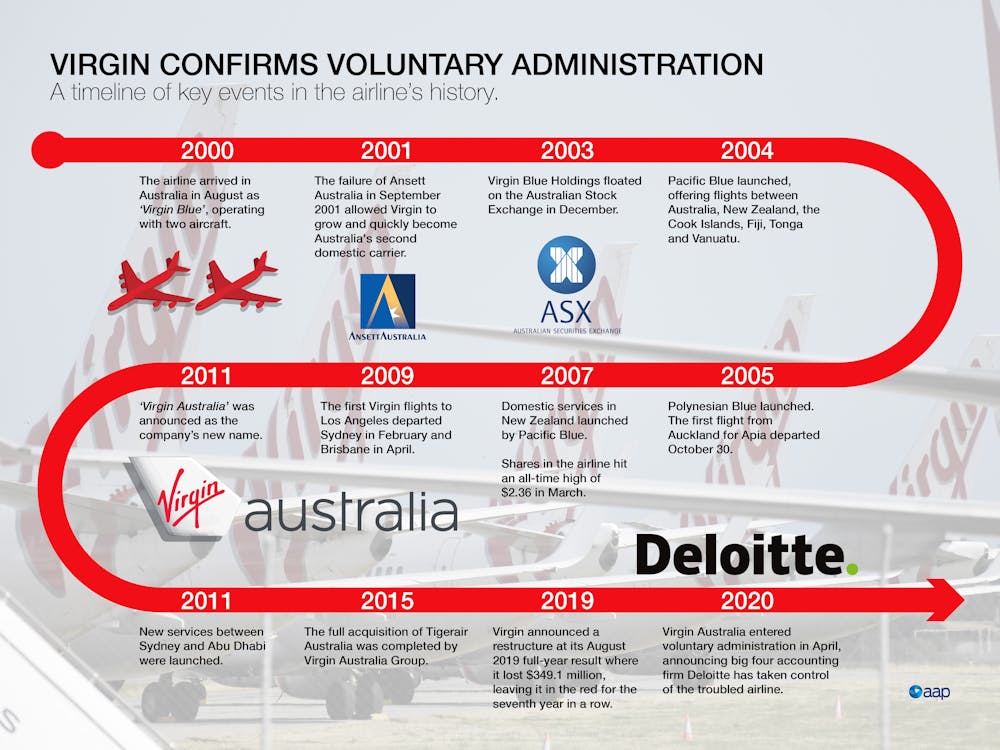 A timeline of key events in the Virgin Australia’s history.
AAP Graphics / Sean Fitzpatrick
A timeline of key events in the Virgin Australia’s history.
AAP Graphics / Sean Fitzpatrick
Read more: 'Home away from home': reflecting on past airline collapses in Australia[6]
What Ansett employees did next
After its collapse, most Ansett workers had remained in the airline industry and joined the then-growing Virgin Airlines. Fewer received jobs at Qantas, citing a lack of openings.
A small percentage joined overseas airlines or retired. A decade after the collapse, many had opted for a career change outside the airline industry.
I was employed by Ansett Australia/Air New Zealand and managed corporate HR in both New Zealand and Australia. After the collapse, I returned to Ansett Australia to assist with HR, winding up the company under administration.
It was hard to sell Ansett assets at the time – the September 11 attacks had punctured the airline industry worldwide and few were in the mood for buying planes.
In the end, Ansett was under administration for ten years, making it Australia’s longest and still the largest collapse.
Over 16,000 direct jobs were lost[7], not including the wider impact on allied jobs. It took ten years for Ansett employees to recoup their entitlements and, in the end, they received 96 cents for every dollar they were owed.
Many of these workers survived this stressful period by helping and supporting each other.
The Ansett family
There was an unwritten “hire family” policy at Ansett, with entire families on staff. Loyalty was strong; Ansett employees had on average 15 years service and many reported they loved their jobs. But entire families were left jobless when the collapse occurred.
Nevertheless, this family-oriented approach may also have helped staff survive the crisis.
Under administration, I (Helena Steel) set up an official company staff support and recruitment website but it was soon replaced by self-made employee sites offering information and advice. This shows a high level of collegiality in the workforce and how much staff wanted to help each other through the crisis.
Today, the “Ansett family” has survived, with annual and sometimes monthly get-togethers[8] organised via groups on Facebook[9] and elsewhere online.
Ex-staff have used these informal groups to keep updated on the next redundancy payments, superannuation entitlements, news from Ansett administration and importantly, job referrals and leads.
Read more: Virgin Australia was never going to last[10]
The current crisis is different - but some lessons still apply
The COVID-19 economic crisis Virgin Australia employees find themselves in today is clearly different to the Ansett collapse in many ways. For starters, the effects are economy-wide, with far greater costs to the public purse and governments don’t seem too keen to bail out Virgin. The ability for ex-staff to find jobs elsewhere in the airline industry is diminished.
That said, Virgin Australia employees can learn a few lessons from former Ansett staff about how to survive, or even thrive.
First, it really helps to know you’re not going through this on your own. The “Ansett family” made ex-staff feel less alone and less likely to blame themselves for their fate. Many said they got some comfort from sharing their redundancy journey with colleagues, and hearing how others made it through and faced challenges along the way.
Second, the “Ansett job loss family” helped remove the stigma many feel when you suddenly lose your job.
Third, being part of networks can help you find new opportunities, stay up to date on entitlements and keep abreast of industry news.
There are already many Facebook groups for Virgin cabin crew[11], union members, and people with an interest in how the Virgin Australia administration[12] is being handled. Finding an airline “family” in such places may help Virgin employees, potentially for many years.
These social support practices should be encouraged by airline leadership and HR to help foster resilience and survive a crisis.
References
- ^ external administrators (theconversation.com)
- ^ put a $200m bid on it (www.abc.net.au)
- ^ derided (www.abc.net.au)
- ^ Australian workforce (www.ibisworld.com)
- ^ September 11 Twin Towers attacks (airlinegeeks.com)
- ^ 'Home away from home': reflecting on past airline collapses in Australia (theconversation.com)
- ^ lost (pdfs.semanticscholar.org)
- ^ get-togethers (www.facebook.com)
- ^ Facebook (www.facebook.com)
- ^ Virgin Australia was never going to last (theconversation.com)
- ^ cabin crew (www.facebook.com)
- ^ administration (www.facebook.com)
Authors: Helena Steel, Lecturer HRM, PhD Candidate - Job loss, career adaptability & HRM interventions, Swinburne University of Technology