HomeBuilder might be the most-complex least-equitable construction jobs program ever devised
- Written by: Geoff Hanmer, Adjunct Professor of Architecture, University of Adelaide
HomeBuilder[1] is a good idea gone bad. It is possibly the most complex and least equitable program the government could have devised to deliver construction jobs.
It gives $25,000 to people who already own a home or already have enough money to buy one while delivering a minimal stimulus to extra construction. It isn’t a program to create jobs, it is a way of making people who are reasonably well off richer.
It does not address homelessness, precarious rental or any of the other pressing problems that are caused by our current housing mix.
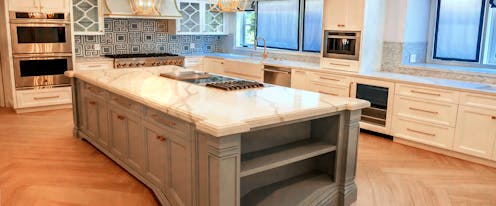
It might build more nice decks for sipping Chardonnay (most already planned), it might deliver ritzy new bathrooms with imported taps or even new kitchens with the latest European appliances, but it won’t help those suffering housing stress.
Read more: Scott Morrison’s HomeBuilder scheme is classic retail politics but lousy economics[2]
Construction is Australia’s third-biggest employer[3], after retail and health care and social assistance. It employs one in every 11 Australians, and it generates other jobs in the building supplies industry and in design and engineering.
The Master Builders Association says construction is facing a decline of 40%[4], with potentially horrendous implications for employment.
The industry has three main components:
residential – apartments and houses
commercial – including offices, airport terminals, retail, tourism, education and factories
engineering – including roads, railways and airport runways.
Engineering construction is doing reasonably well.
Across the country, governments are delivering a veritable infrastructure Utopia[5]. Continuing projects include the Tullamarine Airport Rail Link[6], the second stage of the Sydney Metro[7], the North East Link[8] motorway in Melbourne, the WestConnex[9] motorway in Sydney, the Airport Metro[10] in Perth and Cross River Rail[11] in Brisbane.
All governments have to do is keep this pipeline going, which, by and large, they are doing.
On the other hand, commercial construction will be in deep trouble by the end of the year as current projects finish without new projects to replace them.
Outlook bleak, then COVID
The outlook for residential construction is desolate, although for some people with secure jobs working from home, COVID-19 appears to have ignited a mini home renovation boom.
Prior to COVID-19, commercial construction was forecast[12] to shrink from A$48.77 billion in 2020-11 to $41.3 billion in 2023-24.
Residential construction was forecast to bottom out in 2021-22 with only 168,000 dwelling starts, down from a peak of 233,872 starts in 2016-17.
Now, both forecasts will be slashed.
The tourism sector is dead, the education sector is near death and the multi-unit residential market, already badly impacted by confidence issues around construction quality[13], is in terrible shape with many projects on hold.
Not big enough, not broad enough
The HomeBuilder scheme is not big enough or broad enough to do much to reignite residential construction. To be useful for jobs, it would need to deliver an extra 60,000 housing starts.
Given the only people who will benefit from the grant will be those some way down the track to either buying or building, it is hard to guess what the additional outcome will be, but it would be surprising if the scheme generated much additional activity.
Even if the full budget allocation of the scheme is taken up, it would fund only about 25,000 projects. Many would have gone ahead anyway.
Among the peculiarities of HomeBuilder are that it won’t work in much of Sydney where many houses are likely to be valued above the $1.5 million[14] limit and it won’t work in regional towns where the required spend will overcapitalise existing houses.
Complexities aplenty
It will encourage people to build in fridges, microwaves, coffee makers and washing machines (many of them tastefully European) to bump the contract price up above the $150,000[15] minimum.
It is a potential administrative nightmare for state governments that are already stretched administering existing emergency relief programs.
Who will establish that the value of an existing house is less than the $1.5 million upper limit? Will it be the value now in the middle of the COVID downturn or the value last year, or the value used to set local government rates?
Contracts are meant to be arms-length, but who will ensure the builder is not the cousin or the in-law of the owner, something that might be impossible to avoid in a small country town? If a garage is built on the side of a house, rather than as a separate structure, will it comply with the rules? And on and on and on.
Few extra homes
While these are legitimate questions, they ignore the big, central problem with the scheme: the opportunity to deliver a substantial program of social housing that would address real problems, including homelessness, has been missed.
And the government has done it in a way that will minimise the jobs created and maximise the wealth transfer to Australians who are relatively well off.
For a government that has mostly managed to do the right thing ever since COVID-19 hit, this has been a terrible policy clanger.
It will encourage everyone who cannot afford to buy a home, or who is homeless, to believe the government has forgotten them.
References
- ^ HomeBuilder (treasury.gov.au)
- ^ Scott Morrison’s HomeBuilder scheme is classic retail politics but lousy economics (theconversation.com)
- ^ third-biggest employer (www.abs.gov.au)
- ^ 40% (www.abc.net.au)
- ^ Utopia (iview.abc.net.au)
- ^ Tullamarine Airport Rail Link (bigbuild.vic.gov.au)
- ^ Sydney Metro (www.sydneymetro.info)
- ^ North East Link (northeastlink.vic.gov.au)
- ^ WestConnex (www.westconnex.com.au)
- ^ Airport Metro (www.metronet.wa.gov.au)
- ^ Cross River Rail (crossriverrail.qld.gov.au)
- ^ forecast (www.masterbuilders.com.au)
- ^ construction quality (theconversation.com)
- ^ $1.5 million (treasury.gov.au)
- ^ $150,000 (treasury.gov.au)
Authors: Geoff Hanmer, Adjunct Professor of Architecture, University of Adelaide